Introduce an observer into any field of forces, influences or communications and that field becomes distorted. It is common opinion that Das Kapital has played old harry with capitalism, so that Marxists can hardly recognize it when they see it, and the widespread diffusion of Freud’s ideas has wrought such havoc with clinical psychology that any intelligent patient can make a nervous wreck of his analyst. What has been the influence of contemporary architectural historians on the history of contemporary architecture?
They have created the idea of a Modem Movement-this was known even before Basil Taylor took up arms against false historicism-and beyond that they have offered a rough classification of the ‘isms’ which are the thumb-print of Modernity into two main types: One, like Cubism, is a label, a recognition tag, applied by critics and historians to a body of work which appears to have certain consistent principles running through it, whatever the relationship of the artists; the other, like Futurism, is a banner, a slogan, a policy consciously adopted by a group of artists, whatever the apparent similarity or dissimilarity of their products. And it is entirely characteristic of the New Brutalism-our first native art-movement since the New Art-History arrived here-that it should confound these categories and belong to both at once.

Is Art-History to blame for this? Not in any obvious way, but in practically every other way. One cannot begin to study the New Brutalism without realizing how deeply the New Art-History has bitten into progressive English architectural thought, into teaching methods, into the common language of communication between architects and between architectural critics. What is interesting about R. Furneaux Jordan’s Parthian footnote on the New Brutalism-‘… Lubetkin talks across time to the great masters, the Smithsons talk only to each other’-is not the fact that it is nearly true, and thus ruins his argument, but that its terms of valuation are historical. The New Brutalism has to be seen against the background of the recent history of history, and, in particular, the growing sense of the inner history of the Modern Movement itself.
The history of the phrase itself is revealing. Its form is clearly derived from THE ARCHITECTURAL REVIEW’S post-war trouvaille‘The New Empiricism,’ a term which was intended to describe visible tendencies in Scandinavian architecture to diverge from another historical concept ‘The International Style.’ This usage, like any involving the word new, opens up an historical perspective. It postulates that an old empiricism can be identified by the historian, and that the new one can be distinguished from it by methods of historical comparison, which will also distinguish it from a mere ‘Empirical Revival.’ The ability to deal with such fine shades of historical meaning is in itself a measure of our handiness with the historical method today, and the use of phrases of the form ‘The New X-ism’-where X equals any adjectival root- became commonplace in the early nineteen-fifties in fourth-year studios and other places where architecture is discussed, rather than practiced.
The passion of such discussion has been greatly enhanced by the clarity of its polarization-Communists versus the Rest-and it was somewhere in this vigorous polemic that the term The New Brutalism was first coined. It was, in the beginning, a term of Communist abuse, and it was intended to signify the normal vocabulary of Modern architecture-flat roofs, glass, exposed structure-considered as morally reprehensible deviations from ‘The New Humanism,’ a phrase which means something different in Marxist hands to the meaning which might be expected.
The New Humanism meant, in architecture at that time brickwork, segmental arches, pitched roofs, small windows (or small panes at any rate)-picturesque detailing without picturesque planning. It was, in fact, the so-called ‘William Morris Revival,’ now happily defunct, since Kruschev’s reversal of the Party’s architectural line, though this reversal has, of course, taken the guts out of subsequent polemics. But it will be observed that The New Humanism was again a quasi-historical concept, oriented, however spuriously, toward that mid-nineteenth century epoch which was Marxism’s Golden Age, when you could recognize a capitalist when you met him.
However, London architectural circles are a small field in which to conduct a polemic of any kind, and abuse must be directed at specific persons, rather than classes of persons, since there was rarely enough unanimity (except among Marxists) to allow a class to coalesce. The New Brutalists at whom Marxist spite was directed could be named and recognized and so could their friends in other arts. The term had no sooner got into public circulation than its meaning began to narrow.
Among the non-Marxist grouping there was no particular unity of programme or intention, but there was a certain community of interests, a tendency to look toward Le Corbusier, and to be aware of something called le beton brut, to know the quotation which appears at the head of this article and, in the case of the more sophisticated and aesthetically literate, to know of the Art Brut of Jean Dubuffet and his connection in Paris. Words and ideas, personalities and discontents chimed together and in a matter of weeks-long before the Third Programme and the monthlies had got hold of the phrase-it had been appropriated as their own, by their own desire and public consent, by two young architects, Alison and Peter Smithson.

The phrase had thus changed both its meaning and its usage. Adopted as something between a slogan and a brick-bat flung in the public’s face, The New Brutalism ceased to be a label descriptive of a tendency common to most modern architecture, and became instead a programme, a banner, while retaining some-rather restricted-sense as a descriptive label. It is because it is both kinds of -ism at once that The New Brutalism eludes precise description, while remaining a living force in contemporary British architecture.
As a descriptive label it has two overlapping, but not identical, senses. Non-architecturally it describes the art of Dubuffet, some aspects of Jackson Pollock and of Appel, and the burlap paintings of Alberto Burri-among foreign artists-and, say, Magda Cordell or Edouardo Paolozzi and Nigel Henderson among English artists. With these last two, the Smithsons collected and hung the I.C.A. exhibition Parallel of Life and Art, which, though it probably preceded the coining of the phrase, is nevertheless regarded as alocus classicus of the movement.
The more instructive aspects of this exhibition will be considered later: for the moment let us observe that many critics (and students at the Architectural Association) complained of the deliberate flouting of the traditional concepts of photographic beauty, of a cult of ugliness, and ‘denying the spiritual in Man.’ The tone of response to The New Brutalism existed even before hostile critics knew what to call it, and there was an awareness that the Smithsons were headed in a different direction to most other younger architects in London.
Alison Smiths on first claimed the words in public as her own in a description of a project for a small house in Soho (Architectural Design, November, 1953) designed before the phrase existed, and previously tagged ‘The warehouse aesthetic’-a very fair description of what The New Brutalism stood for in its first phase. Of this house, she wrote: ‘… had this been built, it would have been the first exponent of the New Brutalism in England, as the preamble to the specification shows: “It is our intention in this building to have the structure exposed entirely, without interior finishes wherever practicable. The contractor should aim at a high standard of basic construction, as in a small warehouse”.’
The publication of this project led to an extensive and often hilarious correspondence in various periodicals through the summer of 1954, a correspondence which wandered further and further from its original point because most writers were in fact discussing either the exhibition Parallel of Life and Art, or the (as yet) unpublished school at Hunstanton. When this was finally published (AR, September, 1954) the discussion took a sharper and less humorous tone, for here in three-dimensional and photographic reality, and in the classic Modern Movement materials of concrete, steel and glass, was the Smithsons’ only completed building. The phrase The New Brutalism was immediately applied to it, though it had been designed in the spring of 1950, long before even the house in Soho, but the Brutalists themselves have accepted this appellation, and it has become the tag for Hunstanton wherever the building has been discussed.
Hunstanton, and the house in Soho, can serve as the points of architectural reference by which The New Brutalism in architecture may be defined. What are the visible and identifiable characteristics of these two structures? Both have formal, axial plans-Hunstanton, in fact, has something like true bi-axial symmetry, and the small Gymnasium block alongside the school is a kind of exemplar in little of just how formal the complete scheme was to have been-and this formality is immediately legible from without. Both exhibit their basic structure, and both make a point of exhibiting their materials-in fact, this emphasis on basic structure is so obsessive that many superficial critics have taken this to be the whole of New Brutalist Architecture.

Admittedly, this emphasis on basic structure is important, even if it is not the whole story, and what has caused Hunstanton to lodge in the public’s gullet is the fact that it is almost unique among modern buildings in being made of what it appears to be made of. Whatever has been said about honest use of materials, most modern buildings appear to be made of whitewash or patent glazing, even when they are made of concrete or steel. Hunstanton appears to be made of glass, brick, steel and concrete, and is in fact made of glass, brick, steel and concrete. Water and electricity do not come out of unexplained holes in the wall, but are delivered to the point of use by visible pipes and manifest conduits. One can see what Hunstanton is made of, and how it works, and there is not another thing to see except the play of spaces.
This ruthless adherence to one of the basic moral imperatives of the Modern Movement-honesty in structure and material-has precipitated a situation to which only the pen of Ibsen could do justice. The mass of moderate architects, hommes moyens sensuels, have found their accepted, practices for waiving the requirements of the conscience-code suddenly called in question; they have been put rudely on the spot, and they have not liked the experience. Of course, it is not just the building itself which has precipitated this situation, it is the things the Brutalists have said and done as well, but, as with the infected Spa in An Enemy of the People, the play of personalities focuses around a physical object.
The qualities of that object may be summarized as follows: 1, Formal legibility of plan; 2, clear exhibition of structure, and 3, valuation of materials for their inherent qualities ‘as found.’ This summary can be used to answer the question: Are there other New Brutalist buildings besides Hunstanton? It is interesting to note that such a summary of qualities could be made to describe Marseilles, Promontory and Lakeshore apartments, General Motors Technical Centre, much recent Dutch work and several projects by younger English architects affiliated to ClAM.
But, with the possible exception of Marseilles, the Brutalists would probably reject most of these buildings from the canon, and so must we, for all of these structures exhibit an excess of suaviter in modo, even if there is plenty of fortiter in re about them. In the last resort what characterizes the New Brutalism in architecture as in painting is precisely its brutality, its je-m’en-foutisme, its bloody-mindedness.
Only one other building conspicuously carries these qualities in the way that Hunstanton does, and that is Louis Kahn’s Yale Art Centre. Here is a building which is uncompromisingly frank about its materials, which is inconceivable apart from its boldly exhibited structural method which-being a concrete space-frame -is as revolutionary and unconventional as the use of the Plastic Theory in stressing Hunstanton’s steel H-frames. Furthermore, the plan is very formal in the disposition of its main elements, and makes a kind of symmetry about two clearly defined axes at right angles to one another. And this is a building which some Brutalists can apparently accept as a constituent New Brutalist structure.
But, with all due diffidence, the present author submits that it still does not quite answer to the standard set by Hunstanton. For one thing, the Smithsons’ work is characterized by an abstemious under-designing of the details, and much of the impact of the building comes from the ineloquence, but absolute consistency, of such components as the stairs and handrails. By comparison, Kahn’s detailing is arty, and the stair-rail and balustrading (if that is the word for stainless netting) is jarringly out of key with the rough-shuttered concrete of the main structure. This may be ‘only a matter of detailing’ but there is another short-fall about Yale Art Centre which could not be brushed off so easily.
Every Smithson design has been, obviously or subtly, a coherent and apprehensible visual entity, but this Louis Kahn’s design narrowly fails to be. The internal spaces will be cluttered with display screens which, in the nature of his programme and his solution of it, must be susceptible of being moved, so that formal clarity is always threatened. But beyond this the relation of interior to exterior fails to validate the axes which govern the plan. Available viewpoints, the placing of the entrances, the handling of the exterior walls-all tend to lose or play down the presence of planning axes. No doubt there are excellent functional reasons for the doors being where they are, and excellent structural reasons for the walls being treated in the way they are-but if these reasons were so compelling, why bother with an axial plan anyhow?
This is a hard thing to have to say about a seriously considered building by a reputable architect of some standing, but contact with Brutalist architecture tends to drive one to hard judgements, and the one thing of which the Smithsons have never been accused is a lack of logic or consistency in thinking through a design. In fact it is the ruthless logic more than anything else which most hostile critics find distressing about Hunstanton-or perhaps it is the fact that this logic is worn on the sleeve. One of the reasons for this obtrusive logic is that it contributes to the apprehensibility and coherence of the building as a visual entity, because it contributes to the building as ‘an image.’
An Image-with the utterance of these two words we bridge the gap between the possible use of The New Brutalism as a descriptive label covering, in varying degrees of accuracy, two or more buildings, and The New Brutalism as a slogan, and we also go some way to bridge the gap between the meaning of the term as applied to architecture and its meaning as applied to painting and sculpture. The word image in this sense is one of the most intractable and the most useful terms in contemporary aesthetics, and some attempt to explain it must be made.
A great many things have been called ‘an image’- S. M. della Consolazione at Todi, a painting by Jackson Pollock, the Lever Building, the 1954 Cadillac convertible, the roofscape of the Unitéat Marseilles, any of the hundred photographs in Parallel of Life and Art. ‘Image’ seems to be a word that describes anything or nothing. Ultimately, however, it means something which is visually valuable, but not necessarily by the standards of classical aesthetics.
Where Thomas Aquinas supposed beauty to be quod visum placet(that which seen, pleases), image may be defined as quod visum perturbat-that which seen, affects the emotions, a situation which could subsume the pleasure caused by beauty, but is not normally taken to do so, for the New Brutalists’ interests in image are commonly regarded, by many of themselves as well as their critics, as being anti-art, or at any rate anti-beauty in the classical aesthetic sense of the word. But what is equally as important as the specific kind of response, is the nature of its cause. What pleased St. Thomas was an abstract quality, beauty-what moves a New Brutalist is the thing itself, in its totality, and with all its overtones of human association. These ideas of course lie close to the general body of anti-Academic aesthetics currently in circulation, though they are not to be identified exactly with Michel Tapie’s concept of un Art Autre, even though that concept covers many Continental Brutalists as well as Edouardo Paolozzi.
Nevertheless this concept of Image is common to all aspects of The New Brutalism in England, but the manner in which it works out in architectural practice has some surprising twists to it. Basically, it requires that the building should be an immediately apprehensible visual entity; and that the form grasped by the eye should be confirmed by experience of the building in use. Further, that this form should be entirely proper to the functions and materials of the building, in their entirety. Such a relationship between structure, function and form is the basic commonplace of all good building of course, the demand that this form should be apprehensible and memorable is the apical uncommonplace which makes good building into great architecture.
The fact that this form-giving obligation has been so far forgotten that a great deal of good building can be spoken of as if it were architecture, is a mark of a seriously decayed condition in English architectural standards. It has become too easy to get away with the assumption that if structure and function are served then the result must be architecture-so easy that the meaningless phrase ’ the conceptual building’ has been coined to defend the substandard architectural practices of the routine-functionalists, as if ‘conceptual buildings’ were something new, and something faintly reprehensible in modern architecture.

All great architecture has been ‘conceptual,’ has been image-making-and the idea that any great buildings, such as the Gothic Cathedrals, grew unconsciously through anonymous collaborative attention to structure and function is one of the most insidious myths with which the Modern Movement is saddled. Every great building of the Modern Movement has been a conceptual design, especially those like the Bauhaus, which go out of their way to look as if they were the products of ‘pure’ functionalism, whose aformal compositions are commonly advanced by routine-functionalists in defence of their own abdication of architectural responsibility. But a conceptual building is as likely to be aformal as it is to be formal, as a study of the Smithsons’ post-Hunstanton projects will show.
Hunstanton’s formality is unmistakably Miesian, as Philip Johnson pointed out, possibly because lIT. was one of the few recent examples of conceptual, form-giving design to which a young architect could turn at the time of its conception, and the formality of their Coventry Cathedral competition entry is equally marked, but here one can safely posit the interference of historical studies again, for, though the exact priority of date as between the Smithsons’ design and the publication of Professor Wittkower’sArchitectural Principles of the Age of Humanism is disputed (by the Smithsons) it cannot be denied that they were in touch with Wittkowerian studies at the time, and were as excited by them as anybody else.
The general impact of Professor Wittkower’s book on a whole generation of post-war architectural students is one of the phenomena of our time. Its exposition of a body of architectural theory in which function and form were significantly linked by the objective laws governing the Cosmos (as Alberti and Palladio understood them) suddenly offered a way out of the doldrum of routine-functionalist abdications, and neo-Palladianism became the order of the day.
The effect of Architectural Principles has made it by far the most important contribution-for evil as well as good-by any historian to English Architecture since Pioneers of the Modern Movement, and it precipitated a nice disputation on the proper uses of history. The question became: Humanist principles to be followed? or Humanist principles as an example of the kind of principles to look for? Many students opted for the former alternative, and Routine-Palladians soon became as thick on the ground as Routine-Functionalists. The Brutalists, observing the inherent risk of a return to pure academicism-more pronounced at Liverpool than at the AA-sheered off abruptly in the other direction and were soon involved in the organization of Parallel of Life and Art.
Introducing this exhibition to an AA student debate Peter Smithson declared: ‘We are not going to talk about proportion and symmetry’ and this was his declaration of war on the inherent academicism of the neo-Palladians, and the anti-Brutalist section of the house made it clear how justified was this suspicion of crypto-academicism by taking their stand not only on Palladio and Alberti but also on Plato and the Absolute.
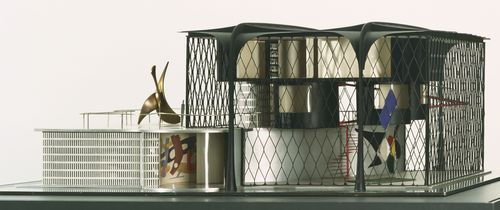
The new direction in Brutalist architectural invention showed at once in the Smithsons’ Golden Lane and Sheffield University competition entries. The former, only remembered for having put the idea of the street-deck back in circulation in England, is notable for its determination to create a coherent visual image by non-formal means, emphasizing visible circulation, identifiable units of habitation, and fully validating the presence of human beings as part of the total image-the perspectives had photographs of people posted on to the drawings, so that the human presence almost overwhelmed the architecture.
But the Sheffield design went further even than this-and aformalism becomes as positive a force in its composition as it does in a painting by Burri or Pollock. Composition might seem pretty strong language for so apparently casual a layout, but this is clearly not an ‘unconceptual’ design, and on examination it can be shown to have a composition, but based not on the elementary rule-and-compass geometry which underlies most architectural composition, so much as an intuitive sense of topology.
As a discipline of architecture topology has always been present in a subordinate and unrecognized way-qualities of penetration, circulation, inside and out, have always been important, but elementary Platonic geometry has been the master discipline. Now, in the Smithsons’ Sheffield project the roles are reversed, topology becomes the dominant and geometry becomes the subordinate discipline. The ‘connectivity’ of the circulation routes is flourished on the exterior and no attempt is made to give a geometrical form to the total scheme; large blocks of topologically similar spaces stand about the site with the same graceless memorability as martello towers or pit-head gear.
Such a dominance accorded to topology-in whose classifications a brick is the same ‘shape’ as a billiard ball (unpenetrated solid) and a teacup is the same ‘shape’ as a gramophone record (continuous surface with one hole) is clearly analogous to the displacement of Tomistic ‘beauty’ by Brutalist ‘Image,’ and Sheffield remains the most consistent and extreme point reached by any Brutalists in their search for Une Architecture Autre. It is not likely to displace Hunstanton in architectural discussions as the prime exemplar of The New Brutalism, but it is the only building-design which fully matches up to the threat and promise of Pamllel of Life and Art. ‘
And it shows that the formal axiality of Hunstanton is not integral to New Brutalist architecture. Miesian or Wittkowerian geometry was only an ad hoc device for the realization of ‘Images,’ and when Parallel of Life and Art had enabled Brutalists to define their relationship to the visual world in terms of something other than geometry, then formality was discarded. The definition of a New Brutalist building derived from Hunstanton and Yale Art Centre, above, must be modified so as to exclude formality as a basic quality if it is to cover future developments and should more properly read: 1, Memorability as an Image; 2, Clear exhibition of Structure; and 3, Valuation of Materials ‘as found.’
Remembering that an Image is what affects the emotions, that structure, in its fullest sense, is the relationship of parts, and that materials ‘as found’ are raw materials, we have worked our way back to the quotation which headed this article ‘L’ Architecture, c’est, avec des Matieres Bruts, etablir des rapports emouvants,’ but we have worked our way to this point through such an awareness of history and its uses that we see that The New Brutalism, if it is architecture in the grand sense of Le Corbusier’s definition, is also architecture of our time and not of his, nor of Lubetkin’s, nor of the times of the Masters of the past. Even if it were true that the Brutalists speak only to one another, the fact that they have stopped speaking to Mansart, to Palladio and to Alberti would make The New Brutalism, even in its more private sense, a major contribution to the architecture of today.
Text by Reyner Banham, The Architectural Review, 1955 December