After the leaves have fallen, we return
To a plain sense of things. It is as if
We had come to an end of the imagination,
Inanimate in an inert savoir.
It is difficult even to choose the adjective
For this blank cold, this sadness without cause.
The great structure has become a minor house.
No turban walks across the lessened floors.
The greenhouse never so badly needed paint.
The chimney is fifty years old and slants to one side.
A fantastic effort has failed, a repetition
In a repetitiousness of men and flies.
Yet the absence of the imagination had
Itself to be imagined. The great pond,
The plain sense of it, without reflections, leaves,
Mud, water like dirty glass, expressing silence
Of a sort, silence of a rat come out to see,
The great pond and its waste of the lilies, all this
Had to be imagined as an inevitable knowledge,
Required, as a necessity requires
Wallace Stevens
Sunday, April 29, 2012
Humanness Always Comes First

Robert Alexander (right) officiating a hot tub wedding ceremony in Venice, 1978. Photo: Lyle Mayer

Alexander's former residence at 1439 Cabrillo Avenue, Venice, California, photographed in 1996. Courtesy of Anthony Pearson.

Charles Brittin, Robert Alexander, ca. 1960. Courtesy of the Charles Brittin Archive, Getty Research Institute, Los Angeles. (2005.M.11)

Exterior of the Gas House, Venice, CA, 1962. Courtesy of the Los Angeles Public Library.

Bob Alexander, Skater of the Week. From The Ocean Front Weekly, December 27, 1978.
Humanness Always Comes First (East of Borneo): In all this, persons come first. None of the above is to be construed as a rule or regulation. Humanness always comes first!—Robert Alexander, Bulletin to Temple of Man Ministry 1 Call it a sign of the times: In July 1979, as American divorce...
Text by Kate Wolf


Saturday, April 28, 2012
Communists Adore Public Art

North Korea's Arirang "Mass Games" or the subjugation of the individual to the collective. 2008
Παρνασσός

Ο τίτλος της έκθεσης «Παρνασσός», έχει διττή σημασία, καθώς δόθηκε για να τιμήσει αφενός τον Φιλολογικό Σύλλογο, που σε τρία χρόνια γιορτάζει τα 150 χρόνια λειτουργίας του, και παράλληλα αναφέρεται έμμεσα στην μεταφορική έννοια της λέξης «βουνό», που χρησιμοποιείται για να δηλώσει τις δυσκολίες που αντιμετωπίζει, και την προσπάθεια που καταβάλλει ο δημιουργικός άνθρωπος προκειμένου να πετύχει τους στόχους του.
Στην έκθεση «Παρνασσός» συμμετέχουν κυρίως νέοι Ελληνες καλλιτέχνες με διεθνή καριέρα, αλλά και ξένοι εικαστικοί που ζουν και εργάζονται στην Αθήνα. Οπως σημειώνει ο Αυστριακός επιμελητής Stefan Bidner, που υπογράφει την επιμέλεια της έκθεσης, «...με ενδιαφέρει πολύ να γνωρίσω την αθηναϊκή εικαστική σκηνή, ειδικά τώρα με όλα αυτά που συμβαίνουν στην Ελλάδα και τα οποία έχουν παγκόσμια απήχηση. Θα ήθελα λοιπόν να παρουσιάσω ορισμένους εκπροσώπους της ελληνικής καλλιτεχνικής κοινότητας σε αυτό τον γεμάτο με ιστορία χώρο. Είναι κάτι σαν ένα εικαστικό-ιστορικό catch up το οποίο βρίσκω εξαιρετικά ενδιαφέρον».

The Shape of Things to Come,2010
111 x 23 x 22 cm
Wood, acrylic
Στην έκθεση συμμετέχουν οι: Φαίδων Αναστασιάδης, Νίκος Αρβανίτης, Νάνος Βαλαωρίτης, Γιάννης Βαρελάς, Κωστής Βελώνης, Γιώργος Γεωργακόπουλος, Αρης και Λάκης Ιωνάς/The Callas, Βάσω Γκαβαϊσέ, Διονύσης Καβαλλιεράτος, Βασίλης Καρούκ, Em Kei & Nicolaich, Πάνος Κουτρουμπούσης, Τjorg Douglas Beer, Μαργαρίτα Μποφιλίου, Ραλλού Παναγιώτου, Πάνος Παπαδόπουλος, Αλέξανδρος Τζάννης, Πέτρος Τουλούδης, Edy Ferguson.
7- 31 Μαΐου 2012
Φιλολογικός Σύλλογος Παρνασσός
Παραγωγή: DaDa Da Academy & Wiener Art Foundation
Επιμέλεια: Stefan Bidner
Συντονισμός: Πάνος Παπαδόπουλος
Friday, April 20, 2012
Ness
I went back to my hometown
and saw a girl who I’d been
told had drowned in the
ocean many years ago. Her
pleasant eyes were climates
crossed soft, and meaningless.
I told her that there were still
heights and that the carrier
wave weakens with what it
carries but she just lulled and
said every human is bound to
die but we can’t leave things
that engage our bodies.”
Katy Chrisler
Tin House volume 13, number 3, 2012
and saw a girl who I’d been
told had drowned in the
ocean many years ago. Her
pleasant eyes were climates
crossed soft, and meaningless.
I told her that there were still
heights and that the carrier
wave weakens with what it
carries but she just lulled and
said every human is bound to
die but we can’t leave things
that engage our bodies.”
Katy Chrisler
Tin House volume 13, number 3, 2012

Saturday, April 14, 2012
Incense Smoke
One stick I lit in the bronzen image.
The smoke curls upward—lazily—between his lips;
Ivory, and the frail blue of shadows.
The image is speaking—
Words of lazy dream-blue smoke
Carved like ivory:
“Do you remember?—
The priests wore dragons, great jeweled dragons on their robes.
They sang dreamily
To the god of the dim temple—
Chanting, chanting
Through the twisted smoke of incense.
But the god did not stir.
His eyes were like opals, veiled with lost mystery!”
The smoke curls upward—drowsily—
Between his lips;
Mist-gray, and the amber of shadows.
The image is speaking.
Words of dim gray-gold smoke
Graven like amber:
“Do you remember
The offering you burned alone at dawn
To one who did not answer?
Across the ashes
You saw the sea-mist rising—rising—
Like the smoke of incense,
And cried out with the pain in your heart.”
The smoke curls upward—dreamily—
Between his lips;
Ivory, and the lost blue of shadows.
Ellen Margaret Janson, 1922
The smoke curls upward—lazily—between his lips;
Ivory, and the frail blue of shadows.
The image is speaking—
Words of lazy dream-blue smoke
Carved like ivory:
“Do you remember?—
The priests wore dragons, great jeweled dragons on their robes.
They sang dreamily
To the god of the dim temple—
Chanting, chanting
Through the twisted smoke of incense.
But the god did not stir.
His eyes were like opals, veiled with lost mystery!”
The smoke curls upward—drowsily—
Between his lips;
Mist-gray, and the amber of shadows.
The image is speaking.
Words of dim gray-gold smoke
Graven like amber:
“Do you remember
The offering you burned alone at dawn
To one who did not answer?
Across the ashes
You saw the sea-mist rising—rising—
Like the smoke of incense,
And cried out with the pain in your heart.”
The smoke curls upward—dreamily—
Between his lips;
Ivory, and the lost blue of shadows.
Ellen Margaret Janson, 1922
Sunday, April 8, 2012
L’infinito
I always loved this solitary hill,
This hedge as well, which takes so large a share
Of the far-flung horizon from my view;
But seated here, in contemplation lost,
My thought discovers vaster space beyond,
Supernal silence and unfathomed peace;
Almost I am afraid; then, since I hear
The murmur of the wind among the leaves,
I match that infinite calm unto this sound
And with my mind embrace eternity,
The vivid, speaking present and dead past;
In such immensity my spirit drowns,
And sweet to me is shipwreck in this sea
Sempre caro mi fu quest'ermo colle,
E questa siepe, che da tanta parte
Dell'ultimo orizzonte il guardo esclude.
Ma sedendo e mirando, interminati
Spazi di là da quella, e sovrumani
Silenzi, e profondissima quiete
Io nel pensier mi fingo; ove per poco
Il cor non si spaura. E come il vento
Odo stormir tra queste piante, io quello
Infinito silenzio a questa voce
Vo comparando: e mi sovvien l'eterno,
E le morte stagioni, e la presente
E viva, e il suon di lei. Cosi tra questa
Immensita s'annega il pensier mio:
E il naufragar m'è dolce in questo mare.
Giacomo Leopardi , L’infinito, 1819
This hedge as well, which takes so large a share
Of the far-flung horizon from my view;
But seated here, in contemplation lost,
My thought discovers vaster space beyond,
Supernal silence and unfathomed peace;
Almost I am afraid; then, since I hear
The murmur of the wind among the leaves,
I match that infinite calm unto this sound
And with my mind embrace eternity,
The vivid, speaking present and dead past;
In such immensity my spirit drowns,
And sweet to me is shipwreck in this sea
Sempre caro mi fu quest'ermo colle,
E questa siepe, che da tanta parte
Dell'ultimo orizzonte il guardo esclude.
Ma sedendo e mirando, interminati
Spazi di là da quella, e sovrumani
Silenzi, e profondissima quiete
Io nel pensier mi fingo; ove per poco
Il cor non si spaura. E come il vento
Odo stormir tra queste piante, io quello
Infinito silenzio a questa voce
Vo comparando: e mi sovvien l'eterno,
E le morte stagioni, e la presente
E viva, e il suon di lei. Cosi tra questa
Immensita s'annega il pensier mio:
E il naufragar m'è dolce in questo mare.
Giacomo Leopardi , L’infinito, 1819
Sunday, April 1, 2012
Voyage autour du monde

George Anson ( 1697 –1762) “Illustrations de Voyage autour du monde”, Henri-Albert Gosse et Compagnie, Genève, 1750 .
Friday, March 30, 2012
A Sea of troubles

A Sea of troubles (Sail the Red Ship to the South)2012
wood, oil, acrylic
62 x 41 x 6 cm
Thursday, March 29, 2012
Arcadian Boxes

Arcadian Boxes brings together works by contemporary artists interested in the confrontation between geometrical volumes and structures on the one hand and the whimsicalness and irregularity of nature on the other. In so doing, these artists situate themselves in an age-old tradition that goes back to megalithic structures characterized by simple geometrical shapes. This fascination for the confrontation between nature and simple geometry also marks the Greek temple and the tradition of the Picturesque, which favored the disposition of neoclassical buildings in rustic gardens. In addition, the juxtaposition of nature and geometry runs like a red thread through modernity, from Goethe’s so-called Good Luck Stone or his Altar of Agathe Tyche (ca 1777) in Weimar to Le Corbusier’s building slabs in park-like environments and the construction of so-called “scenic highways.” Finally, the Earth Works by artists such as Smithson, Heizer, De Maria, and Long in the late 1960s and 1970s epitomized this age-old tradition.
Arcadian Boxes includes works by contemporary artists who share these age-old fascinations for the confrontation between geometry and nature. However, the exhibition focuses on works that also add new perspectives and new definitions of these relations. Some artists make clear that a simple juxtaposition between nature and geometry is simply impossible. Others emphasize that introducing geometry in the landscape inevitably entails its opposite, i.e. containing the landscape in a box. Still others focus on the perception of the landscape. Seeing the landscape becomes an act of measuring or demarcation and geometrical volumes are presented as viewing devices that enable us to enjoy the irregularity of nature.
Participating artists:
Dan Graham, Dirk Zoete, Elias Heuninck, Ellen Harvey, Geert Goiris, Gregor Neuerer
Curated by Steven Jacobs
Siakos Hanappe House of Art, Glyfada, Athens
5 April- 24 May 2012
www.siakos-hanappe.com
Monday, March 26, 2012
Radical Chic? Yes We Are!
Eurozine - Radical Chic? Yes We Are! - Johan Frederik Hartle


Tom Wolfe in 1966 with the Grateful Dead's Jerry Garcia and the band's manager, Rock Scully. (Wolfe is the one in the suit.)


Text by Johan Frederik Hartle, 2012-03-23
Source:/www.eurozine.com


Tom Wolfe in 1966 with the Grateful Dead's Jerry Garcia and the band's manager, Rock Scully. (Wolfe is the one in the suit.)


Text by Johan Frederik Hartle, 2012-03-23
Source:/www.eurozine.com
Monday, March 19, 2012
Παρελάσεις και διαμαρτυρία

Τα πρόσφατα γεγονότα στη Ρόδο συμπυκνώνουν με χαρακτηριστικό τρόπο το επαναλαμβανόμενο μοτίβο: ομάδες αποδοκιμάζουν παρευρισκόμενους πολιτικούς, οι αποδοκιμασίες καταλήγουν σε «επίθεση» με ρίψη αντικειμένων, οι πολιτικοί αποχωρούν. Συχνά οι διαμαρτυρίες προαναγγέλλονται μέσω διαδικτύου και στον αρχικό πυρήνα (που έχει χαρακτηριστικά συντεταγμένης ομάδας) προστίθενται κι άλλοι, καθώς η ασφυκτική συγκυρία αποτελεί τον καλύτερο τροφοδότη της λαϊκής αγανάκτησης. Έχουν πολλά ειπωθεί για τη «διαμαρτυρία των γιαουρτιών» και μάλλον δεν ωφελεί ιδιαίτερα ο «καθεστωτικός» λόγος επίπληξης προς τους διαμαρτυρόμενους. Όμως, χρήσιμες είναι ορισμένες επισημάνσεις.
Ένα σεβαστό τμήμα των «αγανακτισμένων» αναπαράγει το σύνθημα «Αλήτες – προδότες – πολιτικοί». Ελάχιστη γνώση πολιτικής Ιστορίας αρκεί για να αντιληφθούμε την προέλευση του συνθήματος. Ο χαρακτηρισμός «προδότες» αποπνέει ακροδεξιά οσμή που δεν χάνεται, ανεξαρτήτως ποια χείλη ξεστομίζουν το σύνθημα. Αυτό ακριβώς το σημείο αποτελεί μια από τις τραγωδίες της σημερινής Αριστεράς: υποκύπτοντας στην ευκολία του εθνολαϊκιστικού χουλιγκανισμού παίζει με τους όρους εκείνων που βρίσκονται στον ιδεολογικό της αντίποδα. Θεωρεί ότι βάζοντας νερό στο διεθνιστικό της κρασί θα προσελκύσει όσους δονούνται από αισθήματα εθνοφυλετισμού. Στην πραγματικότητα απλώς σύρεται προς το μέρος τους. Χαρακτηριστικό παράδειγμα ο πολιτικός αρχηγός της Αριστεράς που δηλώνει «μάλλον αυτοί που μας κυβερνούν δεν είναι και τόσο Έλληνες». Κλείνει το μάτι σε έναν κόσμο ζηλωτών, μιλάει με κώδικα Τράγκα και ανασύρει την μειωμένη εθνικοφροσύνη. Με λίγα λόγια, σπέρνει ανέμους.
Ταυτόχρονα, η παιδαγωγική της μούντζας ανάγει περίπου σε εμβληματικό τον ρόλο μαθητών που παρελαύνουν με την παλάμη ανοιχτή προς την εξέδρα των επισήμων. Είναι μέρος της ενηλικίωσης οι νέοι να «βγάζουν τη γλώσσα» στους μεγάλους και καμιά ηθικοπλαστική διάθεση δεν αρκεί για να το παραβλέψουμε. Απλώς, ο δεκαεξάχρονος που μουντζώνει την πολιτική ηγεσία είναι σύμβολο της συλλογικής μας ήττας. Όχι τόσο γιατί επιλέγει έναν ακραία ακαλαίσθητο τρόπο αποδοκιμασίας, μα κυρίως γιατί εννοεί να το κάνει εκ του ασφαλούς (με την πεποίθηση και τη διεκδίκηση της ατιμωρησίας) και αδιακρίτως. Και εάν η περσινή πρώτη μούντζα μπορεί να συμβόλιζε την εφηβική οργή, η γενίκευσή της γίνεται τελετουργική καρικατούρα, πιο μπανάλ κι από την ίδια την παρέλαση.
Πολλά από τα παραπάνω τα επισημαίνει και ο κυρίαρχος «αντιλαϊκιστικός» λόγος που καταδικάζει τις «πρακτικές των άκρων». Όμως οι φορείς του οφείλουν ταυτόχρονα να δουν κριτικά την πολιτική που τροφοδότησε το αντισυστημικό περιθώριο. Είναι η ίδια πολιτική που, στο όνομα της εθνικής σωτηρίας, άνοιξε το μεγάλο σαλόνι της κεντρικής πολιτικής σκηνής και υποδέχτηκε τους εκπροσώπους της εθνικιστικής, αντισημιτικής, ρατσιστικής Ακροδεξιάς. Κι εκείνοι άφησαν το τσεκούρι στην είσοδο και φόρεσαν το κουστούμι της συναινετικής υπευθυνότητας χωρίς ποτέ να ανακαλέσουν τις ιδεολογικές τους αναφορές. Το δικομματικό κατεστημένο βαρύνεται ιστορικά με αυτή τη νομιμοποίηση του μεταδικτατορικού χουντισμού. Παράλληλα, η ακροδεξιά ρητορική τείνει να ηγεμονεύσει στο δρόμο. Και έχει ευθύνες γι’ αυτό και η Αριστερά, γιατί θα έπρεπε να τραβάει ευδιάκριτες διαχωριστικές γραμμές και να αποστασιοποιείται από πρακτικές που τροφοδοτούν τον τυφλό εθνολαϊκισμό. Αντ’ αυτού, απλόχερα προσφέρει το άλλοθι της λαϊκής διαμαρτυρίας στη διάχυση της χουλιγκανικής βίας. Έτσι όμως σπρώχνει κόσμο στον τυφλό αντισυστημισμό και τον αντικοινοβουλευτισμό από τον οποίο έχει να χάσει κι η ίδια. Χρειάζεται απόδειξη; Στη Ρόδο, αφού οι εκπρόσωποι της πολιτικής ηγεσίας απομακρύνθηκαν κακήν κακώς, η παρέλαση συνεχίστηκε με την παρουσία εκπροσώπων του στρατού και της εκκλησίας! Κάτι τέτοιο, αν δεν απατά η μνήμη, έχει να συμβεί από την εποχή της δικτατορίας, όταν στρατός και εκκλησία ήταν οι μόνοι «ταγοί του έθνους».
Οι επικείμενες παρελάσεις ευλόγως απασχόλησαν τους αρμόδιους. Επέλεξαν τελικά να τις διοργανώσουν, με αυξημένη παρουσία κυβερνητικών στελεχών και αυστηρή περιφρούρηση. Σεβαστή η απόφαση αλλά σε καμιά περίπτωση δε φανερώνει θάρρος, όπως επιχειρείται να προβληθεί. Το αντίθετο θα έδειχνε τόλμη. Η κυβέρνηση, χωρίς να φοβηθεί τις ιερές κραυγές των εθναμυντόρων, έπρεπε να ανακοινώσει ότι αναστέλλονται οι παρελάσεις, στρατιωτικές και μαθητικές. Θα ρωτήσουν πολλοί: έπρεπε η συντεταγμένη πολιτεία να υποχωρήσει υπό το κράτος του φόβου; Όχι. Έπρεπε με θάρρος να επικαλεστεί τρία επιχειρήματα. Πρώτον, η δημοσιονομική συγκυρία δεν δικαιολογεί τη σπατάλη των παρελάσεων. Δεύτερον, το προαναγγελθέν πανελλαδικό φεστιβάλ αποδοκιμασίας καμιά σχέση δεν έχει με την επέτειο της 25ης Μαρτίου. Τρίτον, οι παρελάσεις αποτελούν κατάλοιπο άλλων εποχών στο οποίο επιδίδονται κυρίως στρατοκρατικά καθεστώτα και «λαϊκές δημοκρατίες». Τι άλλο χρειαζόταν η κυβέρνηση για να επιλέξει μια σεμνή εκδήλωση πραγματικής τιμής και μνήμης, αντίστοιχη με τα δεδομένα και τις ανάγκες των ημερών;
Κωστής Παπαϊωάννου, 19 Φεβ.2012
Source: http://antiphono.wordpress.com
Wednesday, March 14, 2012
Paramath
My dear, what you teach me is:
some premise exists for luck—
a sly elasticity hid
in the apparently sheer
mathematics of Stasis
against Motion—a tuck,
you could say, in the fabric, in-
appreciable as object and ir-
relevant therefor to our cosmic
equations—or (face it) in-
equations (considering this
dire edge What’s-to-Come has,
always, over What-Is)....Oh yes,
I’m a philosopher too,
and wish I could make clear
to colleagues this curve of you
occurring just when it did.
But they are too distant; won’t
come close enough, I fear,
to cry What’s this! What’s this!
and be told Don’t worry. Don’t
erase anything. It’s just bliss.
Peter Kane Dufault
Wednesday, March 7, 2012
Please don't kick me over

Adam Gillam
please don't kick me over", 2012
120 x 70 x 2cms
Conti board, string and marker pen
Source: www.adamgillam.com
Living Revolution : How Swedes and Norwegians Broke the Power of the '1 Percent'
While many of us are working to ensure that the Occupy movement will have a lasting impact, it’s worthwhile to consider other countries where masses of people succeeded in nonviolently bringing about a high degree of democracy and economic justice. Sweden and Norway, for example, both experienced a major power shift in the 1930s after prolonged nonviolent struggle. They “fired” the top 1 percent of people who set the direction for society and created the basis for something different.
Both countries had a history of horrendous poverty. When the 1 percent was in charge, hundreds of thousands of people emigrated to avoid starvation. Under the leadership of the working class, however, both countries built robust and successful economies that nearly eliminated poverty, expanded free university education, abolished slums, provided excellent health care available to all as a matter of right and created a system of full employment. Unlike the Norwegians, the Swedes didn’t find oil, but that didn’t stop them from building what the latest CIA World Factbook calls “an enviable standard of living.”

A march in Ådalen, Sweden, in 1931.
Neither country is a utopia, as readers of the crime novels by Stieg Larsson, Kurt Wallender and Jo Nesbo will know. Critical left-wing authors such as these try to push Sweden and Norway to continue on the path toward more fully just societies. However, as an American activist who first encountered Norway as a student in 1959 and learned some of its language and culture, the achievements I found amazed me. I remember, for example, bicycling for hours through a small industrial city, looking in vain for substandard housing. Sometimes resisting the evidence of my eyes, I made up stories that “accounted for” the differences I saw: “small country,” “homogeneous,” “a value consensus.” I finally gave up imposing my frameworks on these countries and learned the real reason: their own histories.
Then I began to learn that the Swedes and Norwegians paid a price for their standards of living through nonviolent struggle. There was a time when Scandinavian workers didn’t expect that the electoral arena could deliver the change they believed in. They realized that, with the 1 percent in charge, electoral “democracy” was stacked against them, so nonviolent direct action was needed to exert the power for change.
In both countries, the troops were called out to defend the 1 percent; people died. Award-winning Swedish filmmaker Bo Widerberg told the Swedish story vividly in Ådalen 31, which depicts the strikers killed in 1931 and the sparking of a nationwide general strike. (You can read more about this case in an entry by Max Rennebohm in the Global Nonviolent Action Database.)
The Norwegians had a harder time organizing a cohesive people’s movement because Norway’s small population—about three million—was spread out over a territory the size of Britain. People were divided by mountains and fjords, and they spoke regional dialects in isolated valleys. In the nineteenth century, Norway was ruled by Denmark and then by Sweden; in the context of Europe Norwegians were the “country rubes,” of little consequence. Not until 1905 did Norway finally become independent.
When workers formed unions in the early 1900s, they generally turned to Marxism, organizing for revolution as well as immediate gains. They were overjoyed by the overthrow of the czar in Russia, and the Norwegian Labor Party joined the Communist International organized by Lenin. Labor didn’t stay long, however. One way in which most Norwegians parted ways with Leninist strategy was on the role of violence: Norwegians wanted to win their revolution through collective nonviolent struggle, along with establishing co-ops and using the electoral arena.
In the 1920s strikes increased in intensity. The town of Hammerfest formed a commune in 1921, led by workers councils; the army intervened to crush it. The workers’ response verged toward a national general strike. The employers, backed by the state, beat back that strike, but workers erupted again in the ironworkers’ strike of 1923–24.
The Norwegian 1 percent decided not to rely simply on the army; in 1926 they formed a social movement called the Patriotic League, recruiting mainly from the middle class. By the 1930s, the League included as many as 100,000 people for armed protection of strike breakers—this in a country of only 3 million!
The Labor Party, in the meantime, opened its membership to anyone, whether or not in a unionized workplace. Middle-class Marxists and some reformers joined the party. Many rural farm workers joined the Labor Party, as well as some small landholders. Labor leadership understood that in a protracted struggle, constant outreach and organizing was needed to a nonviolent campaign. In the midst of the growing polarization, Norway’s workers launched another wave of strikes and boycotts in 1928.
The Depression hit bottom in 1931. More people were jobless there than in any other Nordic country. Unlike in the U.S., the Norwegian union movement kept the people thrown out of work as members, even though they couldn’t pay dues. This decision paid off in mass mobilizations. When the employers’ federation locked employees out of the factories to try to force a reduction of wages, the workers fought back with massive demonstrations.
Many people then found that their mortgages were in jeopardy. (Sound familiar?) The Depression continued, and farmers were unable to keep up payment on their debts. As turbulence hit the rural sector, crowds gathered nonviolently to prevent the eviction of families from their farms. The Agrarian Party, which included larger farmers and had previously been allied with the Conservative Party, began to distance itself from the 1 percent; some could see that the ability of the few to rule the many was in doubt.
By 1935, Norway was on the brink. The Conservative-led government was losing legitimacy daily; the 1 percent became increasingly desperate as militancy grew among workers and farmers. A complete overthrow might be just a couple years away, radical workers thought. However, the misery of the poor became more urgent daily, and the Labor Party felt increasing pressure from its members to alleviate their suffering, which it could do only if it took charge of the government in a compromise agreement with the other side.
This it did. In a compromise that allowed owners to retain the right to own and manage their firms, Labor in 1935 took the reins of government in coalition with the Agrarian Party. They expanded the economy and started public works projects to head toward a policy of full employment that became the keystone of Norwegian economic policy. Labor’s success and the continued militancy of workers enabled steady inroads against the privileges of the 1 percent, to the point that majority ownership of all large firms was taken by the public interest. (There is an entry on this case as well at the Global Nonviolent Action Database.)
The 1 percent thereby lost its historic power to dominate the economy and society. Not until three decades later could the Conservatives return to a governing coalition, having by then accepted the new rules of the game, including a high degree of public ownership of the means of production, extremely progressive taxation, strong business regulation for the public good and the virtual abolition of poverty. When Conservatives eventually tried a fling with neoliberal policies, the economy generated a bubble and headed for disaster. (Sound familiar?)
Labor stepped in, seized the three largest banks, fired the top management, left the stockholders without a dime and refused to bail out any of the smaller banks. The well-purged Norwegian financial sector was not one of those countries that lurched into crisis in 2008; carefully regulated and much of it publicly owned, the sector was solid.
Although Norwegians may not tell you about this the first time you meet them, the fact remains that their society’s high level of freedom and broadly-shared prosperity began when workers and farmers, along with middle class allies, waged a nonviolent struggle that empowered the people to govern for the common good.
Text By George Lakey, January 25, 2012
Source : http://wagingnonviolence.org.
Both countries had a history of horrendous poverty. When the 1 percent was in charge, hundreds of thousands of people emigrated to avoid starvation. Under the leadership of the working class, however, both countries built robust and successful economies that nearly eliminated poverty, expanded free university education, abolished slums, provided excellent health care available to all as a matter of right and created a system of full employment. Unlike the Norwegians, the Swedes didn’t find oil, but that didn’t stop them from building what the latest CIA World Factbook calls “an enviable standard of living.”

A march in Ådalen, Sweden, in 1931.
Neither country is a utopia, as readers of the crime novels by Stieg Larsson, Kurt Wallender and Jo Nesbo will know. Critical left-wing authors such as these try to push Sweden and Norway to continue on the path toward more fully just societies. However, as an American activist who first encountered Norway as a student in 1959 and learned some of its language and culture, the achievements I found amazed me. I remember, for example, bicycling for hours through a small industrial city, looking in vain for substandard housing. Sometimes resisting the evidence of my eyes, I made up stories that “accounted for” the differences I saw: “small country,” “homogeneous,” “a value consensus.” I finally gave up imposing my frameworks on these countries and learned the real reason: their own histories.
Then I began to learn that the Swedes and Norwegians paid a price for their standards of living through nonviolent struggle. There was a time when Scandinavian workers didn’t expect that the electoral arena could deliver the change they believed in. They realized that, with the 1 percent in charge, electoral “democracy” was stacked against them, so nonviolent direct action was needed to exert the power for change.
In both countries, the troops were called out to defend the 1 percent; people died. Award-winning Swedish filmmaker Bo Widerberg told the Swedish story vividly in Ådalen 31, which depicts the strikers killed in 1931 and the sparking of a nationwide general strike. (You can read more about this case in an entry by Max Rennebohm in the Global Nonviolent Action Database.)
The Norwegians had a harder time organizing a cohesive people’s movement because Norway’s small population—about three million—was spread out over a territory the size of Britain. People were divided by mountains and fjords, and they spoke regional dialects in isolated valleys. In the nineteenth century, Norway was ruled by Denmark and then by Sweden; in the context of Europe Norwegians were the “country rubes,” of little consequence. Not until 1905 did Norway finally become independent.
When workers formed unions in the early 1900s, they generally turned to Marxism, organizing for revolution as well as immediate gains. They were overjoyed by the overthrow of the czar in Russia, and the Norwegian Labor Party joined the Communist International organized by Lenin. Labor didn’t stay long, however. One way in which most Norwegians parted ways with Leninist strategy was on the role of violence: Norwegians wanted to win their revolution through collective nonviolent struggle, along with establishing co-ops and using the electoral arena.
In the 1920s strikes increased in intensity. The town of Hammerfest formed a commune in 1921, led by workers councils; the army intervened to crush it. The workers’ response verged toward a national general strike. The employers, backed by the state, beat back that strike, but workers erupted again in the ironworkers’ strike of 1923–24.
The Norwegian 1 percent decided not to rely simply on the army; in 1926 they formed a social movement called the Patriotic League, recruiting mainly from the middle class. By the 1930s, the League included as many as 100,000 people for armed protection of strike breakers—this in a country of only 3 million!
The Labor Party, in the meantime, opened its membership to anyone, whether or not in a unionized workplace. Middle-class Marxists and some reformers joined the party. Many rural farm workers joined the Labor Party, as well as some small landholders. Labor leadership understood that in a protracted struggle, constant outreach and organizing was needed to a nonviolent campaign. In the midst of the growing polarization, Norway’s workers launched another wave of strikes and boycotts in 1928.
The Depression hit bottom in 1931. More people were jobless there than in any other Nordic country. Unlike in the U.S., the Norwegian union movement kept the people thrown out of work as members, even though they couldn’t pay dues. This decision paid off in mass mobilizations. When the employers’ federation locked employees out of the factories to try to force a reduction of wages, the workers fought back with massive demonstrations.
Many people then found that their mortgages were in jeopardy. (Sound familiar?) The Depression continued, and farmers were unable to keep up payment on their debts. As turbulence hit the rural sector, crowds gathered nonviolently to prevent the eviction of families from their farms. The Agrarian Party, which included larger farmers and had previously been allied with the Conservative Party, began to distance itself from the 1 percent; some could see that the ability of the few to rule the many was in doubt.
By 1935, Norway was on the brink. The Conservative-led government was losing legitimacy daily; the 1 percent became increasingly desperate as militancy grew among workers and farmers. A complete overthrow might be just a couple years away, radical workers thought. However, the misery of the poor became more urgent daily, and the Labor Party felt increasing pressure from its members to alleviate their suffering, which it could do only if it took charge of the government in a compromise agreement with the other side.
This it did. In a compromise that allowed owners to retain the right to own and manage their firms, Labor in 1935 took the reins of government in coalition with the Agrarian Party. They expanded the economy and started public works projects to head toward a policy of full employment that became the keystone of Norwegian economic policy. Labor’s success and the continued militancy of workers enabled steady inroads against the privileges of the 1 percent, to the point that majority ownership of all large firms was taken by the public interest. (There is an entry on this case as well at the Global Nonviolent Action Database.)
The 1 percent thereby lost its historic power to dominate the economy and society. Not until three decades later could the Conservatives return to a governing coalition, having by then accepted the new rules of the game, including a high degree of public ownership of the means of production, extremely progressive taxation, strong business regulation for the public good and the virtual abolition of poverty. When Conservatives eventually tried a fling with neoliberal policies, the economy generated a bubble and headed for disaster. (Sound familiar?)
Labor stepped in, seized the three largest banks, fired the top management, left the stockholders without a dime and refused to bail out any of the smaller banks. The well-purged Norwegian financial sector was not one of those countries that lurched into crisis in 2008; carefully regulated and much of it publicly owned, the sector was solid.
Although Norwegians may not tell you about this the first time you meet them, the fact remains that their society’s high level of freedom and broadly-shared prosperity began when workers and farmers, along with middle class allies, waged a nonviolent struggle that empowered the people to govern for the common good.
Text By George Lakey, January 25, 2012
Source : http://wagingnonviolence.org.
Ουτοπια
Τα νέα αποκτήµατα της συλλογής του Νίκου Χρ. Παττίχη και της εφηµερίδας «Ο Φιλελεύθερος», της οποίας είναι εκδότης, µια από τις πιο σηµαντικές συλλογές σύγχρονης τέχνης στην Κύπρο, παρουσιάζονται στο Ίδρυµα Ευαγόρα και Καθλήν Λανίτη στη Λεµεσό από τις 22 Μαρτίου µέχρι τις 17 Μαΐου. Όπως υποδηλώνει και ο τίτλος της έκθεσης «Utopia», ενώ στην προηγούµενη έκθεση της συλλογής πριν µερικά χρόνια τα έργα αντικατόπτριζαν την ενασχόληση των καλλιτεχνών και το ενδιαφέρον του συλλέκτη για τη φιγούρα και την παραστατικότητα, σε αυτή τη νέα παρουσίαση της συλλογής, η οποία εµπλουτίστηκε στο µεταξύ µε περισσότερο από τριάντα έργα, καταγράφεται η πρόθεση των καλλιτεχνών να διαπραγµατευτούν στη δουλειά τους καίρια ζητήµατα της κοινωνικοπολιτικής πραγµατικότητας του τόπου και όχι µόνον.

Η μελαγχολία της αριστεράς, 2009
Ξύλο, ακρυλικό
5.25 μέτρα ύψος
Στην έκθεση Utopia συµµετέχουν: Αντωνίου Κλίτσα, Βελώνης Κωστής, Βενέτης Χρήστος, Γιωρκάτζης Αλέξανδρος, Eramian Peter, Ιωάννου Ελίνα, Καλλής Σωτήρης, Κυριάκου Φάνος, Κώστα Κυριακή, Λάπας Γιώργος, Λοϊζίδου Μαρία, Μιχαήλ Παναγιώτης, Νεοκλέους Δηµήτρης, Οικονόµου Ελένη, Παναγιώτου Χριστόδουλος, Περικλέους Βίκυ, Πεσλίκας Πόλυς, Σωκράτους Σωκράτης, Ταλιώτης Κωνσταντίνος, Τάπας Λευτέρης, Τουµάζου Μαρία, Τεµπριώτης Πανίκος, Χαραλαµπίδης Νίκος, Χριστοδουλίδης Σάββας.
Επιμελεια Εκθεσης : Έλενα Πάρπα, Μαρία Στάθη.
Ίδρυµα Ευαγόρα και Καθλήν Λανίτη, Λεµεσός, Κυπρος.

Η μελαγχολία της αριστεράς, 2009
Ξύλο, ακρυλικό
5.25 μέτρα ύψος
Στην έκθεση Utopia συµµετέχουν: Αντωνίου Κλίτσα, Βελώνης Κωστής, Βενέτης Χρήστος, Γιωρκάτζης Αλέξανδρος, Eramian Peter, Ιωάννου Ελίνα, Καλλής Σωτήρης, Κυριάκου Φάνος, Κώστα Κυριακή, Λάπας Γιώργος, Λοϊζίδου Μαρία, Μιχαήλ Παναγιώτης, Νεοκλέους Δηµήτρης, Οικονόµου Ελένη, Παναγιώτου Χριστόδουλος, Περικλέους Βίκυ, Πεσλίκας Πόλυς, Σωκράτους Σωκράτης, Ταλιώτης Κωνσταντίνος, Τάπας Λευτέρης, Τουµάζου Μαρία, Τεµπριώτης Πανίκος, Χαραλαµπίδης Νίκος, Χριστοδουλίδης Σάββας.
Επιμελεια Εκθεσης : Έλενα Πάρπα, Μαρία Στάθη.
Ίδρυµα Ευαγόρα και Καθλήν Λανίτη, Λεµεσός, Κυπρος.
Friday, March 2, 2012
Bosco di quercie nel giardino del Quirinale

Bosco di quercie nel giardino del Quirinale, 2011
Source : paesaggioitaliano.blogspot.com
Σκιάς όναρ άνθρωπος
Λίγο μεγαλώνει των ανθρώπων η χαρά
Ξάφνου μια γνώμη αντίδικη τη συνταράζει
και τη σωριάζει καταγής
Είμαστε τα όντα μιας ημέρας
Υπάρχεις ; Δεν υπάρχεις ;
O άνθρωπος; - το όνειρο του ίσκιου.
Πινδαρος
Giardino del Quirinale già di Carlo Alberto


Municipio I, Rione II - Trevi, Roma, 2012
Epoca: XIX - XX secolo
Saturday, February 18, 2012

Lettre à Aube
Chère Écusette de Noireuil,
Au beau printemps de 1952 vous viendrez d'avoir seize ans et peut-être serez-vous tentée d'entrouvrir ce livre dont j'aime à penser qu'euphoniquement le titre vous sera porté par le vent qui courbe les aubépines... Tous les rêves, tous les espoirs, toutes les illusions danseront, j'espère, nuit et jour à la lueur de vos boucles et je ne serai sans doute plus là, moi qui ne désirerais y être que pour vous voir. Les cavaliers mystérieux et splendides passeront à toutes brides, au crépuscule, le long des ruisseaux changeants. Sous de légers voiles vert d'eau, d'un pas de somnambule une jeune fille glissera sous de hautes voûtes, où clignera seule une lampe votive. Mais les esprits des joncs, mais les chats minuscules qui font semblant de dormir dans les bagues, mais l'élégant revolver-joujou perforé du mot « Bal » vous garderont de prendre ces scènes au tragique. Quelle que soit la part jamais assez belle, ou tout autre, qui vous soit faite, je ne puis savoir.

Portrait d'Andre Breton avec sa fille Aube, 1940
Vous vous plairez à vivre, à tout attendre de l'amour. Quoi qu'il advienne d'ici que vous preniez connaissance de cette lettre - il semble que c'est l'insupposable qui doit advenir - laissez-moi penser que vous serez prête alors à incarner cette puissance éternelle de la femme, la seule devant laquelle je me sois jamais incliné. Que vous veniez de fermer un pupitre sur un monde bleu corbeau de toute fantaisie ou de vous profiler, à l'exception d'un bouquet à votre corsage, en silhouette solaire sur le mur d'une fabrique - je suis loin d'être fixé sur votre avenir laissez-moi croire que ces mots : « L'amour fou » seront un jour seuls en rapport avec votre vertige.

Julien Levy(photographer), De Deigo, David Hare, Jacqueline and Aube Breton, c. 1945
Ils ne tiendront pas leur promesse puisqu'ils ne feront que vous éclairer le mystère de votre naissance. Bien longtemps j'avais pensé que la pire folie était de donner la vie. En tout cas j'en avais voulu à ceux qui me l'avaient donnée. Il se peut que vous m'en vouliez certains jours. C'est même pourquoi j'ai choisi de vous regarder à seize ans, alors que vous ne pouvez m'en vouloir. Que dis-je, de vous regarder, mais non, d'essayer de voir par vos yeux, de me regarder par vos yeux.
Ma toute petite enfant qui n'avez que huit mois, qui souriez toujours, qui êtes faite à la fois comme le corail et la perle, vous saurez alors que tout hasard a été rigoureusement exclu de votre venue, que celle-ci s'est produite à l'heure même où elle devait se produire, ni plus tôt ni plus tard et qu'aucune ombre ne vous attendait au-dessus de votre berceau d'osier. Même l'assez grande misère qui avait été et reste la mienne, pour quelques jours faisait trêve. Cette misère, je n'étais d'ailleurs pas braqué contre elle : j'acceptais d'avoir à payer la rançon de mon non-esclavage à vie, d'acquitter le droit que je m'étais donné une fois pour toutes de n'exprimer d'autres idées que les miennes. Nous n'étions pas tant... Elle passait au loin, très embellie, presque justifiée, un peu comme dans ce qu'on a appelé, pour un peintre qui fut de vos tout premiers amis, l'époque bleue. Elle apparaissait comme la conséquence à peu près inévitable de mon refus d'en passer par ou presque tous les autres en passaient, qu'ils fussent dans un camp ou dans un autre. Cette misère, que vous ayez eu ou non le temps de la prendre en horreur, songez qu'elle n'était que le revers de la miraculeuse médaille de votre existence : moins étincelante sans elle eût été la Nuit du Tournesol.

Sylvain Itkine, Jacques Herold, Aube et Andre Breton, Villa Air Bel, hiver 1941, la corvee de bois (archives Aube Breton).
Moins étincelante puisque alors l'amour n'eût pas eu à braver tout ce qu'il bravait, puisqu'il n'eût pas eu, pour triompher, à compter en tout et pour tout sur lui-même. Peut-être était-ce d'une terrible imprudence mais c'était justement cette imprudence le plus beau joyau du coffret. Au-delà de cette imprudence ne restait qu'à en commettre une plus grande : celle de vous faire naître, celle dont vous êtes le souffle parfumé. Il fallait qu'au moins de l'une à l'autre une corde magique fût tendue, tendue à se rompre au-dessus du précipice pour que la beauté allât vous cueillir comme une impossible fleur aérienne, en s'aidant de son seul balancier.

Cette fleur, qu'un jour du moins il vous plaise de penser que vous l'êtes, que vous êtes née sans aucun contact avec le sol malheureusement non stérile de ce qu'on est convenu d'appeler « les intérêts humains ». Vous êtes issue du seul miroitement de ce qui fut assez tard pour moi l'aboutissement de la poésie à laquelle je m'étais voué dans ma jeunesse, de la poesie que j’ai continué à servir, au mépris de tout ce qui n'est pas elle. Vous vous êtes trouvée là comme par enchantement, et si jamais vous démêlez trace de tristesse dans ces paroles que pour la première fois j'adresse à vous seule, dites-vous que cet enchantement continue et continuera à ne faire qu'un avec vous, qu'il est de force à surmonter en moi tous les déchirements du coeur. Toujours et longtemps, les deux grands mots ennemis qui s'affrontent dès qu'il est question de l'amour, n'ont jamais échangé de plus aveuglants coups d'épée qu'aujourd'hui au-dessus de moi, dans un ciel tout entier comme vos yeux dont le blanc est encore si bleu. De ces mots, celui qui porte mes couleurs, même si son étoile faiblit à cette heure, même s'il doit perdre, c'est toujours. Toujours, comme dans les serments qu'exigent les jeunes filles. Toujours, comme sur le sable blanc du temps et par la grâce de cet instrument qui sert à le compter mais seulement jusqu'ici vous fascine et vous affame, réduit à un filet de lait sans fin fusant d'un sein de verre. Envers et contre tout j’aurai maintenu que ce toujours est la grande clé. Ce que j'ai aimé, que je l'aie gardé ou non, je l'aimerai toujours. Comme vous êtes appelée à souffrir aussi, je voulais en finissant ce livre vous expliquer. J'ai parlé d'un certain « point sublime » dans la montagne. Il ne fut jamais question de m'établir à demeure en ce point.

Il eût d'ailleurs, à partir de là, cessé d'être sublime et j'eusse, moi, cessé d'être un homme. Faute de pouvoir raisonnablement m'y fixer, je ne m'en suis du moins jamais écarté jusqu'à le perdre de vue, jusqu'à ne plus pouvoir le montrer. J'avais choisi d'être ce guide, je m'étais astreint en conséquence a ne pas démériter de la puissance qui, dans la direction de l'amour éternel, m'avait fait voir et accordé le privilège plus rare de faire voir. Je n'en ai jamais démérité, je n'ai jamais cessé de ne faire qu'un de la chair de l'être que j'aime et de la neige des cimes au soleil levant. De l'amour je n'ai voulu connaître que les heures de triomphe, dont je ferme ici le collier sur vous. Même la perle noire, la dernière, je suis sûr que vous comprendrez quelle faiblesse m'y attache, quel suprême espoir de conjuration j'ai mis en elle. Je ne nie pas que l'amour ait maille à partir avec la vie. Je dis qu'il doit vaincre et pour cela s'être élevé à une telle conscience poétique de lui-même que tout ce qu'il rencontre nécessairement d'hostile se fonde au foyer de sa propre gloire.
Du moins cela aura-t-il été en permanence mon grand espoir, auquel n'enlève rien l'incapacité où j'ai été quelquefois de me montrer à sa hauteur. S'il est jamais entré en composition avec un autre, je m'assure que celui-ci ne vous touche pas de moins près. Comme j'ai voulu que votre existence se connût cette raison d'être que je l'avais demandée à ce qui était pour moi, dans toute la force du terme, la beauté, dans toute la force du terme, l'amour - le nom que je vous donne en haut de cette lettre ne me rend pas seulement, sous sa forme anagrammatique, un compte charmant de votre aspect actuel puisque, bien après l'avoir inventé pour vous, je me suis aperçu que les mots qui le composent, page 66 de ce livre, m'avaient servi à caractériser l'aspect même qu'avait pris pour moi l'amour : ce doit être cela la ressemblance -j'ai voulu encore que tout ce que j'attends du devenir humain, tout ce qui, selon moi, vaut la peine de lutter pour tous et non pour un, cessât d'être une manière formelle de penser, quand elle serait la plus noble, pour se confronter à cette réalité en devenir vivant qui est vous. Je veux dire que j'ai craint, à une époque de ma vie, d'être privé du contact nécessaire, du contact humain avec ce qui serait après moi. Après moi, cette idée continue à se perdre mais se retrouve merveilleusement dans un certain tournemain que vous avez comme (et pour moi pas comme) tous les petits enfants. J'ai tant admiré, du premier jour, votre main. Elle voltigeait, le frappant presque d'inanité, autour de tout ce que j'avais tenté d'édifier intellectuellement. Cette main, quelle chose insensée et que je plains ceux qui n'ont pas eu l'occasion d'en étoiler la plus belle page d'un livre! Indigence, tout à coup, de la fleur. Il n'est que de considérer cette main pour penser que l'homme fait un état risible de ce qu'il croit savoir. Tout ce qu'il comprend d'elle est qu'elle est vraiment faite, en tous les sens, pour le mieux. Cette aspiration aveugle vers le mieux suffirait à justifier l'amour tel que je le conçois, l'amour absolu, comme seul principe de sélection physique et morale qui puisse répondre de la non-vanité du témoignage, du passage humains.

Claude Cahun, Aube Breton in rock pool
J'y songeais, non sans fièvre, en septembre 1936, seul avec vous dans ma fameuse maison inhabitable de sel gemme. J'y songeais dans l'intervalle des journaux qui relataient plus ou moins hypocritement les épisodes de la guerre civile en Espagne, des journaux derrière lesquels vous croyiez que je disparaissais pour jouer avec vous à cache-cache. Et c'était vrai aussi puisqu'à de telles minutes, l'inconscient et le conscient, sous votre forme et sous la mienne, existaient en pleine dualité tout près l'un de l'autre, se tenaient dans une ignorance totale l'une de l'autre et pourtant communiquaient à loisir par un seul fil tout-puissant qui était entre nous l'échange du regard. Certes ma vie alors ne tenait qu'à un fil. Grande était la tentation d'aller l'offrir à ceux qui, sans erreur possible et sans distinction de tendances, voulaient coûte que coûte en finir avec le vieil « ordre » fondé sur le culte de cette trinité abjecte : la famille, la patrie et la religion. Et pourtant vous me reteniez par ce fil qui est celui du bonheur, tel qu'il transparaît dans la trame du malheur même. J'aimais en vous tous les petits enfants des miliciens d'Espagne, pareils à ceux que j'avais vus courir nus dans les faubourgs de poivre de Santa Cruz de Tenerife. Puisse le sacrifice de tant de vies humaines en faire un jour des êtres heureux ! Et pourtant je ne me sentais pas le courage de vous exposer avec moi pour aider à ce que cela fût.

Andre Breton et sa fille Aube a sa droite, detail d'une photo de William Klein parue dans Vogue a l'occasion de l'exposition internationale du surrealisme, Eros, a la Galerie Cordier, 1959-1960
Qu'avant tout l'idée de famille rentre sous terre! Si j'ai aimé en vous l'accomplissement de la nécessité naturelle, c'est dans la mesure exacte où en votre personne elle n'a fait qu'une avec ce qu'était pour moi la nécessité humaine, la nécessité logique et que la conciliation de ces deux nécessités m'est toujours apparue comme la seule merveille à portée de l'homme, comme la seule chance qu'il ait d'échapper de loin en loin à la méchanceté de sa condition. Vous êtes passée du non-être à l'être en vertu d'un de ces accords réalisés qui sont les seuls pour lesquels il m'a plu d'avoir une oreille. Vous étiez donnée comme possible, comme certaine au moment même où, dans l'amour le plus sûr de lui, un homme et une femme vous voulaient.
M'éloigner de vous ! Il m'importait trop, par exemple, de vous entendre un jour répondre en toute innocence à ces questions insidieuses que les grandes personnes posent aux enfants : « Avec quoi on pense, on souffre? Comment on a su son nom, au soleil? D'où ça vient la nuit? » Comme si elles pouvaient le dire elles-mêmes ! Étant pour moi la créature humaine dans son authenticité parfaite, vous deviez contre toute vraisemblance me l'apprendre...
Je vous souhaite d'être follement aimée.
Andre Breton, « L’amour fou », 1937
Au beau printemps de 1952 vous viendrez d'avoir seize ans et peut-être serez-vous tentée d'entrouvrir ce livre dont j'aime à penser qu'euphoniquement le titre vous sera porté par le vent qui courbe les aubépines... Tous les rêves, tous les espoirs, toutes les illusions danseront, j'espère, nuit et jour à la lueur de vos boucles et je ne serai sans doute plus là, moi qui ne désirerais y être que pour vous voir. Les cavaliers mystérieux et splendides passeront à toutes brides, au crépuscule, le long des ruisseaux changeants. Sous de légers voiles vert d'eau, d'un pas de somnambule une jeune fille glissera sous de hautes voûtes, où clignera seule une lampe votive. Mais les esprits des joncs, mais les chats minuscules qui font semblant de dormir dans les bagues, mais l'élégant revolver-joujou perforé du mot « Bal » vous garderont de prendre ces scènes au tragique. Quelle que soit la part jamais assez belle, ou tout autre, qui vous soit faite, je ne puis savoir.

Portrait d'Andre Breton avec sa fille Aube, 1940
Vous vous plairez à vivre, à tout attendre de l'amour. Quoi qu'il advienne d'ici que vous preniez connaissance de cette lettre - il semble que c'est l'insupposable qui doit advenir - laissez-moi penser que vous serez prête alors à incarner cette puissance éternelle de la femme, la seule devant laquelle je me sois jamais incliné. Que vous veniez de fermer un pupitre sur un monde bleu corbeau de toute fantaisie ou de vous profiler, à l'exception d'un bouquet à votre corsage, en silhouette solaire sur le mur d'une fabrique - je suis loin d'être fixé sur votre avenir laissez-moi croire que ces mots : « L'amour fou » seront un jour seuls en rapport avec votre vertige.

Julien Levy(photographer), De Deigo, David Hare, Jacqueline and Aube Breton, c. 1945
Ils ne tiendront pas leur promesse puisqu'ils ne feront que vous éclairer le mystère de votre naissance. Bien longtemps j'avais pensé que la pire folie était de donner la vie. En tout cas j'en avais voulu à ceux qui me l'avaient donnée. Il se peut que vous m'en vouliez certains jours. C'est même pourquoi j'ai choisi de vous regarder à seize ans, alors que vous ne pouvez m'en vouloir. Que dis-je, de vous regarder, mais non, d'essayer de voir par vos yeux, de me regarder par vos yeux.
Ma toute petite enfant qui n'avez que huit mois, qui souriez toujours, qui êtes faite à la fois comme le corail et la perle, vous saurez alors que tout hasard a été rigoureusement exclu de votre venue, que celle-ci s'est produite à l'heure même où elle devait se produire, ni plus tôt ni plus tard et qu'aucune ombre ne vous attendait au-dessus de votre berceau d'osier. Même l'assez grande misère qui avait été et reste la mienne, pour quelques jours faisait trêve. Cette misère, je n'étais d'ailleurs pas braqué contre elle : j'acceptais d'avoir à payer la rançon de mon non-esclavage à vie, d'acquitter le droit que je m'étais donné une fois pour toutes de n'exprimer d'autres idées que les miennes. Nous n'étions pas tant... Elle passait au loin, très embellie, presque justifiée, un peu comme dans ce qu'on a appelé, pour un peintre qui fut de vos tout premiers amis, l'époque bleue. Elle apparaissait comme la conséquence à peu près inévitable de mon refus d'en passer par ou presque tous les autres en passaient, qu'ils fussent dans un camp ou dans un autre. Cette misère, que vous ayez eu ou non le temps de la prendre en horreur, songez qu'elle n'était que le revers de la miraculeuse médaille de votre existence : moins étincelante sans elle eût été la Nuit du Tournesol.

Sylvain Itkine, Jacques Herold, Aube et Andre Breton, Villa Air Bel, hiver 1941, la corvee de bois (archives Aube Breton).
Moins étincelante puisque alors l'amour n'eût pas eu à braver tout ce qu'il bravait, puisqu'il n'eût pas eu, pour triompher, à compter en tout et pour tout sur lui-même. Peut-être était-ce d'une terrible imprudence mais c'était justement cette imprudence le plus beau joyau du coffret. Au-delà de cette imprudence ne restait qu'à en commettre une plus grande : celle de vous faire naître, celle dont vous êtes le souffle parfumé. Il fallait qu'au moins de l'une à l'autre une corde magique fût tendue, tendue à se rompre au-dessus du précipice pour que la beauté allât vous cueillir comme une impossible fleur aérienne, en s'aidant de son seul balancier.

Cette fleur, qu'un jour du moins il vous plaise de penser que vous l'êtes, que vous êtes née sans aucun contact avec le sol malheureusement non stérile de ce qu'on est convenu d'appeler « les intérêts humains ». Vous êtes issue du seul miroitement de ce qui fut assez tard pour moi l'aboutissement de la poésie à laquelle je m'étais voué dans ma jeunesse, de la poesie que j’ai continué à servir, au mépris de tout ce qui n'est pas elle. Vous vous êtes trouvée là comme par enchantement, et si jamais vous démêlez trace de tristesse dans ces paroles que pour la première fois j'adresse à vous seule, dites-vous que cet enchantement continue et continuera à ne faire qu'un avec vous, qu'il est de force à surmonter en moi tous les déchirements du coeur. Toujours et longtemps, les deux grands mots ennemis qui s'affrontent dès qu'il est question de l'amour, n'ont jamais échangé de plus aveuglants coups d'épée qu'aujourd'hui au-dessus de moi, dans un ciel tout entier comme vos yeux dont le blanc est encore si bleu. De ces mots, celui qui porte mes couleurs, même si son étoile faiblit à cette heure, même s'il doit perdre, c'est toujours. Toujours, comme dans les serments qu'exigent les jeunes filles. Toujours, comme sur le sable blanc du temps et par la grâce de cet instrument qui sert à le compter mais seulement jusqu'ici vous fascine et vous affame, réduit à un filet de lait sans fin fusant d'un sein de verre. Envers et contre tout j’aurai maintenu que ce toujours est la grande clé. Ce que j'ai aimé, que je l'aie gardé ou non, je l'aimerai toujours. Comme vous êtes appelée à souffrir aussi, je voulais en finissant ce livre vous expliquer. J'ai parlé d'un certain « point sublime » dans la montagne. Il ne fut jamais question de m'établir à demeure en ce point.

Il eût d'ailleurs, à partir de là, cessé d'être sublime et j'eusse, moi, cessé d'être un homme. Faute de pouvoir raisonnablement m'y fixer, je ne m'en suis du moins jamais écarté jusqu'à le perdre de vue, jusqu'à ne plus pouvoir le montrer. J'avais choisi d'être ce guide, je m'étais astreint en conséquence a ne pas démériter de la puissance qui, dans la direction de l'amour éternel, m'avait fait voir et accordé le privilège plus rare de faire voir. Je n'en ai jamais démérité, je n'ai jamais cessé de ne faire qu'un de la chair de l'être que j'aime et de la neige des cimes au soleil levant. De l'amour je n'ai voulu connaître que les heures de triomphe, dont je ferme ici le collier sur vous. Même la perle noire, la dernière, je suis sûr que vous comprendrez quelle faiblesse m'y attache, quel suprême espoir de conjuration j'ai mis en elle. Je ne nie pas que l'amour ait maille à partir avec la vie. Je dis qu'il doit vaincre et pour cela s'être élevé à une telle conscience poétique de lui-même que tout ce qu'il rencontre nécessairement d'hostile se fonde au foyer de sa propre gloire.
Du moins cela aura-t-il été en permanence mon grand espoir, auquel n'enlève rien l'incapacité où j'ai été quelquefois de me montrer à sa hauteur. S'il est jamais entré en composition avec un autre, je m'assure que celui-ci ne vous touche pas de moins près. Comme j'ai voulu que votre existence se connût cette raison d'être que je l'avais demandée à ce qui était pour moi, dans toute la force du terme, la beauté, dans toute la force du terme, l'amour - le nom que je vous donne en haut de cette lettre ne me rend pas seulement, sous sa forme anagrammatique, un compte charmant de votre aspect actuel puisque, bien après l'avoir inventé pour vous, je me suis aperçu que les mots qui le composent, page 66 de ce livre, m'avaient servi à caractériser l'aspect même qu'avait pris pour moi l'amour : ce doit être cela la ressemblance -j'ai voulu encore que tout ce que j'attends du devenir humain, tout ce qui, selon moi, vaut la peine de lutter pour tous et non pour un, cessât d'être une manière formelle de penser, quand elle serait la plus noble, pour se confronter à cette réalité en devenir vivant qui est vous. Je veux dire que j'ai craint, à une époque de ma vie, d'être privé du contact nécessaire, du contact humain avec ce qui serait après moi. Après moi, cette idée continue à se perdre mais se retrouve merveilleusement dans un certain tournemain que vous avez comme (et pour moi pas comme) tous les petits enfants. J'ai tant admiré, du premier jour, votre main. Elle voltigeait, le frappant presque d'inanité, autour de tout ce que j'avais tenté d'édifier intellectuellement. Cette main, quelle chose insensée et que je plains ceux qui n'ont pas eu l'occasion d'en étoiler la plus belle page d'un livre! Indigence, tout à coup, de la fleur. Il n'est que de considérer cette main pour penser que l'homme fait un état risible de ce qu'il croit savoir. Tout ce qu'il comprend d'elle est qu'elle est vraiment faite, en tous les sens, pour le mieux. Cette aspiration aveugle vers le mieux suffirait à justifier l'amour tel que je le conçois, l'amour absolu, comme seul principe de sélection physique et morale qui puisse répondre de la non-vanité du témoignage, du passage humains.

Claude Cahun, Aube Breton in rock pool
J'y songeais, non sans fièvre, en septembre 1936, seul avec vous dans ma fameuse maison inhabitable de sel gemme. J'y songeais dans l'intervalle des journaux qui relataient plus ou moins hypocritement les épisodes de la guerre civile en Espagne, des journaux derrière lesquels vous croyiez que je disparaissais pour jouer avec vous à cache-cache. Et c'était vrai aussi puisqu'à de telles minutes, l'inconscient et le conscient, sous votre forme et sous la mienne, existaient en pleine dualité tout près l'un de l'autre, se tenaient dans une ignorance totale l'une de l'autre et pourtant communiquaient à loisir par un seul fil tout-puissant qui était entre nous l'échange du regard. Certes ma vie alors ne tenait qu'à un fil. Grande était la tentation d'aller l'offrir à ceux qui, sans erreur possible et sans distinction de tendances, voulaient coûte que coûte en finir avec le vieil « ordre » fondé sur le culte de cette trinité abjecte : la famille, la patrie et la religion. Et pourtant vous me reteniez par ce fil qui est celui du bonheur, tel qu'il transparaît dans la trame du malheur même. J'aimais en vous tous les petits enfants des miliciens d'Espagne, pareils à ceux que j'avais vus courir nus dans les faubourgs de poivre de Santa Cruz de Tenerife. Puisse le sacrifice de tant de vies humaines en faire un jour des êtres heureux ! Et pourtant je ne me sentais pas le courage de vous exposer avec moi pour aider à ce que cela fût.

Andre Breton et sa fille Aube a sa droite, detail d'une photo de William Klein parue dans Vogue a l'occasion de l'exposition internationale du surrealisme, Eros, a la Galerie Cordier, 1959-1960
Qu'avant tout l'idée de famille rentre sous terre! Si j'ai aimé en vous l'accomplissement de la nécessité naturelle, c'est dans la mesure exacte où en votre personne elle n'a fait qu'une avec ce qu'était pour moi la nécessité humaine, la nécessité logique et que la conciliation de ces deux nécessités m'est toujours apparue comme la seule merveille à portée de l'homme, comme la seule chance qu'il ait d'échapper de loin en loin à la méchanceté de sa condition. Vous êtes passée du non-être à l'être en vertu d'un de ces accords réalisés qui sont les seuls pour lesquels il m'a plu d'avoir une oreille. Vous étiez donnée comme possible, comme certaine au moment même où, dans l'amour le plus sûr de lui, un homme et une femme vous voulaient.
M'éloigner de vous ! Il m'importait trop, par exemple, de vous entendre un jour répondre en toute innocence à ces questions insidieuses que les grandes personnes posent aux enfants : « Avec quoi on pense, on souffre? Comment on a su son nom, au soleil? D'où ça vient la nuit? » Comme si elles pouvaient le dire elles-mêmes ! Étant pour moi la créature humaine dans son authenticité parfaite, vous deviez contre toute vraisemblance me l'apprendre...
Je vous souhaite d'être follement aimée.
Andre Breton, « L’amour fou », 1937
When You Are Old
When you are old and grey and full of sleep,
And nodding by the fire, take down this book,
And slowly read, and dream of the soft look
Your eyes had once, and of their shadows deep;
How many loved your moments of glad grace,
And loved your beauty with love false or true,
But one man loved the pilgrim soul in you,
And loved the sorrows of your changing face;
And bending down beside the glowing bars,
Murmur, a little sadly, how Love fled
And paced upon the mountains overhead
And hid his face amid a crowd of stars.
William Butler Yeats, 1893
Thursday, February 16, 2012
The Great Reynard

The Ventriloquist Entertainer Ed Reynard was also known as Edward Sharpless and The Great Reynard. Famous Routine: Morning in Hicksville. c. 1880s -- United States
Source : www.ventriloquistcentral.com

Sunday, February 12, 2012
Life without Tragedy

Untitled (life without tragedy), 2011
Ceramics, plywood, wood, acrylic
33 x 31 x 34 cm
Guy Fawkes

George Cruikshank's illustration of Guy Fawkes,
published in William Harrison Ainsworth's 1840 novel.
Friday, February 10, 2012
Real Estate

Presentation - Numero #3 / Le Catalogue Immobilier « DYSTOPIQUE »
Undo-Redo publie le nouveau numéro de la revue MADE IN CHINA le 17 février prochain.
L'objet revue se présente cette fois sous forme d'un improbable Catalogue immobilier 2030-2031.
19 artistes ont imaginé des modules d'habitation dystopiques (ironiques, cyniques, voire impraticables) pour les locataires du futur.
Parodie du marché immobilier actuel, où l'on joue à pile ou face notre droit au logement, et où on nous demande de gagner, de troquer, ou de jouer au hasard le moindre confort de nos habitations, une grande fête foraine accueillera dans l'atelier Undo-Redo tous les locataires prêts à conquérir par des épreuves d'habilité, de rapidité, voire d'effort physique leur chance d'être encore logé en ville d'ici 20 ans.
Oeuvres et textes par
Jay Batlle / Cecilia Braschi / Andrea Chiesi / Jeremy Edwards / Viola Ferby / Panos Kouros / Aspassia Kouzoupi / Sébastien Lallemand / Eric Mitchell / Emanuele Sferruzza Moszkowicz / Florence Muller / Marino Neri / Massimo Polvara / Ronan Riou / Matt Root / Vanessa Théodoropoulou / Undo-Redo / Frédéric Vaesen / Goran Vejvoda / Kostis Velonis
Disparition de Pascal Häusermann

“Architecte suisse, Pascal Häusermann, né en 1936, nous a quittés le 1er novembre 2011, à Madras, en Inde. Il ne pensait qu’à la liberté de l’homme, sous toutes ses formes. Il avait une confiance totale en lui. Il voulait que chacun habite un logement individuel et surtout qu’il soit le moins cher possible. Un jour, je lui demande : si je vous commande une belle maison et que j’ai énormément d’argent, vous me faites quoi ? Il me répond : rien, absolument rien de plus que si vous n’avez pas d’argent.

Pour lui, la maison devait ressembler à une voiture : industrialisée mais avec plusieurs modèles, mobile et modulable, un objet de consommation courante et surtout pas un investissement pérenne. J’ai toujours été fasciné par cette idée totalement à contre-courant. Je lui disais : mais l’homme veut tout le contraire de cette idée. Il cherche à s’enraciner et investir ! Imperturbable, il me rappelait que l’homme est formaté par la société pour perdre sa liberté et que lui, en tant qu’architecte, devait lui offrir la possibilité de choisir et s’échapper de ces contraintes. Il avait des idées révolutionnaires. Comme faire des habitations en plastique, pour pouvoir les démonter, les mettre sur un camion et les remonter plus loin. Ou encore les faire en voiles de béton, soi-même, ou en plastique. Et puis ses maisons étaient rondes, puisqu’il fallait trouver la forme la plus économique. Il n’aimait pas les transports en commun, pour lui ça ressemblait trop aux logements collectifs. Individualiste forcené, il voulait que la collectivité existe grâce aux règles inventées par les habitants et non pas celles qu’on leur impose.

Un jour, il me raconte qu’en Inde, des habitants relogés dans de petits immeubles confortables suite à la destruction de leur bidonville, en récréaient un nouveau, juste à côté de leur nouvel habitat qu’ils sous-louaient. La municipalité l’appelait à la rescousse parce qu’elle prenait conscience que ces gens avaient l’habitude de vivre en organisant leur propre urbanisme, et parce qu’Haüsermann, lui, pouvait proposer un compromis modulable et propre à une population qui ne connaissait pas la vie dans le logement collectif. Finalement cela n’a pas marché. Je ne sais pas pourquoi. Mais le désordre apparent de l’Inde lui convenait très bien, lui l’architecte suisse qui ne croyait pas à la poétique de l’angle droit…”
Text par Julien Donada
Source: http://avivreleblog.wordpress.com,le 5 janvier 2012.
Pour en savoir plus
- « Bulles Cosmiques », Architectures à vivre n°55, pp.116 – 127, consacré à la maison ardéchoise en voile de béton de Pascal et Claude Häusermann.
- Julien Donada, La bulle et l’architecte, TS Productions / Voi Sénart, 2003, DVD.
- Julien Donada, Bulles, conversation avec Pascal Häusermann, Bruxelles, éditions du facteur humain, 2010.
Thursday, February 9, 2012
Glenn Gould on Sviatoslav Richter
Glenn Gould on Sviatoslav Richter, and in particular his interpretation of Schubert.
Saturday, February 4, 2012
The Story of Klement Tchtatelnikov
This interview took place back in January on the occasion of the exhibition of Stephanos Kamaris at the Cheap Art Gallery in Athens, 7/2-9/3/2012. The interview is also published in an exhibition catalogue by the editions Futura, 2012.
Kostis Velonis - You engage with the Soviet past, while being aware of both sides. There is, indeed, a good side, that of those who resisted Stalin’s hell, through poetry and the various ingenious inventions of escape, as in the case of your hero, K. Tchtatelnikov.
Stephanos Kamaris - When I built my first wish-machine several years ago, I didn’t know anything about all that - and I still don’t. I placed a plexiglass lid on the machine and then thought of adding a label: “Wish-machine. Found in ... (date) in the frozen lands of Siberia. Considered to be the Soviet answer to Aladdin’s lamp.” I suppose I just really liked Cyrillic letters, both visually and due to that lovely mystery they create - you can understand a bit (it’s not Chinese, say), but not enough. More generally, it must also be due to that rather strange sensation that Russian history inspires, it may also be due to the various odd objects I used to see in my grandmother’s house, or even the badges and handkerchiefs my godfather used to give me when I was small - my other grandfather went on to use the handkerchiefs, when he and my grandmother still visited Greece, for cleaning shoes and other items. I think that this last detail (and the combination in general) may explain quite a lot (not to go into family matters) and is probably the reason why I can view this Soviet past more easily and critically, but also relatively cheerfully. But it’s their fault too, I mean it’s not just my impression that these Soviet objects were often very amusing and identified with self-destruction. I can think of quite a few. In any case, this story gradually took on its present form - and perhaps it was logical that it should take this direction - once the word “Siberia” appeared on the first label. The first wish-machines, however, were intended to throw coins into a well I’d built.

Stephanos Kamaris "Klement Tchtatelnikov - Magic Machine/ Icarus II", circa 1929 (80x50x40 cm)
K.Velonis- Your morphological undertaking has to do with the attempt to gather and ultimately group together narrative “utilitarian” objects in an oppositional relationship between Tchtatelnikov and Bozov. Good versus evil, which can also be a complementary relationship.
S.Kamaris- Certainly. In one of the boxes containing the personal items of the two protagonists, you can see a large pair of scissors. There I mention that the scissors once belonged to Bozov, who was a very good friend of Tchtatelnikov until he discovered that Tchtatelnikov had stolen them. So this great conflict is sparked off by this incident, with Bozov taking on the role of the bad guy more out of obstinacy than anything else. But as the story unfolds, I find Bozov becoming more and more likeable, because despite his medals and his obvious copying of his former friend’s wish-machine with the prescribed-wish machine (the one with the hammer-and-sickle that stops at an ex-voto), for me he is the truly unhappy one. And I thought of restoring his honour somehow... by having him commit suicide, or suddenly become paranoid at some gathering and start to shoot officers indiscriminately and so on. But anyway, yes, here he roughly symbolises evil, but I deliberately gave him a round and rather funny face, because I probably want him to be saved too.
K.V- While the plot of your work and the consistency of your materials is reminiscent of the atmosphere of a Dostoyevsky, Gorky or Solzhenitsyn novel, the way in which you remake your relationship with the material has a wider cultural significance; sometimes it even makes me think of the California School, for instance the assemblage guru Edward Kienholz.
S.K -I’m getting quite embarrassed now, as, after my ignorance of Soviet history, my ignorance of art and sculpture history is revealed. I might say that my excuse is that I supposedly studied painting, while my first work was probably on comics... That’s gone now, but anyway, I’ve just looked at Kienholz, I knew a few of his works (mainly the one with the pinball machine), and I can make out the affinities you mentioned. I only wish I could make things like that one day, though to be honest I’ve no idea what direction I might take in future. But I see a rather caustic mood in his work, and a mixture of different materials which I find quite familiar. Due to my origins, my dual nationality if you will, and the various disparate stimuli I received growing up, I often feel closer to certain foreign artists. The Balkan or the oriental element, so to say, are much more foreign to me, even though I’ve lived here in Greece almost my whole life. So maybe thanks to this rather fresh, if I can call it that, multiculturalism which distinguishes American history, I can more easily find affinities with artists there - when, of course, there are also affinities in character and way of thinking... I’m probably just talking at random. Never mind.

Stephanos Kamaris, "Klement Tchtatelnikov - Wish Monument", circa 1929 (120x70x50cm)
K.V- It’s probably not very important whether you know your “spiritual” relatives or not; once some possible similarities arise due to idiosyncrasy and common cultural references, it is inevitable that this story of genealogy will be repeated ad infinitum even if you or anybody else is disinclined to take it seriously. Do you believe that the viewer has the right to perceive your sculpture exclusively in static terms, as a composition in which he does not need to perceive the mechanical movement? Because in all your constructions there is always the ghost of a structure in progress, an imminent event, due to the fact that they are constructions that can offer movement, like the wish-machines for example, and also their noise when they are put into operation.
S.K- What I realise, and really makes me think, is that I’m not at all sure of my works. I don’t know if they can stand up if I remove all this history, if I remove the glass boxes and labels. But there again, I like writing and making up mythologies, I mean to say that I have never used anything with an ulterior motive, to conceal some other weakness. As to the other thing, what you’re probably really asking, I’m afraid the answer’s yes. But unfortunately, I too have got used to them being motionless and soundless, mainly for practical reasons. The machines are particularly sensitive, so half the time when I put them into operation something goes wrong and they won’t work. And even when they do, I stop them quickly because I’m afraid the worst might happen. Sometimes they seem to be avenging themselves for all the previous failed attempts and start speeding up exponentially. At least with the Antimachine, for example, I know that I can’t leave it on by definition, because - if it works - in about a minute (more or less) it will have sawn through its base and become something else. Also, in “Me and Bozov #2 and 3” (I gave it two numbers because I thought the character could change depending on the side it’s viewed from), the combustion construction, I made sure it was inoperable from the start (which wasn’t difficult), to avoid causing any damage. And you’re quite right about the noise you mention. Unfortunately though, purely for practical reasons of the machines’ survival, I can’t have them working for more than a very short time.

Stephanos Kamaris "Vitaliy Bozov - “Ready-Wish Machine”, also known as the “commissioned wish machine”, circa 1930.
K.V- Observing your constructions, I am tempted to find some analogies with modern art history, particularly a pioneering view that envisioned the application of science and engineering to sculpture, for example the industrial universe of kinetic sculpture.
S.K- I would love to have the knowledge to be able to combine science and art, but unfortunately I can’t. Of course, even there I believe that something always predominates. Searching for influences, I think first of Da Vinci, who was always been my favourite hero. But physics and chemistry were lessons I was always extremely bad at, although I would have liked it to be otherwise. All these machines are based mostly on the conversion of circular into linear motion, just as we see in train wheels, in the way they are connected. There’s nothing clever about them (I mean my own machines). I don’t think Tinguely influenced me either, as I wasn’t aware of him when I started building the machines. Duchamp probably did, and so did the famous German band Einstürzende Neubauten, with the various crazy instruments made by its members.
I’ve just remembered a small photograph I once saw in an art history book. It must have been by Giacometti, a very simple and beautiful structure, something like a male-female, with a sort of banana if I remember right, revolving or going up and down over a sphere - without an engine - but probably perpetually. That has certainly influenced me subconsciously in the construction with the theoretical combustion - where Klement Tchtatelnikov as a sphere with matches moves towards a revolving pyramid with sandpaper rings - Bozov. In two more works, again, the wish-machine with the rat built by Tchtatelnikov in prison and the Antimachine, in the little red sticks bearing the razor blades, I think I’ve been influenced by your own works.
K.V- You are referring to the best-known photographic version of the “Suspended Ball” in the Guggenheim Museum, from what I believe is Giacometti’s most creative period, before he became identified with his famous thin, elongated Impressionist figures. This playful mood of a metaphysics of mechanics which is common to you and to his early work, helps me to better apprehend a sort of Dadaist transcendence in your work, with technological know-how being used in order to be refuted, to lead from the invention to its ridicule, something which is evident in the construction with the sphere of matches moving towards the revolving sandpaper pyramid.

S.Kamaris, "Klement Tchtatelnikov - Wish-Machine № 5" (/Rat Machine),found in Solovki, where Klement Tchtatelnikov spent 8 years as a prisoner
S.K -Yes, that’s the one I meant, I hadn’t seen it since then and I still love it. Now, as regards the machines... They really do have something comical and ridiculous about them... But I’d better start at the beginning, with the completely useless and malfunctioning wish-machines, which just push a few coins, without of course being able to fulfil their promises. The starting-point was the habit, probably human above all (?), of dreaming and wishing for something better. When we throw a coin in the water and wish for something. I love this habit... maybe visually too, with the metal and the water. And it’s something that never stops. As a priest says, probably in 8½, we didn’t come into this world to be happy. With the “wish monument” - which does not have any mechanical function - I am also referring to this last, drawing a parallel with the wishes we make on falling stars: in this work, the wish-stars which have been fulfilled are essentially dead, as they have a bullet in their centre. So although this should normally have been a work symbolising happiness, it’s a common graveyard. But on the right we see a new star appearing again, and we start over... On the other hand, the inability of these machines to fulfil their promises clearly has something human and vulnerable about it. And from a political point of view, one could contrast these machines with the faceless and terrifying Communist regime. For me, in other words, these machines are more human than the supposedly joyful faces we see in Soviet propaganda posters. They are certainly machines, but machines running in reverse...
Let me refer here to the “Antimachine”, since you mentioned transcendence. This machine, whose concept, to be honest, seems far too simple for me not to have copied it from somewhere else - even if unconsciously - is a machine that becomes detached from itself. It is supported solely on a couple of springs and gnaws away at itself, or at least at its truly mechanical part, that which has nothing human about it, until it finally falls and is released from it. I’d originally given it a second title, “Scorpion Committing Suicide”. I’d also written a short poem (in English and then I developed it a bit), along the lines of:
Two insects dream of their future helmets,
I’ll be an astronaut, says the ant,
I’ll be a fireman, says the scorpion.
Something like that... So there goes the scorpion... But I finally decided that this was all wrong, because the Antimachine probably doesn’t commit suicide. It’s rather that it kills one of its selves, the purely mechanical one. In any case the title “Antimachine” is fairly appropriate and I think it’s enough. Now I think the poem was wrong too, as the scorpion might have achieved its transcendence, but then it would have had to be called “The Scorpion’s Revenge”, which I wouldn’t have liked at all.
K.V-The beginning of the poem is amazing... but let’s move on to the other works. The contest between Bozov and Tchtatelnikov in a final chess game with quite radically altered rules. What does this difference in the rules constitute? Evolution, revolution or sabotage?
S.K- Thank you very much... These different rules are obviously sabotage against Klement Tchtatelnikov, but one that he is probably responsible for, since I don’t think the game was ever played - I don’t think even Bozov himself would have agreed to play on such favourable terms, with over twice as many pawns and roughly an extra 4 points. Obviously the knight in chess is identified with the unexpected, with freedom (as opposed to the bishop of the same value, for example, which is a tower that moves diagonally), and therefore with the revolution. One could also say this of the pawn, since this is the only piece - with a lot of work, of course - which has the magical property of transformation. Practically, however, as any chess-player knows, the pawn always turns into a queen (like some powerful trade unionists). So I chose to use it basically for Bozov’s needs, as two rows of pawns would give him a sense of safety to start with, and of course he could also sacrifice many of them as required. So we have six knights versus two rooks, four bishops and another eight pawns, which probably means admitting defeat in advance - so this game expresses a more general futility. I tried to make them both play as well as possible (or at least make Bozov play relatively tolerably), and the fact that the game managed to reach 33 moves shows that there may have been some small hope for Klement Tchtatelnikov. The title, apart from the obvious political references, also refers to the “Evergreen Game”, an actual game played between Anderssen and Dufresne in 1852 which has gone down in history for its beauty.

Klement Tchtatelnikov - Me and Bozov # 2&3, circa 1945 (30x33x18cm)
K.V- Tchtatelnikov is recognised as a humble mortal who will be glorified for his ingenuity, his resourcefulness and, finally, his actual sense of humour, which sometimes makes the human race seem likeable. In fact, however, in the gulags there was no intention among all those thousands of dissidents of having a heroic and glorious death.
Does your own antihero represent these souls consciously, as far as you are concerned, or do you limit yourself to the requirements of the narrative? What is your ideological position?
S.K- Although I haven’t read any books on the subject, I did glance at Appelbaum’s on the Internet and bought the encyclopaedia of Russian prison tattoos (2 and 3), and I also remember I saw a book on eBay referring to plays being put on in Solovki Gulag itself. From the tattoo books I learnt that political prisoners were tortured by various common murderers, etc., with the blessings of the guards. And that the usual term for political dissidents was eight years. That’s what Tchtatelnikov got. Since, as I told you, I knew nothing about the subject, I wanted to avoid something completely simplistic like “he was sent to the gulag and died there”. From what I read, many people managed to survive. In a museum in Riga I also saw various beautiful objects made by inmates, and I thought that maybe - depending on the circumstances and at least in secret - someone might be able to make something while he was a prisoner. And of course it suited the story itself that Klement Tchtatelnikov should get out of there alive, so he would be able to refer to his experiences afterwards. (I’ve also thought of sending him to America to make completely different works, or to Uruguay where he could have, unbeknown to him, a former Nazi for a neighbour - more for fun than anything else).
Now, to answer the question, I won’t say anything groundbreaking: I’m in favour of freedom of the individual, and in favour of honesty, in a rather vague and general way. I don’t know if there are any perfect systems of government, but I do know that there is always a huge gap between theory and practice. I could call myself a leftist, but again I don’t know; all that requires a consistency that I haven’t got, and I don’t know whether people like me should appropriate the term just because it sounds good. And when I see certain public figures, especially, trying to identify themselves with the left, just making a noise, while their whole life’s attitude is based on abuse of power, I get really annoyed. So I’d better not say anything. If I talk about anarchism, maybe again it’s just a convenient word which can be applied to anything, and in my case means simply opportunism in a supposedly revolutionary wrapping. I really don’t know how to answer at all. If, of course, I didn’t think there was something good in the Communist system, I wouldn’t bother with it or criticise it. I mean to say, I wouldn’t be as interested in portraying a comparable case of a hero in the Nazi regime. There, I think things would be much simpler, and the potential hero would immediately be a superhero... So I was interested in this coexistence of good and evil, not in evil in its pure form. That, again, may sound pro-Stalinist... What can I say, I’m against all those organised situations...
K.V- With your myth-making you are sharing your knowledge of a man’s past, as though you were responsible for preserving and finally exhibiting his personal archive. By this choice you are undermining, at least theoretically, your own quality of creator, since the executor of the work is K. Tchtatelnikov himself and, in a few cases, Bozov. Apart from the special circumstances of the concept of the group, which demand distancing as a technique for better utilisation of the narrative, might there also be other reasons for this?

Stephanos Kamaris, "Klement Tchtatelnikov – Tchtatelnikov Square Model", 1/15 scale, circa 1929 (30x35x40 cm)
S.K -All right, I think this undermining is quite theoretical, as you say. But I must admit that I felt quite strange when, in one of the first versions of Klement Tchtatelnikov’s self-portrait after the gulag - the door with many eyes - I signed with his initials at the bottom… The initials have now been removed, though for aesthetic reasons. Certainly the answer requires a lot of psychoanalysis… Because it’s not the first time I’ve done something like this, and it can’t just be chance. As I told you before, I used to work - as a complete amateur - on comics. The technical part of my degree dissertation at the School of Fine Arts in Italy was entitled “The signature of Matthew Longthroat”. It was the story of a failed (at least until the final page, when things are reversed) artist, who was ashamed to sign his works, and who, whenever he did, quickly regretted it and erased his signature. I am very emotionally attached to this story, particularly the last panel. Later I also tried to write a novel, which I abandoned after some time. The hero was, again, a painter, but a relatively well-known one - as opposed to the previous hero. The plot, of course, was rather far-fetched - the painter had three secret pseudonyms (and identities), and a younger half-sister (with whom he had of course lost touch), who knew one of them because the hero had used it in the paintings he used to draw for her when they were both small. Things were so twisted that another, fourth identity of the hero was that of an art critic who constantly abused him in his reviews... So I think all this could do with psychoanalysis. It must be some sort of persecution complex. Perhaps I’m trying, out of fear or embarrassment, to find a somewhat safe point between creation and criticism, although these concepts are peculiarly relative and mutually inclusive to some degree in each case...
Kostis Velonis - You engage with the Soviet past, while being aware of both sides. There is, indeed, a good side, that of those who resisted Stalin’s hell, through poetry and the various ingenious inventions of escape, as in the case of your hero, K. Tchtatelnikov.
Stephanos Kamaris - When I built my first wish-machine several years ago, I didn’t know anything about all that - and I still don’t. I placed a plexiglass lid on the machine and then thought of adding a label: “Wish-machine. Found in ... (date) in the frozen lands of Siberia. Considered to be the Soviet answer to Aladdin’s lamp.” I suppose I just really liked Cyrillic letters, both visually and due to that lovely mystery they create - you can understand a bit (it’s not Chinese, say), but not enough. More generally, it must also be due to that rather strange sensation that Russian history inspires, it may also be due to the various odd objects I used to see in my grandmother’s house, or even the badges and handkerchiefs my godfather used to give me when I was small - my other grandfather went on to use the handkerchiefs, when he and my grandmother still visited Greece, for cleaning shoes and other items. I think that this last detail (and the combination in general) may explain quite a lot (not to go into family matters) and is probably the reason why I can view this Soviet past more easily and critically, but also relatively cheerfully. But it’s their fault too, I mean it’s not just my impression that these Soviet objects were often very amusing and identified with self-destruction. I can think of quite a few. In any case, this story gradually took on its present form - and perhaps it was logical that it should take this direction - once the word “Siberia” appeared on the first label. The first wish-machines, however, were intended to throw coins into a well I’d built.

Stephanos Kamaris "Klement Tchtatelnikov - Magic Machine/ Icarus II", circa 1929 (80x50x40 cm)
K.Velonis- Your morphological undertaking has to do with the attempt to gather and ultimately group together narrative “utilitarian” objects in an oppositional relationship between Tchtatelnikov and Bozov. Good versus evil, which can also be a complementary relationship.
S.Kamaris- Certainly. In one of the boxes containing the personal items of the two protagonists, you can see a large pair of scissors. There I mention that the scissors once belonged to Bozov, who was a very good friend of Tchtatelnikov until he discovered that Tchtatelnikov had stolen them. So this great conflict is sparked off by this incident, with Bozov taking on the role of the bad guy more out of obstinacy than anything else. But as the story unfolds, I find Bozov becoming more and more likeable, because despite his medals and his obvious copying of his former friend’s wish-machine with the prescribed-wish machine (the one with the hammer-and-sickle that stops at an ex-voto), for me he is the truly unhappy one. And I thought of restoring his honour somehow... by having him commit suicide, or suddenly become paranoid at some gathering and start to shoot officers indiscriminately and so on. But anyway, yes, here he roughly symbolises evil, but I deliberately gave him a round and rather funny face, because I probably want him to be saved too.
K.V- While the plot of your work and the consistency of your materials is reminiscent of the atmosphere of a Dostoyevsky, Gorky or Solzhenitsyn novel, the way in which you remake your relationship with the material has a wider cultural significance; sometimes it even makes me think of the California School, for instance the assemblage guru Edward Kienholz.
S.K -I’m getting quite embarrassed now, as, after my ignorance of Soviet history, my ignorance of art and sculpture history is revealed. I might say that my excuse is that I supposedly studied painting, while my first work was probably on comics... That’s gone now, but anyway, I’ve just looked at Kienholz, I knew a few of his works (mainly the one with the pinball machine), and I can make out the affinities you mentioned. I only wish I could make things like that one day, though to be honest I’ve no idea what direction I might take in future. But I see a rather caustic mood in his work, and a mixture of different materials which I find quite familiar. Due to my origins, my dual nationality if you will, and the various disparate stimuli I received growing up, I often feel closer to certain foreign artists. The Balkan or the oriental element, so to say, are much more foreign to me, even though I’ve lived here in Greece almost my whole life. So maybe thanks to this rather fresh, if I can call it that, multiculturalism which distinguishes American history, I can more easily find affinities with artists there - when, of course, there are also affinities in character and way of thinking... I’m probably just talking at random. Never mind.

Stephanos Kamaris, "Klement Tchtatelnikov - Wish Monument", circa 1929 (120x70x50cm)
K.V- It’s probably not very important whether you know your “spiritual” relatives or not; once some possible similarities arise due to idiosyncrasy and common cultural references, it is inevitable that this story of genealogy will be repeated ad infinitum even if you or anybody else is disinclined to take it seriously. Do you believe that the viewer has the right to perceive your sculpture exclusively in static terms, as a composition in which he does not need to perceive the mechanical movement? Because in all your constructions there is always the ghost of a structure in progress, an imminent event, due to the fact that they are constructions that can offer movement, like the wish-machines for example, and also their noise when they are put into operation.
S.K- What I realise, and really makes me think, is that I’m not at all sure of my works. I don’t know if they can stand up if I remove all this history, if I remove the glass boxes and labels. But there again, I like writing and making up mythologies, I mean to say that I have never used anything with an ulterior motive, to conceal some other weakness. As to the other thing, what you’re probably really asking, I’m afraid the answer’s yes. But unfortunately, I too have got used to them being motionless and soundless, mainly for practical reasons. The machines are particularly sensitive, so half the time when I put them into operation something goes wrong and they won’t work. And even when they do, I stop them quickly because I’m afraid the worst might happen. Sometimes they seem to be avenging themselves for all the previous failed attempts and start speeding up exponentially. At least with the Antimachine, for example, I know that I can’t leave it on by definition, because - if it works - in about a minute (more or less) it will have sawn through its base and become something else. Also, in “Me and Bozov #2 and 3” (I gave it two numbers because I thought the character could change depending on the side it’s viewed from), the combustion construction, I made sure it was inoperable from the start (which wasn’t difficult), to avoid causing any damage. And you’re quite right about the noise you mention. Unfortunately though, purely for practical reasons of the machines’ survival, I can’t have them working for more than a very short time.

Stephanos Kamaris "Vitaliy Bozov - “Ready-Wish Machine”, also known as the “commissioned wish machine”, circa 1930.
K.V- Observing your constructions, I am tempted to find some analogies with modern art history, particularly a pioneering view that envisioned the application of science and engineering to sculpture, for example the industrial universe of kinetic sculpture.
S.K- I would love to have the knowledge to be able to combine science and art, but unfortunately I can’t. Of course, even there I believe that something always predominates. Searching for influences, I think first of Da Vinci, who was always been my favourite hero. But physics and chemistry were lessons I was always extremely bad at, although I would have liked it to be otherwise. All these machines are based mostly on the conversion of circular into linear motion, just as we see in train wheels, in the way they are connected. There’s nothing clever about them (I mean my own machines). I don’t think Tinguely influenced me either, as I wasn’t aware of him when I started building the machines. Duchamp probably did, and so did the famous German band Einstürzende Neubauten, with the various crazy instruments made by its members.
I’ve just remembered a small photograph I once saw in an art history book. It must have been by Giacometti, a very simple and beautiful structure, something like a male-female, with a sort of banana if I remember right, revolving or going up and down over a sphere - without an engine - but probably perpetually. That has certainly influenced me subconsciously in the construction with the theoretical combustion - where Klement Tchtatelnikov as a sphere with matches moves towards a revolving pyramid with sandpaper rings - Bozov. In two more works, again, the wish-machine with the rat built by Tchtatelnikov in prison and the Antimachine, in the little red sticks bearing the razor blades, I think I’ve been influenced by your own works.
K.V- You are referring to the best-known photographic version of the “Suspended Ball” in the Guggenheim Museum, from what I believe is Giacometti’s most creative period, before he became identified with his famous thin, elongated Impressionist figures. This playful mood of a metaphysics of mechanics which is common to you and to his early work, helps me to better apprehend a sort of Dadaist transcendence in your work, with technological know-how being used in order to be refuted, to lead from the invention to its ridicule, something which is evident in the construction with the sphere of matches moving towards the revolving sandpaper pyramid.

S.Kamaris, "Klement Tchtatelnikov - Wish-Machine № 5" (/Rat Machine),found in Solovki, where Klement Tchtatelnikov spent 8 years as a prisoner
S.K -Yes, that’s the one I meant, I hadn’t seen it since then and I still love it. Now, as regards the machines... They really do have something comical and ridiculous about them... But I’d better start at the beginning, with the completely useless and malfunctioning wish-machines, which just push a few coins, without of course being able to fulfil their promises. The starting-point was the habit, probably human above all (?), of dreaming and wishing for something better. When we throw a coin in the water and wish for something. I love this habit... maybe visually too, with the metal and the water. And it’s something that never stops. As a priest says, probably in 8½, we didn’t come into this world to be happy. With the “wish monument” - which does not have any mechanical function - I am also referring to this last, drawing a parallel with the wishes we make on falling stars: in this work, the wish-stars which have been fulfilled are essentially dead, as they have a bullet in their centre. So although this should normally have been a work symbolising happiness, it’s a common graveyard. But on the right we see a new star appearing again, and we start over... On the other hand, the inability of these machines to fulfil their promises clearly has something human and vulnerable about it. And from a political point of view, one could contrast these machines with the faceless and terrifying Communist regime. For me, in other words, these machines are more human than the supposedly joyful faces we see in Soviet propaganda posters. They are certainly machines, but machines running in reverse...
Let me refer here to the “Antimachine”, since you mentioned transcendence. This machine, whose concept, to be honest, seems far too simple for me not to have copied it from somewhere else - even if unconsciously - is a machine that becomes detached from itself. It is supported solely on a couple of springs and gnaws away at itself, or at least at its truly mechanical part, that which has nothing human about it, until it finally falls and is released from it. I’d originally given it a second title, “Scorpion Committing Suicide”. I’d also written a short poem (in English and then I developed it a bit), along the lines of:
Two insects dream of their future helmets,
I’ll be an astronaut, says the ant,
I’ll be a fireman, says the scorpion.
Something like that... So there goes the scorpion... But I finally decided that this was all wrong, because the Antimachine probably doesn’t commit suicide. It’s rather that it kills one of its selves, the purely mechanical one. In any case the title “Antimachine” is fairly appropriate and I think it’s enough. Now I think the poem was wrong too, as the scorpion might have achieved its transcendence, but then it would have had to be called “The Scorpion’s Revenge”, which I wouldn’t have liked at all.
K.V-The beginning of the poem is amazing... but let’s move on to the other works. The contest between Bozov and Tchtatelnikov in a final chess game with quite radically altered rules. What does this difference in the rules constitute? Evolution, revolution or sabotage?
S.K- Thank you very much... These different rules are obviously sabotage against Klement Tchtatelnikov, but one that he is probably responsible for, since I don’t think the game was ever played - I don’t think even Bozov himself would have agreed to play on such favourable terms, with over twice as many pawns and roughly an extra 4 points. Obviously the knight in chess is identified with the unexpected, with freedom (as opposed to the bishop of the same value, for example, which is a tower that moves diagonally), and therefore with the revolution. One could also say this of the pawn, since this is the only piece - with a lot of work, of course - which has the magical property of transformation. Practically, however, as any chess-player knows, the pawn always turns into a queen (like some powerful trade unionists). So I chose to use it basically for Bozov’s needs, as two rows of pawns would give him a sense of safety to start with, and of course he could also sacrifice many of them as required. So we have six knights versus two rooks, four bishops and another eight pawns, which probably means admitting defeat in advance - so this game expresses a more general futility. I tried to make them both play as well as possible (or at least make Bozov play relatively tolerably), and the fact that the game managed to reach 33 moves shows that there may have been some small hope for Klement Tchtatelnikov. The title, apart from the obvious political references, also refers to the “Evergreen Game”, an actual game played between Anderssen and Dufresne in 1852 which has gone down in history for its beauty.

Klement Tchtatelnikov - Me and Bozov # 2&3, circa 1945 (30x33x18cm)
K.V- Tchtatelnikov is recognised as a humble mortal who will be glorified for his ingenuity, his resourcefulness and, finally, his actual sense of humour, which sometimes makes the human race seem likeable. In fact, however, in the gulags there was no intention among all those thousands of dissidents of having a heroic and glorious death.
Does your own antihero represent these souls consciously, as far as you are concerned, or do you limit yourself to the requirements of the narrative? What is your ideological position?
S.K- Although I haven’t read any books on the subject, I did glance at Appelbaum’s on the Internet and bought the encyclopaedia of Russian prison tattoos (2 and 3), and I also remember I saw a book on eBay referring to plays being put on in Solovki Gulag itself. From the tattoo books I learnt that political prisoners were tortured by various common murderers, etc., with the blessings of the guards. And that the usual term for political dissidents was eight years. That’s what Tchtatelnikov got. Since, as I told you, I knew nothing about the subject, I wanted to avoid something completely simplistic like “he was sent to the gulag and died there”. From what I read, many people managed to survive. In a museum in Riga I also saw various beautiful objects made by inmates, and I thought that maybe - depending on the circumstances and at least in secret - someone might be able to make something while he was a prisoner. And of course it suited the story itself that Klement Tchtatelnikov should get out of there alive, so he would be able to refer to his experiences afterwards. (I’ve also thought of sending him to America to make completely different works, or to Uruguay where he could have, unbeknown to him, a former Nazi for a neighbour - more for fun than anything else).
Now, to answer the question, I won’t say anything groundbreaking: I’m in favour of freedom of the individual, and in favour of honesty, in a rather vague and general way. I don’t know if there are any perfect systems of government, but I do know that there is always a huge gap between theory and practice. I could call myself a leftist, but again I don’t know; all that requires a consistency that I haven’t got, and I don’t know whether people like me should appropriate the term just because it sounds good. And when I see certain public figures, especially, trying to identify themselves with the left, just making a noise, while their whole life’s attitude is based on abuse of power, I get really annoyed. So I’d better not say anything. If I talk about anarchism, maybe again it’s just a convenient word which can be applied to anything, and in my case means simply opportunism in a supposedly revolutionary wrapping. I really don’t know how to answer at all. If, of course, I didn’t think there was something good in the Communist system, I wouldn’t bother with it or criticise it. I mean to say, I wouldn’t be as interested in portraying a comparable case of a hero in the Nazi regime. There, I think things would be much simpler, and the potential hero would immediately be a superhero... So I was interested in this coexistence of good and evil, not in evil in its pure form. That, again, may sound pro-Stalinist... What can I say, I’m against all those organised situations...
K.V- With your myth-making you are sharing your knowledge of a man’s past, as though you were responsible for preserving and finally exhibiting his personal archive. By this choice you are undermining, at least theoretically, your own quality of creator, since the executor of the work is K. Tchtatelnikov himself and, in a few cases, Bozov. Apart from the special circumstances of the concept of the group, which demand distancing as a technique for better utilisation of the narrative, might there also be other reasons for this?
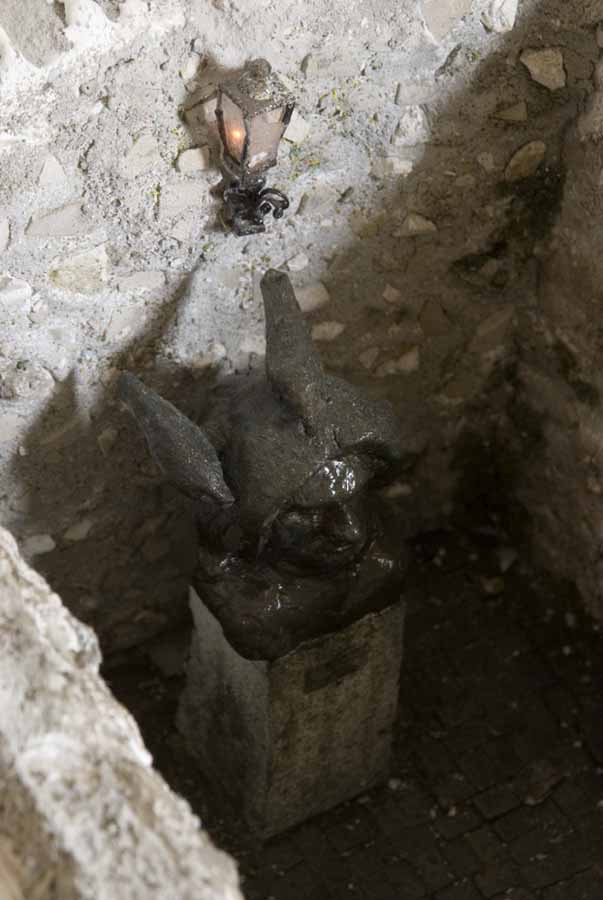
Stephanos Kamaris, "Klement Tchtatelnikov – Tchtatelnikov Square Model", 1/15 scale, circa 1929 (30x35x40 cm)
S.K -All right, I think this undermining is quite theoretical, as you say. But I must admit that I felt quite strange when, in one of the first versions of Klement Tchtatelnikov’s self-portrait after the gulag - the door with many eyes - I signed with his initials at the bottom… The initials have now been removed, though for aesthetic reasons. Certainly the answer requires a lot of psychoanalysis… Because it’s not the first time I’ve done something like this, and it can’t just be chance. As I told you before, I used to work - as a complete amateur - on comics. The technical part of my degree dissertation at the School of Fine Arts in Italy was entitled “The signature of Matthew Longthroat”. It was the story of a failed (at least until the final page, when things are reversed) artist, who was ashamed to sign his works, and who, whenever he did, quickly regretted it and erased his signature. I am very emotionally attached to this story, particularly the last panel. Later I also tried to write a novel, which I abandoned after some time. The hero was, again, a painter, but a relatively well-known one - as opposed to the previous hero. The plot, of course, was rather far-fetched - the painter had three secret pseudonyms (and identities), and a younger half-sister (with whom he had of course lost touch), who knew one of them because the hero had used it in the paintings he used to draw for her when they were both small. Things were so twisted that another, fourth identity of the hero was that of an art critic who constantly abused him in his reviews... So I think all this could do with psychoanalysis. It must be some sort of persecution complex. Perhaps I’m trying, out of fear or embarrassment, to find a somewhat safe point between creation and criticism, although these concepts are peculiarly relative and mutually inclusive to some degree in each case...
Thursday, February 2, 2012
The Functional Architect


The Functional Architect” building blocks designed by the architects A.A Schoug and G.Dalsgaard, 1935. The blocks were made in Danish prisons and sold by the Danish Toy Factory.
Subscribe to:
Posts (Atom)