Wednesday, March 15, 2017

The Plasticity of Libido After the Dillema of Abstraction and Figuration


Athens School of Fine Arts
Visual Arts Semester Courses. Spring 2017
March

The Plasticity of Libido After the Dillema of Abstraction and Figuration 

In some recent artistic practices, there is an approach that betrays the libido, in both its Latin sense as “desire” and its Freudian interpretation. In this section, we will see how “arts plastiques” borrow their ability to use supple materials from the vocabulary of psychoanalysis. We will focus on a certain sculpture and a certain three dimensional painting, in modern and contemporary art, that are viewed more on the level of matter than on the level of geometry. Our main guide to a critical examination of formless matter will be Georges Bataille’s ideas expressed in the journals Documents (1929-1930) and Acéphale (1936-1939). We will also discuss corresponding cases, in the history of music, of music viewed on the level of matter (the history of percussion instruments, the recording tape, the body as a musical instrument in embodied performance through sensors).

Ανώτατη σχολή καλών τεχνών
«Εικαστικές Τέχνες – Σεμινάρια Εαρινού Εξαμήνου” 2017
Μαρτιος

Η πλαστικότητα της λίμπιντο μετά το δίλημμα της αφαίρεσης και της αναπαράστασης

Σε κάποιες πρόσφατες καλλιτεχνικές πρακτικές υπάρχει μια κατεύθυνση που προδίδει τη libido, τόσο με την έννοια της λατινικής σημασίας της ως “επιθυμία” όσο και με την φροϋδική ερμηνεία του όρου. Στην συγκεκριμένη ενότητα θα διαπιστώσουμε πως οι “πλαστικές” τέχνες δανείζονται την ικανότητα για τη χρήση των εύπλαστων υλικών από το λεξιλόγιο της ψυχανάλυσης. Θα εστιάσουμε σε μια γλυπτική όπως και σε μια διευρυμένη ζωγραφική στη μοντέρνα και στη σύγχρονη τέχνη η οποία γίνεται αντιληπτή περισσότερο στο επίπεδο της ύλης και λιγότερο της γεωμετρίας. Οδηγός για μια κριτική αξιολόγηση της άμορφης ύλης θα αποτελέσουν κυρίως οι ιδέες του George Bataille μέσα από τις περιοδικές εκδόσεις Documents (1929-1930) και Acéphale (1936-1939). Αντιστοιχίσεις στην ιστορία της μουσικής, σε περιπτώσεις μουσικής η οποία γίνεται αντιληπτή στο επίπεδο της ύλης (ιστορία των κρουστών, μαγνητοταινία, το σώμα ως μουσικό όργανο στην embodied performance μέσω αισθητήρων).

Βιβλιογραφία/ Bibliography

Yve-Alain Bois & Rosalind Krauss, «Base materialism» in L' Informe. Mode d'Emploi. (Paris: Centre Georges Pompidou, 1996).

Georges Bataille, «Le bas materialisme et la Gnose», Documents, no 1, 1930

Georges Bataille, Ηλιακός πρωκτός, μετ. Κ. Παπαγιώργης (Αθήνα: Νεφέλη, 1980)

Salvador Dali “De la beauté terrifiante et comestible, de l’architecture Modern style”, Minotaure 3–4 (Paris: Editions Albert Skira, 1933)

Gilles Deleuze et Claire Parnet, Dialogues (Paris : Flammarion, 1977)

Denis Hollier, “The labyrinth, the pyramid and the Labyrinth” in Against Architecture : the writings of Georges Bataille (Cambridge, Massachusetts, London : The MIT Press,1992)

Ben Highmore “Imager-breaking , God -making Paollozi's Brutalism, October 136, Spring 2011

Jamer Hunt, Ingestion / The Shelf-Life of Liquefying Objects, Cabinet magazine, Issue 13, Spring 2004 http://cabinetmagazine.org/issues/13/hunt.php

Rosalind E. Krauss, “No More Play” in “The Originality of the Avante-Garde and Other Modernist Myths” (MIT Press, 1986)
Lewis Kachur, An afternoon on the outskirts of european history : Salvador Dali's Dream of Venus Pavilion in Displaying the Marvelous, Marcel Duchamp, Salvador Dali, and Surrealist Exhibition Installations (Cambridge, Massachusetts: MIT Press, 2001).

Julia Kristeva, Pouvoirs de l'horreur : essai sur l'abjection (Paris : Édition Seuil, Collection : Tel Quel,1980)


english

Lemi, E. and Serafin S. (2016). Researching Gesture as a Multi-Sensory Haptic Feedback. In: Musical Gesture as Creative Interface. p.79-80

Lemi, E. (2016) Visual Narration in Sonic Ambience: a Case Study based on Tiberius Grotto, In: Ar- chaeoacoustics, The Archaeology of Sound II Conference, OTS Foundation, pp.81-92

Lucretius, On the Nature of Things (De Rerum Natura), transl. by Martin Ferguson Smith (Indianapolis & Cambridge: Hackett, 1969)

J. Laplanche & J.-B. Pontalis, Λεξιλόγιο της ψυχανάλυσης, μετ. Β. Καψαμπέλης, Λ. Χαλκούση, Α. Σκουλήκα, Π. Αλούπης. (Αθήνα: Κέδρος,1986), σ.385
Micheal Leiris, “Alberto Giacometti," Documents no 1, 1929
Piero Manzoni, “Free Dimension” in Charles Harrison and Paul Wood (eds.), Art in Theory 1900–2000: An Anthology of Changing Ideas, Oxford 1993, σ.709
Anthony Vidler, Homes for Cyborgs in The Architectural Uncanny: Essays in the modern unhomely (Cambridge, Massachusetts, London : The MIT Press,1992

Kostis Velonis “Alfred Jarry and Asger Jorn: The Epicurean Influence as Social “Swerve”

Κωστής Βελώνης, “Η γλυπτική της επιθυμίας”, Αυγή της Κυριακής, 31 Μαιου 2015


Artists
Βλάσσης Kανιάρης/ Nίκος Κεσσανλής/Γιώργος Λαζόγκας/ Ντόρα Οικονόμου/ Κώστας Σαχπάζης/ Μαρία Γεωργούλα/ Παντελής Χανδρής /Νανά Σαχίνη/Γιώργος Σαπουντζής/ Poka Yio
Vlassis Caniaris/ Nikos Kessanlis/Yorgos Lazongas/Dora Economou/Kostas Sahpazis/Maria Georgoula/ Pantelis Chandris/Nana Sachini/Poka Yio/Yorgos Sapountzis/
Μedardo Rosso/ Αlberto Βurri/ Lucio Fontana's Ceramica Spatiale/Piero Manzoni's 'Achromes','Artist's Shit' /John Latham/ Alina Szapocznikow / Dali's 'Dream of Venus Pavilion' 1939 /Antoni Tapies / Rauschenberg's 'Combines'/ Bernard Requichot's 'Reliquaires'/ Giacometti's Bord games/ Eduardo Paolozzi's lecture, ICA, London, 1958/ Paul McCarthy & Mike Kelley--Heidi, 1992

Filmography

Keywords: plastizität der Libido- freie Beweglichkeit / L'informe (Formless) versus l'art informel / Dirty Abstraction/ / L'abject -Julia Kristeva/ Bas materialisme – Georges Bataille/ Agencement -Gilles Deleuze /Between Abject and Grotesque/ Sculpture hysterique-Dali/Karl Marx's 'Warenfetischismus' / Abjection as Swerve / Clinamen -Lucretius.


Friday, March 10, 2017

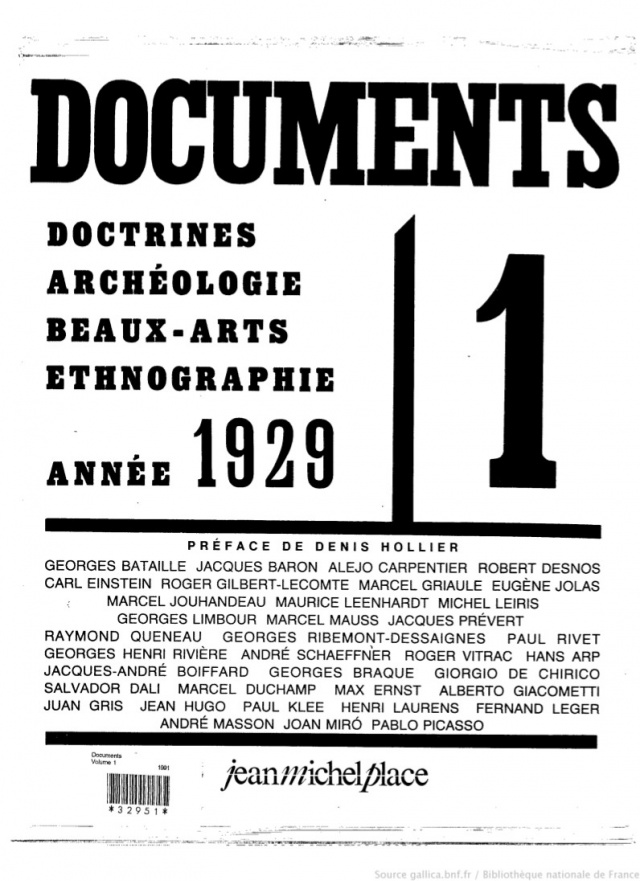
Documents


Documents: doctrines, archéologie, beaux-arts, ethnographie was a Surrealist art magazine edited by Georges Bataille. Published in Paris between April 1929 and January 1931, it ran for 15 issues, each of which contained a wide range of original writing and photographs.

 https://monoskop.org/Documents

Tuesday, March 7, 2017

On the mineralogy of the “Anthropocene Epoch”


The “Anthropocene Epoch” has been proposed as a new post-Holocene geological time interval—a period characterized by the pervasive impact of human activities on the geological record. Prior to the influence of human technologies, the diversity and distribution of minerals at or near Earth’s surface arose through physical, chemical, and/or biological processes. Since the advent of human mining and manufacturing, particularly since the industrial revolution of the mid-eighteenth century, mineral-like compounds have experienced a punctuation event in diversity and distribution owing to the pervasive impact of human activities. We catalog 208 mineral species approved by the International Mineralogical Association that occur principally or exclusively as a consequence of human processes. At least three types of human activities have affected the diversity and distribution of minerals and mineral-like compounds in ways that might be reflected in the worldwide stratigraphic record. The most obvious influence is the widespread occurrence of synthetic mineral-like compounds, some of which are manufactured directly for applications (e.g., YAG crystals for lasers; Portland cement) and others that arise indirectly (e.g., alteration of mine tunnel walls; weathering products of mine dumps and slag). A second human influence on the distribution of Earth’s near-surface minerals relates to large-scale movements of rocks and sediments—sites where large volumes of rocks and minerals have been removed. Finally, humans have become relentlessly efficient in redistributing select natural minerals, such as gemstones and fine mineral specimens, across the globe. All three influences are likely to be preserved as distinctive stratigraphic markers far into the future.

Text by Robert M. Hazen, Edward S. Grew,Marcus J. Origlieri, Robert T. Downs

http://ammin.geoscienceworld.org/content/102/3/595

Scratch


One of my studies on visual poetry, using typography, something I really love.
© Ana Mendes 2014, all rights reserved.

Borders


Borders (Puppetry for Long Distance People) 2016
 Concrete, wood, acrylic
 25 x 58 x 25 cm

Thursday, March 2, 2017

Acéphale


André Masson, Acéphale, nº 2, 1937

Wednesday, March 1, 2017

The Impossible Return and the Question of Diaspora


Athens School of Fine Arts
Visual Arts Semester Courses. Spring 2017


The Impossible Return and the Question of Diaspora

The aim of the class is to attempt to juxtapose different approaches to critical discourses around the notion of sculpture in the expanded field. Symptoms that range from the modernist abolition of the enclosed sculptural mass, to recent affinities of the sculptural medium with an architectural conception of contemporary cultural production will be examined through an interdisciplinary methodology including essays and conversations with artists and scholars.

In the aftermath of a subversive modernism nowadays, the effect of this opening up will enable the emergence of a vital space which ultimately is literally inhabited.

How does contemporary art respond to the violent but also conscious displacements or to the experience of exile and Diaspora? How are the morphological narratives affected by a revision of the dominant narratives on the static view of an obsolete territorial and gender identity? How can we still have a sense of urgency designed into a sculpture that translates the precarious form of employment? How does this quest for mobility translate into the traditional artistic media? Ultimately, are there still any viable reasons why we should be fascinated by the tectonic rigidity of the form?
Focusing on student’s identity as artists and social beings we take into consideration the fact that visual arts are also connected to other arts, innovative technology, human studies and science.
The class is subdivided into 3 chapters, one for each of the spring months: 

MarchThe plasticity of libido after the dillema of abstraction and figuration 
April: Beyond the border
May: Games of scale; from the architectural model to dollhouse 
Every Thursday 11:00 - 3:00 at the old library room 
Lecturers: Esther Lemi, Kostis Velonis
up to 30 students (listeners are welcome); subscribe until Feb 28 at 30wanderers@gmail.com   

Ανώτατη σχολή Καλών τεχνών
«Εικαστικές Τέχνες – Σεμινάρια Εαρινού Εξαμήνου” 2017

Η αδύνατη επιστροφή και το ερώτημα της διασποράς

Στόχος του μαθήματος είναι να αναρωτηθούμε μέσα από μια διεπιστημονική μεθοδολογία πάνω στα συμπτώματα της σταδιακής κατάργησης του περίκλειστου πλαστικού όγκου, του ανοίγματος του σχεδίου και της πανοπτικης προδιάθεσης του τεχνολογικού υλικού ώστε να καταδείξουμε τις συγγένειες προς μια αρχιτεκτονική σύλληψη της σύγχρονης πολιτισμικής παραγωγής.

Στον απόηχο μιας ανατρεπτικής νεωτερικότητας οι συνέπειες αυτής της διάνοιξης που φέρουν το ρήγμα στην παραδοσιακή αυτονόμηση του έργου τέχνης θα αντιπαρατεθεί από μια αναλυτική προσέγγιση που κάνει ορατές τις κατασκευαστικές λεπτομέρειες του έργου και επιτρέπει την ανάπτυξη ενός ζωτικού χώρου μέχρι την κυριολεκτική κατοίκηση του.

Αυτή η χωρική κατεύθυνση θα αποδοθεί εξίσου στις κοινωνικές επιστήμες , όπου θα αναδειχθούν εκείνα τα χαρακτηριστικά που επιτρέπουν την απομυθοποίηση τόσο από τους κανονιστικούς κώδικες μιας 'ομαλής' σύλληψης του έργου τέχνης όσο και από μια οντολογική εδραιστική αντίληψη της σχέσης του υποκειμένου με μια αυστηρή γεωγραφική ζώνη.

Πώς ανταποκρίνεται η σύγχρονη τέχνη στις βίαιες αλλά και στις συνειδητές παρεκτοπίσεις όπως και στην εμπειρία της εξορίας και της διασποράς; Πώς μια αναθεώρηση των κυρίαρχων αφηγήσεων πάνω στη στατική αντίληψη μιας παλιωμένης ταυτότητας του εδαφικού και του φυλετικού επιδρά στις μορφολογικές αφηγήσεις; Πώς μπορεί να υφίσταται ένας σχεδιασμός του επείγοντος σε μια γλυπτική που μεταφράζει τις επισφαλείς μορφές εργασίας; Πώς μεταφράζεται αυτή η αναζήτηση της κινητικότητας στα παραδοσιακά εκφραστικά μέσα; Τελικά υπάρχουν ακόμη βάσιμοι λόγοι όπου μπορεί να μας γοητεύει η τεκτονική ακαμψία της φόρμας;

Μάρτιος : Η πλαστικότητα της λίμπιντο μετά το δίλημμα της αφαίρεσης και της αναπαράστασης
Απρίλιος: Πέρα από τα σύνορα
Μάιος: Παιχνίδια της κλίμακας: από το αρχιτεκτονικό μοντέλο για κουκλόσπιτο
Κάθε Πέμπτη 11:00-3:00 στην παλιά αίθουσα βιβλιοθήκης

Διδάσκοντες: Εσθήρ Λέμη, Κωστής Βελώνης

The Armory Show 2017


Kostis Velonis, Management Fights the Unions (‘Trade Union Conflicts’ series), 2017, acrylic, pastel, watercolor and color pencil on canvas, 100 x 100 cm
2 - 5 March 2017
Pier 94 / Contemporary
Kalfayan Galleries Booth 817
Artists presented:

Panos Tsagaris & Kostis Velonis

Saturday, February 11, 2017

Stupeur de jeunes recrues en apercevant pour la première fois ton azur, ô Méditerranée!


Alphonse Allais, Stupeur de jeunes recrues en apercevant pour la première fois ton azur, ô Méditerranée,” 1887, in Album Primo-Avrilesque. Paris: Ollendorf, 1897

Ascension


Otto Freundlich, Ascension, 1929 / Cast  1979

Theory’s history, 196X – 199X. Challenges in the historiography of architectural knowledge


In recent international literature addressing the history of 20th century architectural theory, the year 1968 is indicated as a decisive moment, giving rise to a ‘new’ architectural theory. From that moment onwards, emphasis was no longer placed on the aesthetics of architecture, but on its critical potential. Yet, according to some scholars, this intensification of theory was short-lived. A presence of coexisting and even contradictory paradigms derived from very different epistemic domains (anthropology, philosophy, linguistics, social sciences, etc.) led to a setback of theory, resulting in an end-of-theory atmosphere in the 1990s.
It is not a coincidence that the so called death of architectural theory concurred with the upsurge of anthologies on architectural theory that collect and classify referential texts. Instead of burying theory, these anthologies had an additional effect, namely to institutionalise it. In other words, they offered both closure to a past period and also defined the locus of a next period of theorisation, invoking a ‘historical turn’. At the same time architectural discourses, and especially architectural historiography, were engaging with new theoretical fields such as gender studies or postcolonial studies, giving rise to a continued production of theoretically informed books and articles.
The goal of this conference is to discuss the methodological challenges that come along with this historical gaze towards theory, by focusing on the concrete processes in which knowledge is involved. By screening the unspoken rules of engagement that the accounts of post-war architectural theory have agreed to and distributed, we want to point at dominant assumptions, biases and absences. While anthologies inevitably narrate history with rough meshes, we believe it is time to search for those versions of theory formation that have slipped through these nets of historiography, in order to question the nature of theory and the challenges it poses to historians. How do you do historical research on something as intangible as theory, or in a broadened sense, the knowledge of architecture?

We are in other words not only interested in what theorists and practicing architects were arguing for, but also how, why and where they did so. Looking at case-studies, the singular and ‘minor’ expressions of theory, the local discourses and the different formative contexts (e.g. education, publication culture) can be subjected to careful scrutiny. We particularly welcome case-studies from the 1960s to the 1990s that deal with one or more topics formulated in the full CFP:

Wednesday, January 25, 2017

House


“—at the house,”
nursing a small pot, neat
as a purse-snatch, waiting to be used,
parenting a coma, just
thou, afterthought, hung on a hook,
nasty pout in the hallway, house, its life complete,
small as a guild, literal and omnipotent,
a plea we might enter later—
ow lovely to live somewhere so brief,
you must say hello from me.


Joy Katz

Thursday, January 19, 2017

Precision German Craftsmanship


The title was borrowed from a poem by the American poet Matthew Rohrer, in which he describes his ideas of German craftsmanship, especially with regards to the proverbial German thoroughness and precision. Kostis Velonis plays with this idea and intentionally creates crafts which are not based on such values. The smoothness and polish of typical design products are substituted by scratching on the raw surfaces and the aspect of deterioration and collapse of the cultural object. Most of the surfaces of these objects remain dirty, smudgy and stained, offering their own narratives.

Akademie Schloss Solitude, Stuttgart
January, 19 to March, 5, 2016


Wednesday, January 4, 2017

Precision Cutting Service

Precision Cutting Service, 2016
Wood,  colored pencil, pastel , acrylic
130 x 43 x 16 cm

Monday, January 2, 2017

Little Red


Δεν θα ξανάρθω πια γιαγιά, δεν θα ξανάρθω
με το καλάθι μου όλο σκίνα όλο μυρτιές
ολο τον κίνδυνο ως την άκρη εκεί, του δάσους
ενα γιαπί, ένα γήπεδο,
μέσα στο τίποτα ένα κέντρο, ένα αυθαίρετο έξαφνο ένα φως
η είσοδος μισανοιχτή, δεν θα ξανάρθω
με το παλτό μου, σαν τρελή χαρά
τακ τακ δεν θέλω πάλι στα τακούνια – τι χαλίκια, τι ασβέστες.
Αυτός ο λύκος, πόσο τρυφερά
μας φτάνει στην κραιπάλη
ανυποψίαστα παιδάκια διαρκώς.
Πόσο γλυκός, πόσο δικός, ο τρομερός του τρόπος – νύχια δόντια
τα γκρίζα μάτια σου ολόιδια κι αλλιώς
η απειλή σαν συμβουλή μας κόβει την ψυχή, μας παρασύρει
αυτή η φωνή – βυθός και
αφρός –τα ασπρόρουχά μας, μια χροιά σκόνη και γύρη– ναι, γιαγιά
η απαράλλαχτή μας δόξα μοιρασμένη.

Κι αυτή η πόλη, η λεκάνη της, μια αυλή,
βλέπω κοτούλες, βλέπω προβατάκια σαν να με κάλεσε η σύμπασα ζωή –για να με κάνει, τι; – Να ονειρευτώ,
να ονειρευτεί η αθεράπευτή μου η νύχτα εχτές ξανά,
κάτω απ’ το χώμα
το νερό τυφλό.
Εκεί με πάει, η άσφαλτός μας να πλυθώ
μέσα στο κρύο – ένας ναός
οι άδηλές του εκεί, στο σύθαμπο οι κολώνες.
Ντύνομαι γδύνομαι γιαγιά πόσους αιώνες
μου ετοιμάζατε αυτόν τον προορισμό
εμένα με το κέικ, με τη σκούφια – το βουνό τι με κοιτάζει;
Δεν θα ξανάρθω
κι ας αφήσω – που σας έχω τόση αγάπη
ας τον αφήσω όλο τον κόσμο μου
αβοήθητο
στον πυρετό.

Μέλπω Γρυπάρη, 2012


Monument to the "First!"


Monument to the "First!", Avtory monument. Αrchitects : Rafael Revzin and Valery Serebryakov, opened August 16, 1970. 

In the Meantime


What seemed a mystery was
in fact a choice. Insert bird for sorrow.  

What seemed a memory was in fact
a dividing line. Insert bird for wind. 

Insert wind for departure when everyone is
standing still. Insert three mountains

burning and in three valleys a signal seer
seeing a distant light and a signal bearer

sprinting to a far-off bell. What seemed
a promise was in fact a sigh.

What seemed a hot wind, a not quite enough,   
a forgive me, it has flown away, is in fact.   

In the meantime we paint the floors
red. We stroke the sound of certain names

into a fine floss that drifts across our teeth.
We stay in the room we share and listen

all night to what drifts through the window—
dog growl, owl call, a fleet of mosquitoes

setting sail, and down the road,
the swish of tomorrow’s donkey-threshed grain.

Lisa Olstein, 2006 


Saturday, December 31, 2016

Eile mit Weile


Andreas Alciatus “ Eile mit Weile “ , Emblemata ,1531

Friday, December 23, 2016

Would You Say That Your (Artistic) Practice is Political?


The various possible answers to the question seem scripted in advance – like we are arriving at this question too late.
In the second half of the twentieth century, the domain of politics was imagined to have shifted from a rarefied space (however historically constituted, i.e., the polis, the public sphere, etc.), to a decentralized and »capillary« operation within all spaces. This led to a significant blurring of boundaries, most clearly elucidated in the key mantra of Second Wave feminism: »the personal is political.« By the mid-1990s, however, locating the political was a process marked by a certain melancholy, even exhaustion. The Google Ngram below plots the use of the expression »everything is political« between 1800 and 2008


by Gavin Steingo

Friday, December 16, 2016

Unlearning Alphabet


Unlearning Alphabet, 2016
Wood, plywood, acrylic
250 x 80 x 7 cm 


Don’t Overthink It


Matthew B. Crawford’s first book, the best-selling Shop Class as Soulcraft (2009), established him as a polemical champion of the superiority, mental and moral, of manual labor over the kind of employment typically sought by college graduates, including any work done on a computer and in a cubicle. For some readers, the fact that the author had earned a doctorate in political philosophy and also owned a motorcycle-repair shop lent a certain kick-ass authenticity to his enterprise. Now ensconced at the University of Virginia’s Institute for Advanced Studies in Culture, Crawford is back with a heady argument against headiness, and to aid him he invokes as models a couple of artisans and an array of regular guys—short-order cooks, hockey players, and, of course, any dude who knows his way around a Harley. In The World Beyond Your Head: On Becoming an Individual in an Age of Distraction, he doesn’t just herald the soul-cleansing properties of skilled craftwork. He indicts the philosophical tradition that he believes has robbed us of the world beyond our muddled, misdirected minds. Crawford calls this tradition the Enlightenment, though his description of the European intellectual movement of the 17th and 18th centuries distorts it almost beyond recognition.


By Rebecca Newburger Goldstein

http://www.theatlantic.com/magazine/archive/2015/05/dont-overthink-it/389519/

Instructions for Happiness


Happiness can be understood as a basic human need. And the exhibition is all about the personal pursuit for happiness. But instructions for happiness?
As happiness is quite an individual matter, instructions for happiness are of course a pretty absurd promise. Regardless of whether happiness is sought after in the interpersonal, the immediate or the everyday respectively the beauty of the small things in life – the exhibition tries to question the notions of happiness.

Selected artists were invited to contribute a work, that also includes a manual: A work that – based on an instruction – invites to do something, for instance use an object, react to a situation, interact with others under certain rules, perform something for others or oneself or simply initiates a thought process. The form of the work (as well as the instruction) could take any possible shape – resulting in artworks that are as diverse and formally divergent as the technical possibilities. But the seemingly chaotic diversity also reflects a plurality of perspectives on happiness that the artist (as well as society) share.

Aside from the question of happiness in the context of today’s Athens, the exhibition also tries to reflect upon art’s possibilities of immediate effects on society. Thus the boarders of the power of the aesthetic field can be questioned in the show on one side, while tracing the notions of happiness on the other side through experiencing the works in order to maybe also find answers for oneself.


Untitled (Life without tragedy Series), 2015 

Featuring works by Anna Sophie Berger, Liudvikas Buklys, Heinrich Dunst, Simon Dybbroe Møller, Christian Falsnaes, Benjamin Hirte, Barbara Kapusta, Stelios Karamanolis, Alexandra Kostakis, Adriana Lara, Lara Nasser, Rallou Panagiotou, Natasha Papadopoulou, Angelo Plessas, Maruša Sagadin, Hans Schabus, Björn Segschneider, Socratis Socratous, Misha Stroj, Stefania Strouza, Jannis Varelas, Kostis Velonis and Salvatore Viviano; curated by Severin Dünser and Olympia Tzortzi


Opening Tuesday, 20.12.2016, 8pm
21.12. – 30.12.2016, 12pm – 8pm
Lekka 23 – 25 & Perikleous 34, Athens

Kindly supported by The Federal Chancellery of Austria, NON SPACES and KUP


The Kids Want Communism

"The Kids Want Communism” is a yearlong exhibitions project at MoBY-Museums Bat Yam that is held in conjunction with a number of different artists and institutions around the world, including exhibitions, lectures, exhibits, screenings and publications throughout the year of 2016-2017. Partner institutions include the Tranzit Prague, VCRC Kiev, Free / Slow University of Warsaw, State of Concept in Athens, Škuc Gallery in Ljubljana and MoBY.
As part of the third round of “The Kids Want Communism” the entrance exhibits the paintings by the artist Toy Boy, who was born in Luanda, and grew up as a street kid in Angola after the Cuban war against South Africa and the United States. The unique story of this unknown war which led to the fall of the Apartheid is being told through the artist’s experiences.
Beside him, the installation of Hila Laviv and Dana Yoeli “In the Corner This Morning,” an installation poster inspired by the utopian rooms designed by the father of the Soviet constructivist art movement El Lissitzky (1890-1941). The visitors are invited to take with them a poster with a paper self-preparation model, and are encouraged to touch, cut, fold, paint, and decorate in handicrafts tradition of DIY (Do it Yourself). In this way the painting becomes an object.
On the second floor, the large-scale installation of Max Epstein “Dacha,” which was created especially for the exhibition, restores not only the traditional Russian wooden summer house, but also provides the uncanny features it involved. Tamar Nissim presents “I am Simha Sabari,” which tells the fascinating story of Sabari (1913-2004), a Jewish Communist from Yemeni descent, born an albino in the Yemenite Quarter in Tel Aviv and was active in the party in Palestine. The rich political, ideological and cultural contradictions of Sabari’s character display a complexity which seems to have disappeared today.
Mati Lahat exhibits “Titans,“ an installation created especially for the exhibition and composed of original frescoes created by Shraga Weil and Shmuel Katz in the communal dining hall of Kibbutz Ein Hamefratz in 1954. Lahat rescued the frescoes before the dining hall wall was destroyed. At MoBY he presents them against graphite drawings of the Liquidators monument in the Ukraine. These volunteers sacrificed their lives to seal the nuclear reactor at Chernobyl with concrete in 1986 in order to prevent further leakage of radioactive radiation.
Tal Gafny’s installation "Atidim” was also created especially for the exhibition. In its center is the image of Alyssa Carson, an American girl who has been practicing for the last nine years in order to participate in the first manned expedition to Mars, planned by NASA for 2033. The work represents a summary of the first chapter of the project which will accompany Alyssa on her departure to Mars in 17 years.
The exhibition “Notes on Division,” curated by Iliana Fokianaki of State of Concept in Athens, one of the international partners of "The Kids Want Communism” activities, focuses on a return to the Greek civil war of 1946-1949 and the political discourse surrounding the current economic crisis in the country. The exhibition will host six major artists from the art scene in Athens, including: Konstantinos Kotsis, Yota Ioannidou, Antonis Pittas, Yorgos Sapountzis, Kostis Velonis and Vangelis Vlahos.
In addition, the installation “Charging Station" by Nir Harel moves from the central entrance space to the top floor and spreads between spaces. The installations “Red Star” by Noa Yafe - a diorama of Mars; the incubator/sarcophagus of the “Great Soviet Encyclopedia” created by Nicole Wermers; “Structure for Rest” by Ohad Meromi of beds for daydreaming, are moving in the second floor to construct new constellations between the exhibits. The mural by Jonathan Gold showing people standing in line has been completed during the year and is now presented in its final form.

Care a lot, 2016 
Wood, marble, acrylic 
24 x 14 x 11 cm

“The Kids Want Communism” is an annual exhibitions project at MoBY-Museums of Bat Yam, and is held in conjunction with a number of different artists and institutions around the world, throughout 2016. The Kids Want Communism is organized by Iliana Fokianaki, Vladimir Vidmar, Oleksiy Radynski, Vit Havranek, Kuba Szreder and Joshua Simon.

MoBY-Museums Bat Yam 
 December 15, 2016

Saturday, December 3, 2016

Precision German Craftsmanship


It was a good day and I was about to do something important
and good, but then I unscrewed the pen I was using
to see the ink. Precision German craftsmanship.
The Germans are so persnickety and precise,
they wash their driveways. Their mountains and streams
dance around each other in a clockwork, courtly imitation
of spring. They build the Panzer tank, out of rakes
hoses and garden gnomes; they built me.
And I’ve seated myself above an avenue on the brink
of mystery, always just on the lip, with my toes over the lip
but my bowels behind.
When I replaced the ink the sky was socked in,
only one window of blue open in the north, directly over someone.
But that person was reading about Rosicrucians in the laundromat,
he was unaware as the blue window closed above him.
The rest of us are limp and damp,
I see a button in front of us that says “spin cycle.”
I’m going to push it.


Matthew Rohrer, 2001