Friday, June 26, 2020

199


199
27.6.2020-1.11.2020
Deste Foundation Project Space, Slaughterhouse, Hydra
#199 #destefoundation  #hydraslaughterhouse #masonry #gravity#kostisvelonis #poster #deste #indestructible

Monday, June 22, 2020

Young Woman on a Stool


Leon Spilliaert, Young Woman on a Stool, 1909 

Νεκρικό εκμαγείο του Ιωάννη Μακρυγιάννη

Νεκρικό εκμαγείο του Ιωάννη Μακρυγιάννη, 1864.  Φιλοτεχνημένο από το γλύπτη Δημήτρη Κόσσo

Gruas no cais descarregam mercadorias e eu amo-te

Gruas no cais descarregam mercadorias e eu amo-te.
homens isolados caminham nas avenidas e eu amo-te.
silêncios eléctricos faíscam dentro das máquinas e eu amo-te.
destruição contra o caos, destruição contra o caos e eu amo-te.
reflexos de corpos desfiguram-se nas montras e eu amo-te.
envelhecem anos no esquecimento dos armazéns e eu amo-te.
toda a cidade se destina à noite e eu amo-te.

José Luis Peixoto, 2008 - Gaveta de Papéis

Sunday, June 21, 2020

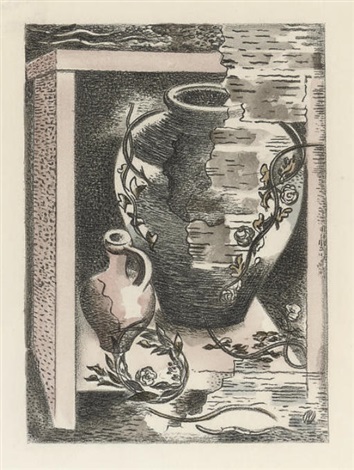
Buried Urne (from Urne Buriall and The Garden of Cyrus)


Paul Nash, Buried Urne (from Urne Buriall and The Garden of Cyrus), 1932
Collotype with pochoir
31.5 x 22.5 cm

Ομηρικό Ακρογιάλι

Γεράσιμος  Στέρης, George de Steris or Guelfo Ammon d' Este (Gerasimos Stamatelatos), Ομηρικό Ακρογιάλι.

Daphne and Laura and So Forth

He was the one who saw me
just before I changed,
before bark/fur/snow closed over
my mouth before my eyes grew eyes.

I should not have shown fear,
or so much leg.

His look of disbelief - 
I didn’t mean to!
Just, her neck was so much more
fragile than I thought.

The gods don't listen to reason,
they need what they need -
that suntan line at the bottom
of the spine, those teeth like mouthwash,
that drop of sweat pearling
the upper lip - 
or that's what gets said in court.

Why talk when you can whisper?
Rustle, like dried leaves.
Under the bed.

It's ugly here, but safer.
I have eight fingers
and a shell, and live in corners.
I'm free to stay up all night.
I'm working on
these ideas of my own:
venom, a web, a hat,
some last resort.

He was running,
he was asking something,
he wanted something or other


Margaret Atwood, Morning in the Burned House 

Η Δάφνη και η Λάουρα, και τα λοιπά


Αυτός ήταν, που με είδε
λίγο πριν μεταμορφωθώ,
πριν ο φλοιός του δέντρου /το τρίχωμα/ το χιόνι
μου μπουκώσουν το στόμα,
πριν τα μάτια μου πετάξουν μάτια.


Δεν έπρεπε να δείξω φόβο,
ή τόσο πολύ γάμπα.

Το άναυδο βλέμμα του —
Δεν το ήθελα!
Μόνο που ο λαιμός της
ήταν πιο λεπτός απ’ ό,τι νόμιζα.

Οι θεοί δεν ακούνε τη λογική,
θέλουν αυτό που θέλουν —
το σημάδι της ηλιοθεραπείας
στο κάτω μέρος της ράχης,
εκείνα τα δόντια σαν
αποσμητικό στόματος,
τη σταγόνα εκείνη του ιδρώτα
να στολίζει το πάνω χείλι—
ή έτσι τα περιγράφουν
στα δικαστήρια.

Γιατί ν’ ακουστείς όταν
μπορείς να ψιθυρίσεις;
Θρόισε, σαν τα ξερά φύλλα.
Κάτω απ’ το κρεβάτι.

Είναι άσχημα εδώ, αλλά πιο ασφαλές.
Έχω οκτώ δάχτυλα
κι ένα καβούκι, και ζω στις γωνίες.
Μπορώ να μείνω ξύπνια όλη νύχτα.
Επεξεργάζομαι
τις δικές μου ιδέες:
το δηλητήριο, ένα δίχτυ, ένα καπέλο.
μια τελευταία ευκαιρία.
Έτρεχε εκείνος,
κάτι ρώταγε,
κάτι ήθελε.
Margaret Atwood, 2001 

Friday, June 19, 2020

Wednesday, June 17, 2020

DESTE Foundation, Project Space, Slaughterhouse, Hydra


The DESTE Foundation, as a gesture in response to the 200th commemoration of the Greek War of Independence, has decided to celebrate the 199th anniversary by commissioning Greek artist Kostis Velonis to conceive an immersive presentation of ten funerary masks of fighters of 1821 from the collection of the National Historical Museum of Athens. The exhibition will be on view in the old Hydra Slaughterhouse starting on June 27 and through November 1, 2020.
Conceived as an intense visual and corporeal experience, 199 is an emblematic memento mori. The exhibition is based on juxtapositions and unexpected associations of this special historical material in the setting of the old slaughterhouse and the distinctive topography of Hydra. Steering clear of the traits of a strictly celebratory exhibition or the conventional and moralistic approaches and ideological constructs around the subject, the artist invites viewers to re-examine their relation to the historic event and restore the role of art and artists in the social and cultural processes as well as in the re-evaluation of historical research.
If the year 1821 marks the start of modernity for Greece and its induction into the Age of Enlightenment and its contradictions, 199  explores some of the consequences and implications of this prospect, the contemporary significance of artistic representation, the allegories and memory of the bodies, as well as the questions and emotional turmoil triggered by such an historical event.
In this way, the exhibition repositions the relations between the body and history, between inner experience and collective self-knowledge, identity, and alterity, reality and imagination as well as between man and animals. As Kostis Velonis states, “the mourning of Cyparissus –whom Apollo turned into the evergreen cypress tree out of pity when Cyparissus was devastated by the loss of his beloved stag– is equated here with the loss of hundreds of animals in the Slaughterhouse and the sacrifices of fighters in the Greek War of Independence”.
And he continues: “The phantom that hovers over a rebellious Greece seems to set off from Pontikonissi, Kerkyra, which is almost the archetype for Die Toteninsel, the 1880 painting of Arnold Böcklin. The famous picture of the islet at sunset contributes to this peculiar time machine, travelling to arid Hydra and bringing some particular vegetation into the Slaughterhouse. This temporary sojourn brings together such contrasting concepts as the accessible and the inaccessible, the endless and the finite, the perishable and the eternal, paying tribute to the spectres that seek their new place.”
**Please note that due to the Covid-19 social distancing regulations, there will be no opening event for this exhibition*

DESTE Foundation Project Space, Slaughterhouse, Hydra
27.6.2020 - 1.11.2020
Daily 11:00–13:00 & 19:00–22:00
Tuesday Closed

A girl

 
The tree has entered my hands, 
the sap has ascended my arms, 
the tree has grown in my breast - downward, 
the branches grow out of me, like arms. 

Tree you are, moss you are, 
you are violets with wind above them. 
A child - so high - you are, 
and all this is folly to the world. 

Ezra Pound

Μίμος


Μίμος, 2019
                                                                   Ceramic, wood, plywood, acrylic, oil

#mime #imp #fool #ghost #beggar #sculpture#kostisvelonis #saltimbanques

Sunday, June 14, 2020

Nocturne


Breath of the One Unmoved. Animal face
Frozen with azure, with its sanctity.
Immense the power of silence in stone.

The mask of a night bird. A quiet triad
Fades on one sound. Elai! your countenance
Inclines unspeaking over the pale-blue waters.

O you calm mirrors of the truth.
On the ivory cheeks of the lonely one appears
Reflected the splendour of fallen angels.

Georg Trakl

Nachtlied


Des Unbewegten Odem. Ein Tiergesicht  
Erstarrt vor Bläue, ihrer Heiligkeit.  
Gewaltig ist das Schweigen im Stein; 
Die Maske eines nächtlichen Vogels. Sanfter Dreiklang  
Verklingt in einem. Elai! dein Antlitz  
Beugt sich sprachlos über bläuliche Wasser. 
O! ihr stillen Spiegel der Wahrheit.  
An des Einsamen elfenbeinerner Schläfe  
Erscheint der Abglanz gefallener Engel. 

Georg Trakl

Saturday, June 6, 2020

Pierrot in Love


Pierrot in Love, 2020
Wood, plywood, clay, acrylic, marble 
143 x 45 x 60 cm 

Ghost Beggars


Circus Mind, 2020
Ink, pencil and acrylic on paper
100 x 70 cm   


The historic figure of Pierrot, constantly transformed yet always imprisoned in his white look and feckless attitude, is the main inspiration for the sculptures, drawings and paintings exhibited in the show at Kalfayan Galleries. Known for his own passivity, Pierrot is akin to the nameless citizen who vanishes in the crowd. In this respect, the works function as dramatic exercises of introversion in the political realm. The rhetoric of whiteness introduces a dialogue about radical alterity, the absolute Other that may concern the Self as well. At this point, the theatrical figure of Pierrot, with the white powder on his face accentuated by the paleness of a non-radiant moon, becomes a vector of a wide array of references, from sculpture’s relation to the original meaning of the“clown” ( clot/clod )  and the semiotics of white in fashion and clothing design. 

The title of the exhibition is inspired by the appearance of beggars – dressed in white and with their faces painted white- at the central streets of Athens in late 2010. These figures, sad and still, wrapped in a white sheet, begged without the usual acrobatic skill of clowns and other street entertainers. Weakened, mournful and feckless, they ironically contributed to the tradition of Pierrot who strives for his own annihilation and wanders around like a ghost

Duration: 10 June – 26 September 2020
Kalfayan Galleries 


Sunday, May 31, 2020

The White Stripes


The White Stripes, 2019
Wood, clay, acrylic 
52 x 28 x 14 cm

Saturday, May 30, 2020

Το κυπαρίσσι


Εξαίρεση,
το κυπαρίσσι:
μόνο αυτό
διψά για ουρανό,
μόνο αυτό
μάχεται να ξεφύγει.

Όλα τά άλλα
ερωτοτροπούνε με τη γη

Xρίστος Λάσκαρης 

Venus pleurant la mort d’Adonis


Anonyme, Venus pleurant la mort d’Adonis, c.1550-c.1600 #tearsoferos#venus #adonis #larmes #tears #eros #ecoledefontainebleau

Friday, May 22, 2020

Αόρατα Νήματα / Invisible threads

Αόρατα Νήματα / Invisible threads


Βιβλιογραφία, σημειώσεις 
Bibliography / REF/ Works Cited / Films / Performances 

Antonucci , Giovanni. Chonache del theatro futurista, Roma: Abete, 1975.

Barthes, Roland. Μάθημα γραφής, Σύγχρονος κινηματογράφος τευχος 15-16, 1977.  
http://www.cinemalab.eu.org/sygxronos-kinimatografos/details/1/27-sygxronos-kinimatografos-77
Barthes, Roland. On Bunraku, The Drama Review: TDR, Vol. 15, No. 2, Theatre in Asia (Spring, 1971), pp. 76-80 https://www.jstor.org/stable/1144622

Barris, Roann, The Life of the Constructivist Theatrical Object,
 Theatre Journal, Vol. 65, No. 1 (March 2013), pp. 57-76 https://www.jstor.org/stable/41819822


Bell, John. Κούκλες, μάσκες και παραστατικά αντικείμενα στο τέλος του 20ου  αιώνα, Νήμα, τευχ.30, Μαιος 2000.  

Βλαβιανός, Χάρης.  Το νερό έγινε πέτρα, Το Βημα, 14 Δεκ.,  2014 

Bowlt, John E., Constructivism and Russian Stage Design, Performing Arts Journal, Vol. 1, No. 3 (Winter, 1977), pp. 62-84,  https://www.jstor.org/stable/3245250
Beeson, Nora Meyerhold, Vsevolod, The Tulane Drama Review, Vol. 4, No. 1 (Sep., 1959), pp. 139-149
 https://www.jstor.org/stable/1124810

Corra, Bruno, antognoli Marinetti, F. T., Settimelli, Emilio. Μανιφέστο του Φουτουριστικού Συνθετικού Θεάτρου (Teatro Futurista Sintetico)   Μιλάνο, 11 Ιανουαρίου 1915 - 18 Φεβρουάριου 1915,  μτφρ.Κώστας Κουρμουλάκης. 
https://www.academia.edu/11335211/Μετάφραση_των_φουτουριστικών_μανιφέστων_του_Μαρινέτι_για_το_θέατρο

Cappelletto, Chiarra. The puppet's paradox: An organic prosthesis
 RES: Anthropology and Aesthetics, No. 59/60 (spring/autumn 2011), pp. 325-336 
www.jstor.org/stable/23647798

Craig, Edward Gordon, The Actor and the Über-Marionette, The Mask, Volume 1, Number 2, April 1908
https://bluemountain.princeton.edu/bluemtn/?a=d&d=bmtnaau190804-01.2.5&
Simone Germini, Il teatro avanguardista di F. T. Marinetti, Marzo 30, 2017

https://imalpensanti.it/2017/03/30/il-teatro-avanguardista-di-filippo-tommaso-marinetti/

Güthenke, Constanze, Postclassicism, Disturbed Philology and Kleist’s Fencing Bear, Oxford German Studies, 47:2, 2018, 184-200https://doi.org/10.1080/00787191.2018.1452706 

Gray, John, H ψυχή της μαριονέτας – Μια σύντομη έρευνα για την ανθρώπινη ελευθερία Μετάφραση Γιώργος Λαμπράκος, Εκδόσεις Οκτώ, 2018 

Gross, Kenneth, The Madness of Puppets , The Hopkins Review, Volume 2, Number 2, Spring 2009 (New Series), pp. 182-205  https://doi.org/10.1353/thr.0.0066 

Hebron, Stephen, John Keats and ‘negative capability’, British Library, 2014 
https://www.bl.uk/romantics-and-victorians/articles/john-keats-and-negative-capability

 Unger, Roberto. False Necessity: Anti-Necessitarian Social Theory in the Service of Radical Democracy, Revised Edition. London: Verso, 2004 
http://www.robertounger.com/en/wp-content/uploads/2017/10/false-necessity.pdf

The Letters of John Keats, ed. by H E Rollins, 2 vols, Cambridge: Cambridge University Press, 1958

Koss Juliet, Bauhaus Theater of Human Dolls.
The Art Bulletin, Vol. 85, No. 4 (Dec., 2003), pp. 724-745 
https://www.jstor.org/stable/3177367


Lorefice,Tito. Ariel Bufano : Πάνω την ερμηνεία της Κούκλας, Νήμα, τευχ. 35, Μάιος 2004 

Lyons, Charles R,   Gordon Craig's Concept of the Actor, Educational Theatre Journal, Vol. 16, No. 3 (Oct., 1964), pp. 258-269 https://www.jstor.org/stable/3204670

Lyotard, Jean Francois,  «Ο Θεός και η μαριονέτα» στο «Το απάνθρωπο, κουβέντες για τον χρόνο», μτφρ. Βασίλης Πατσογιάννης , Αθήνα:  Πλεθρον, 2019 

Victoria Nelson. The Secret Life of Puppets. Cambridge: Harvard University Press, 2001


Obraztsov, Sergey. My Profession,  μτφρ. Ralph Parker, Valentina Scott , Moscow : Foreign Languages, 1950

Ray, William. Suspended in the Mirror: Language and the Self in Kleist's "Über das Marionettentheater", Studies in Romanticism, Vol. 18, No. 4, The Rhetoric of Romanticism (Winter, 1979), pp. 521-546 https://www.jstor.org/stable/25600209 

Schiller, Friedrich. «Περί αφελούς και συναισθηματικής ποίησεως» στο Επιλογή από το έργο του, εις.- επιλ.-μτφρ.  Ανδρουλιδάκης, Κώστας, Αθήνα : Στιγμή, 2015.

Tritschler, Paul. Negative capability, Aeon magazine, 07 November, 2018
https://aeon.co/essays/deny-and-become-the-radical-ethos-of-negative-capability


Films /Performances

“Dolls” Trailer  by Takeshi Kitano, 2002 


Intro scene from the 2002 film "Dolls" directed by Takeshi Kitano (2002)


Vengono - Omaggio a Filippo Tommaso Marinetti, Teatro cust 2000 di Urbino, Regia di Livio Taricco

https://www.youtube.com/watch?v=eG8ixJiO7fs


Meyerhold's Biomechanics, the university of Iova 
https://www.youtube.com/watch?v=eoq8_90id2o

Tadeusz Kantor "Umarła klasa" (Dead Class) 

https://www.youtube.com/watch?v=a235hHGFIps

Sergey Obraztsov puppets

https://www.youtube.com/watch?v=WuU12VDxCY4


Obraztsov, theme and variations

https://www.youtube.com/watch?v=HjdNg2zjbMU


Κωστής Βελώνης, Αδεξιότητα και νεωτερικότητα  (We Are All Clowns)
Clumsiness and Modernity (We Are All Clowns) Course 
ΑΣΚΤ -Athens School of Fine Arts (ASFA) Winter/Spring Semester 
Αμφιθέατρο νέας βιβλιοθήκης,  Πειραιώς 256