Sunday, February 19, 2023

Genius and the Contigencies of Weathering


In the Gospel of John, there is a scene where Jesus talks with Nicodemus, during nighttime, about the existence of God. They both stand on a rooftop in Jerusalem, and Jesus addresses Nicodemus, explaining that God is a spirit, just as today we talk sometimes rather lightly with a friend or two, at a backyard, on a rooftop or a balcony in a neighborhood of Athens, late in the evening. There is another very familiar scene in summertime: we are on a beach and watch the constellations, or we enjoy watching the sun going down as the stars emerge on the sky in the countryside. What Jesus and Nicodemus talk about, according to the Gospel, has to do with the experience of spirit, which can be felt through a description of wind:

“The wind blows wherever it pleases. You hear its sound, but you cannot tell where it comes from or where it is going. So it is with everyone born of the Spirit.” (John 3:8) [1]

We can assume that as they talk there is a light wind blowing, and its breeze is immediately felt by both persons. The Jewish word ruah is the equivalent of the Greek πνεύμα (pneuma) and the Latin spiritus, and all three terms mean the breath of wind. But there is also a related word about the essence of spirit: ψυχή (psychē) in Greek, anima in Latin. The fascinating thing about it is that neither here can we avoid the presence of wind, since anima derives from the Greek άνεμος (anemos). While in religious consciousness one can easily understand why the wind is a useful and handy metaphor for the existence of God, of equal interest is the animist character that the wind can impose on the tectonic immobility of matter. In art and its applications, this can be summarized in the dynamics of life itself, with the description and performance of movement, which is also a product of wind.

But first let me return to the breath of wind, in the sense of an experience that eludes us when we try to define it as a form and a magnitude, resisting all our attempts at encircling or shaping it. I do not intend to set this orientation of my thinking towards the wind and its alterations strictly within the limits of the Judeo- Christian theology; rather, I would like to redefine it through the vicissitudes of weather, the principle of motion and its products, such as animation or even slapstick aesthetics. How does this natural phenomenon in the Greek-Roman thought, with the deities of winds and the origins of gods, relate to fate and its ability to spread chaos in an ecological and political context?

Concerning fate, chaos and the symbolic representation of wind, or winds in general, which can be disastrous or beneficial, I would add that the common base of it all is a reflection on contingency in human life. This position enables us to draw a wider conclusion about the principle of indeterminacy in the movement of matter, and to see the essence of wind in philosophical terms, as well as through a repositioning of the didactic reading of environmental issues. This kind of thinking combines the literal blow of the wind with contingency, which is opposed to mechanical necessity and the deterministic chain of cause and effect. The wind here is revealed in its invisible apperception, and in this sense it eludes the coarseness of a world so eager to make everything visible and predictable. So, is it possible that free human will is itself dependent upon weather conditions that affect individual sentiments? This leads us to an interpretation that remains open, to an acceptance of the complexity of decisions that affect the kinetics and motivation of human nature, and may even include the Epicurean notion of individual deviation in nature, “when the atoms are being drawn down through the void by their property of weight, at absolutely unpredictable times and places, [and] deflect slightly from their straight course, to a degree that could be described as no more than a shift of movement”. [2]

The reading of wind and its symbolisms in the structuring of movement and its impregnation with life provides an explanation equally foreign to a narrow technical ecological view about the formation of nature. Wind pollination is the best proof of this, yet every kind of pollination requires movement and the rustle of wings inside the flowers. In my attempt at discerning the charismatic aspects of contingency, I cannot, once again, ignore the tectonic constitution of animism, I cannot stop searching the changing plasticity of “weather” and its ability to define incompatible manifestations of the sensible world. This changing plasticity has a direct impact on a series of weather-dependent activities – “weather permitting”, as we often say in the language of shipping (“If the weather is good enough to allow the sailing of the boat”). [3]

All this variability of weather can be included in an “anemophilic network” that, along with the movement, the direction, and the force of a wind, it also recognizes the weather conditions, where the wind is of utmost importance. This experience of being touched by the wind that is poetically highlighted in the Bible, how is it translated today, with the emergence of diversity and the awareness of climate change? At this point, we can define weather “not so much as a noun, but as a verb, ‘to weather’, in its present continuous conjugation, ‘weathering’.” [4] Through weathering, how can one challenge the so-called “mood”, this surge of temper that surrounds us and is unchangeable when it happens? Do we realize that we are affected by weather, but at the same time, as a reflection of the impact of the weather upon us, that in the last instance we might be the weather itself? On a wider scale, can we avoid the remark of Astrida Neimanis and Jennifer Mae Hamilton that weathering is “a particular way of understanding how bodies, places and the weather are all inter-implicated in our climate changing world”? [5

It is interesting to recall that weathering in its original scientific definition describes the breaking down of rocks and minerals on the surface of the Earth – among others, water, acids, plants and animals, and gradual changes in temperature are all agents of weathering. On the educational site of the National Geographic Research Library, we read: “Once a rock has been broken down, a process called erosion transports the bits of rock and mineral away. No rock on Earth is hard enough to resist the forces of weathering and erosion.” [6]

Can we formulate the connotations of corruption and erosion in terms pertaining to other fields? Even more so, when we acknowledge that they touch our own person, our innermost core, since “not all bodies weather the same; weathering is a situated phenomenon embedded in social and political worlds. This understanding of weathering also asks that we expand how we understand ‘the weather’. Weather is pervasive in ways that makes distinctions between the meteorological and the social rather leaky, not unlike the much-critiqued nature/ culture divide”. [7]

If we are always weathering, that doesn’t mean that we are always weathering in the same way. [8] The common element is the charm of the unattended, the unexpected and the unpredictable in the windblow. To some, the windblow will reveal their connection with the Biblical spirit, the search of the divine; to others, the awakening of a different methodology of wind, love as breathed by Sappho in her verses:

“Eros has shaken my mind, wind sweeping down the mountain on oaks.” (Frag. 47 Lobel-Page) [9]

So, we relinquish ourselves to the contingency and variability of an anemophilic network, and we start thinking about weather.

I would add that weathering has to do with sensitive ecologies structured in our contemporary, vulnerable Anthropocene. If in the past the experience of weather could be predicted and limited in the natural cycle of seasons, today changes in the atmosphere are unexpected and disastrous, and climate change poses a threat that calls for our resistance. The possibility of an in-depth information through the numerous weather forecasts doesn’t solve the problem. Weathering has also to do with our psyche, as has always been the case, yet now the vicissitudes and changes are more abrupt, more threatening and, above all, better known. Even weather channels and applications know how to intensify our anxiety.

Let me repeat that this anxiety may affect our innermost core. There is a fragment of a poetry collection that highlights my interest in the wind as a kind of permanent anxiety. What Eugène Guillevic says, in his poem entitled “Terraqué”, is compelling because at the same time it is something very common:

Il y a quelqu’un dans le vent. – There is someone in the wind. [10]

Is there something common between the demon and ourselves – what we call daimon heautou, “demon of the self”? This “someone in the wind” invoked by Guillevic, could it be our own individual demon?

GENIUS

In De Deo Socratis (On the God of Socrates), Apuleius (125-170 AD), a Platonist orator and philosopher, argues that a demon is assigned to every one of us, guiding us discretely. [11]

Socrates is an extreme example, because his philosophical quality enabled him to know and honor his demon, and to entertain a healthy communication with it. Our native demon, Genius, is born with us, feeds from us, and protects us, until the end of our days. The wind that we feel on our forehead, when we experience cold or heat, and make this peculiar gesture, as if we want to keep this sensation or get rid of it, is related to the demon having a kind of contact or effect upon us. We may be upset, we may have had some unexpected idea, we may feel awkward by something we saw, we may have thought of a solution to a problem, or we may have been impressed by something; in any case, this gesture towards our forehead is a gesture of appeasement, of recognition that our demon is a witness to this process. Genius has to do with our forehead, in these moments where the variability of the wind gives us this piece of information – and I guess that for those of us that still have their hair the feeling is even more intense. Besides, this is a way to understand the direction of the wind in art, in painting and sculpture, in the sense that if life is represented in the works, inspiration is not only expressed in a body in motion, but also in the movement of hair around the forehead. [12] Along with clothes, this is a way to register the wind, as a form of historical weathervane, no less.

Insofar as wind, in its etymological relation with anima, corresponds to the Greek word psychē, we see how dominant it is in the conduct of “weather” and how it contributes to our thoughts and acts through weathering. Consequently, our δαιμόνιον, our spirit and intelligence, is determined by this vital course of Genius, which is something that transcends us, exceeds us, and eludes us, just like the wind that is always invisible but real, nonetheless.

According to Giorgio Agamben, “this most intimate and personal god is also that which is most impersonal in us; it is the personalization of what, in us, goes beyond and exceeds us. If it seems to be identified with us, it is only in order to reveal itself immediately afterward as more than us, and to show us that we are more and less than ourselves. Comprehending the conception of man implicit in Genius means understanding that man is not only an ego and an individual consciousness, but rather that from birth to death he is accompanied by an impersonal, pre-individual element”. [13]

This pre-individual element, could it be perceived in great emotions? And what might be the correspondences with fractiousness and the sudden changes in weather? When we feel enchanted by heavy rain, by the blasting and howling of the wind, when we encounter the unexpected, we find ourselves moved.

“Even before we wonder at the world outside us, what awes and stuns us is the presence within us of a part that is forever immature, infinitely adolescent, and hesitant to cross the threshold of any individuation.” [14]

There is something unknown when we deal with ourselves, and I hope that it doesn’t pertain solely to psychoanalysis. This element resists stubbornly to interpretation, as it is a “zone of unknowability” that becomes even more important when in everyday practice contingency affects our destiny. However calculated our life, this pre-individual element, which is dependent upon Genius and not upon our ego (especially that conventional ego of our IDs and CVs), cannot be recorded and emancipated. On the other hand, the existence of Genius can be revealed in a crossing relation with weather. The “creative melancholy” brought to us by a change in weather activates our relationship with the demon, while this crossing relation is itself marked by the seasons of the year. Here, autumn would probably be the most popular choice, but in fact every season brings out a different view of the demon.

And while in Greek thought two demons coexist in every person, a benevolent and a malevolent one, Horace argues that in fact there is only one, unstable and capricious, now luminous, and now dark – same as the weather.

Our atlas of weather is like the self-portrait of the famous engraving of a map of the world that represents the figure of a jester, a medieval fool, covering the whole world: the Fool’s Cap Map of the World (end of 16th century). This map, dressed in the traditional garb of a court jester with a double-tipped cap – peak, bell –, might have an association with the most extreme weather phenomena: fierce winds, tornadoes, hurricanes, dust- and hailstorms, heavy rainfalls. [15]

If “weathering means learning to live with the changing conditions of rainfall, drought, heat, thaw and storm as never separable from the ‘total climate’ of social, political, and cultural existence of bodies”, [16] then our personal mood could not be unrelated to our own atlas of weather. What if, in the end, it is not Genius that changes, but our relationship with it, for better or for worse – and this variability is itself a result of our relation to weather?

Therefore, our fate is formed in parallel with weather, and Genius, or Juno, as a second self, similarly reacts to our own vicissitudes, having been previously exposed to weather, waiting for us to react and, depending on our mood, to be played accordingly. Against variability, good and bad luck, what matters is how we deal with these emotions and what are the reactions of Genius. All thing considered, our relationship with the demon concerns us as a slapstick condition, in the sense of a view of life rhythmed and tempered as a relation of action and reaction. Sometimes we will slip on the banana peel, we will fall and cry, and others we will fall alright, but we will only laugh about it.

Text by Kostis Velonis

NOTES


1 “The wind blows wherever it pleases.
You hear its sound, but you cannot tell where
it comes from or where it is going. So it is
with everyone born of the Spirit” 
(Τὸ πνεῦμα ὅπου θέλει πνε􏰀, καὶ τὴν φωνὴν αὐτοῦ ἀκούεις, ἀλλ ̓ οὐκ οἶδας πόθεν ἔρχεται καὶ ποῦ ὑπάγει· οὕτως ἐστὶ πᾶς ὁ γεγεννημένος ἐκ τοῦ Πνεύματος) (John 3: 8).

2 Lucretius, On the Nature of Things
(De Rerum Natura)
, translated, with an introduction and notes by Martin Ferguson Smith (Indianapolis & Cambridge: Hackett, 1969), Book II: 216, 40.

3 In this sense, when someone, for example, wants to rent a boat, one will sign a contract mentioning among others: “The itinerary is
weather permitted. In case of adverse weather conditions determined by the captain prior to the charter embarkation or /and disembarkation will take place in the home port of Athens”. From the MYBA contract (standard contract between the charter company and the charterer): “The captain shall comply with all reasonable orders given to him by the CHARTERER regarding the management operation and movement of the Yacht, wind, weather and other circumstances permitting” (MYBA Captains’ Guidelines).

4 Lindsay Bremner, “Editorial”, Weathering, Weathermaking, e-flux Architecture, “Survivance”, June 2021, https://www.e-flux.com/architecture/ survivance/397842/editorial-weathering- weathermaking.

5 Astrida Neimanis & Jennifer Hamilton, “Weathering”, Feminist Review 118, no. 1 (2018): 81.

6 “Weathering”, National Geographic Research Library, https://education.nationalgeographic.org/ resource/resource-library-weathering.

7 Neimanis & Hamilton, op. cit.

8 Sria Chatterjee, “The Arts, Environmental Justice, and the Ecological Crisis”, British Art Studies, Issue 18, https://doi.org/10.17658/ issn.2058-5462/issue-18/conversation.

9 Sappho, Poems and Fragments, trans. Stanley Lombardo (Indianapolis/Cambridge: Hackett Publishing Company, 2002). In Greek: Ἔρος
δ ̓ ἐτίναξέ μοι φρένας, ὠς ἄνεμος κὰτ ὄρος δρύσιν ἐμπέτων.

10 Eugène Guillevic, “Terraqué”, Poèmes (Paris: Gallimard, 1942).

11 Modern Greek edition of De Deo SocratisΤο δαιμόνιον του Σωκράτη (Athens: Roes Publications, 2020).

12 “It is pleasing to see some movement in hair, locks, boughs, leafy fronds, and garments.As I said, I myself take pleasure in seeing seven different movements of the hair: hair should twist as if trying to break loose from its ties and rippling in the air like flames, some of it weaving in and out like vipers in a nest, some swelling here, some there.” From Alberti’s famous Libro della pittura,an excerpt also used by Aby Warburg in Renewal of Pagan Antiquity: Contributions to the Cultural History of the European Renaissance, translated by David Britt, introduction by Kurt W. Forster

(Los Angeles: Getty Center for the History of Art and the Humanities, 1999). (Warburg refers there to the deities of wind in Botticelli’s The Birth


13 Giorgio Agamben, Profanations, translated by Jeff Fort (Princeton: Zone Books), 11.

  1. 14  Op. cit., 15

  2. 15  The irrational element and the stupidity

connected with the presence of wind could also
find an advocate in Baudelaire. In his late fragments, he declares: “I have cultivated my hysteria with
joy and terror. Now, I am continually overcome
by vertigo, and today, Jan. 23, 1862, I was given
a special warning: I felt t
he wind of the wing of imbecility pass over me.” Charles Baudelaire,
Late Fragments. Flares, My Heart Laid Bare,
Prose Poems, Belgium Disrobed, 
translated by Richard Sieburth (Yale: Yale Universirty Press, 2022).

16 Neimanis & Hamilton, op. cit., 82.

Friday, February 17, 2023

Quis evadet?


Quis evadet? Hendrick Goltzius (Netherlandish, Mühlbracht 1558–1617 Haarlem)1594.Engraving

Wednesday, February 15, 2023

Bright star! would I were steadfast as thou art

Bright star! would I were steadfast as thou art—
   Not in lone splendour hung aloft the night,
And watching, with eternal lids apart,
   Like Nature's patient sleepless Eremite,
The moving waters at their priestlike task
   Of pure ablution round earth's human shores,
Or gazing on the new soft fallen mask
   Of snow upon the mountains and the moors—
No—yet still steadfast, still unchangeable,
   Pillow'd upon my fair love's ripening breast,
To feel for ever its soft fall and swell,
   Awake for ever in a sweet unrest,
Still, still to hear her tender-taken breath,

And so live ever—or else swoon to death.

John  Keats

Choose Something Like a Star


O Star (the fairest one in sight),
We grant your loftiness the right
To some obscurity of cloud—
It will not do to say of night,
Since dark is what brings out your light.
Some mystery becomes the proud.
But to the wholly taciturn
In your reserve is not allowed.
Say something to us we can learn
By heart and when alone repeat.
Say something! And it says, 'I burn.'
But say with what degree of heat.
Talk Fahrenheit, talk Centigrade.
Use language we can comprehend.
Tell us what elements you blend.
It gives us strangely little aid,
But does tell something in the end.
And steadfast as Keats' Eremite,
Not even stooping from its sphere,
It asks a little of us here.
It asks of us a certain height,
So when at times the mob is swayed
To carry praise or blame too far,
We may choose something like a star
To stay our minds on and be staid.

Robert Frost, 1916

Kneeling King


Kneeling King, 2022-23

Wood, plaster, acrylic, oil

60 x 26 x 19 cm 

Monday, February 13, 2023

I’m a Luddite. You should be one too

I’m a Luddite. This is not a hesitant confession, but a proud proclamation. I’m also a social scientist who studies how new technologies affect politics, economics and society. For me, Luddism is not a naive feeling, but a considered position. 
And once you know what Luddism actually stands for, I’m willing to bet you will be one too — or at least much more sympathetic to the Luddite cause than you think. 
Today the term is mostly lobbed as an insult. Take this example from a recent report by global consulting firm Accenture on why the health-care industry should enthusiastically embrace artificial intelligence:
Excessive caution can be detrimental, creating a luddite culture of following the herd instead of forging forward.
To be a Luddite is seen as synonymous with being primitive — backwards in your outlook, ignorant of innovation’s wonders, and fearful of modern society. This all-or-nothing approach to debates about technology and society is based on severe misconceptions of the real history and politics of the original Luddites: English textile workers in the early 19th century who, under the cover of night, destroyed weaving machines in protest to changes in their working conditions.
Our circumstances today are more similar to theirs than it might seem, as new technologies are being used to transform our own working and social conditions — think increases in employee surveillance during lockdowns, or exploitation by gig labour platforms. It’s time we reconsider the lessons of Luddism.
Even among other social scientists who study these kinds of critical questions about technology, the label of “Luddite” is still largely an ironic one. It’s the kind of self-effacing thing you say when fumbling with screen-sharing on Zoom during a presentation: “Sorry, I’m such a Luddite!”
It wasn’t until I learned the true origins of Luddism that I began sincerely to regard myself as one of them. 
The Luddites were a secret organisation of workers who smashed machines in the textile factories of England in the early 1800s, a period of increasing industrialisation, economic hardship due to expensive conflicts with France and the United States, and widespread unrest among the working class. They took their name from the apocryphal tale of Ned Ludd, a weaver’s apprentice who supposedly smashed two knitting machines in a fit of rage.
The contemporary usage of Luddite has the machine-smashing part correct — but that’s about all it gets right.
First, the Luddites were not indiscriminate. They were intentional and purposeful about which machines they smashed. They targeted those owned by manufacturers who were known to pay low wages, disregard workers’ safety, and/or speed up the pace of work. Even within a single factory — which would contain machines owned by different capitalists — some machines were destroyed and others pardoned depending on the business practices of their owners.
Second, the Luddites were not ignorant. Smashing machines was not a kneejerk reaction to new technology, but a tactical response by workers based on their understanding of how owners were using those machines to make labour conditions more exploitative. As historian David Noble puts it, they understood “technology in the present tense”, by analysing its immediate, material impacts and acting accordingly.
Luddism was a working-class movement opposed to the political consequences of industrial capitalism. The Luddites wanted technology to be deployed in ways that made work more humane and gave workers more autonomy. The bosses, on the other hand, wanted to drive down costs and increase productivity. 
Third, the Luddites were not against innovation. Many of the technologies they destroyed weren’t even new inventions. As historian Adrian Randall points out, one machine they targeted, the gig mill, had been used for more than a century in textile manufacturing. Similarly, the power loom had been used for decades before the Luddite uprisings. 
It wasn’t the invention of these machines that provoked the Luddites to action. They only banded together once factory owners began using these machines to displace and disempower workers.
The factory owners won in the end: they succeeded in convincing the state to make “frame breaking” a treasonous crime punishable by hanging. The army was sent in to break up and hunt down the Luddites. 
The Luddite rebellion lasted from 1811 to 1816, and today (as Randall puts it), it has become “a cautionary moral tale”. The story is told to discourage workers from resisting the march of capitalist progress, lest they too end up like the Luddites.
Today, new technologies are being used to alter our lives, societies and working conditions no less profoundly than mechanical looms were used to transform those of the original Luddites. The excesses of big tech companies - Amazon’s inhumane exploitation of workers in warehouses driven by automation and machine vision, Uber’s gig-economy lobbying and disregard for labour law, Facebook’s unchecked extraction of unprecedented amounts of user data - are driving a public backlash that may contain the seeds of a neo-Luddite movement.
As Gavin Mueller writes in his new book on Luddism, our goal in taking up the Luddite banner should be “to study and learn from the history of past struggles, to recover the voices from past movements so that they might inform current ones”. 
What would Luddism look like today? It won’t necessarily (or only) be a movement that takes up hammers against smart fridges, data servers and e-commerce warehouses. Instead, it would treat technology as a political and economic phenomenon that deserves to be critically scrutinised and democratically governed, rather than a grab bag of neat apps and gadgets.
In a recent article in Nature, my colleagues and I argued that data must be reclaimed from corporate gatekeepers and managed as a collective good by public institutions. This kind of argument is deeply informed by the Luddite ethos, calling for the hammer of antitrust to break up the tech oligopoly that currently controls how data is created, accessed, and used.
A neo-Luddite movement would understand no technology is sacred in itself, but is only worthwhile insofar as it benefits society. It would confront the harms done by digital capitalism and seek to address them by giving people more power over the technological systems that structure their lives.
This is what it means to be a Luddite today. Two centuries ago, Luddism was a rallying call used by the working class to build solidarity in the battle for their livelihoods and autonomy. 
And so too should neo-Luddism be a banner that brings workers together in today’s fight for those same rights. Join me in reclaiming the name of Ludd!
Text by Jathan Sadowski 
https://theconversation.com/im-a-luddite-you-should-be-one-too-163172


Friday, February 10, 2023

Orchestra (Life Without Tragedy Series)


Orchestra (Life Without Tragedy Series) 2023
wood, concrete blocks, acrylic
dimensions variable
@perasmainstabul
02 02- 04 03

From off my Countenance These Glassy Tears


Perasma is pleased to announce its first exhibition, which will be held between 2 February - 4 March! Hosted by Art On Pera, the group exhibition, titled “From off my Countenance These Glassy Tears”, proposes a reappraisal of the predicaments of our day with inspiration from ancient Greek tragedies. It opens to discussion the ethical problems we live in today and specifically concepts of action, destiny, coincidence and responsibility through tragedies, which have a prominent place in the history of thought. Featuring works by FRANCIS ALŸS, SİLVA BINGAZ, FULYA ÇETİN, EVRİM KAVCAR, MALVINA PANAGIOTIDI, STEFANIA STROUZA, KOSTIS VELONIS, EVGENIA VERELI and CANSU YILDIRAN, the exhibition attempts to read between the lines of agent and action through a variety of dualities, choosing to ask questions instead of offering suggestions, on the human and the nonhuman, culture and nature, the knowable and the unknown.


Greek tragedies emerged in the 6th century BC and were influential for a short period of about a hundred years. Even though they were set up in very different social realities, each story possesses depths that have enabled the universal problems they dealt with to be discussed anew in different ways throughout the history of thought.


From off my Countenance These Glassy Tears rethinks in today’s reality the dilemma in which the tragic hero finds himself in, the fate he weaves with his own hands as he tries to escape, the tragic end that he fails to change despite his efforts, and most importantly, the inescapable and unfathomable certainty of the reasons that have led to this end. The exhibition intends to open to discussion: tragedies, alienation, justice, the possibilities and limits of human-made laws, civilization and speech.


The exhibition is named after Dante Alighieri’s Divine Comedy, a masterpiece of literary history. In his imaginary journey to Hell after Heaven and Limbo, Alighieri sees sinners frozen in ice. One of those lying motionless in the frozen lake tells Dante that he cannot even cry out the torment of his soul, describing the tears that freeze in his eyes and turn to glass at every attempt and asking Dante for help: “And, that thou mayest more willingly remove. From off my countenance these glassy tears, Know that as soon as any soul betrays. As I have done, his body by a demon. Is taken from him, who thereafter rules it, Until his time has wholly been revolved. Itself down rushes into such a cistern; And still perchance above appears the body. Of yonder shade, that winters here behind me.”


Wednesday, February 8, 2023

The Dissolving Fabric


He who has his own wound

cannot speak of it.

Nor is there any geography which

takes cognizance of it.


To know and then to heal

that is the rule.

But discipline is not sufficient

despite our speculations.


And there is no one, not the god

who understood it.

And the fact is that she withdrew it,

the fact is that she owned it.


She possesed her own life, and took it.


Paul Blackburn, 1955

Friday, January 27, 2023

Late Spring Morning, First Summer Night


Late Spring Morning, 2022/ Acrylic and oil on wood 

First Summer Night, 2022/ Acrylic and oil on wood 

120 x 60 cm

#Seasons #Almanac #Diaries #Almanachdesbergers #weather #field #kostisvelonis #ShepherdsDiary #painting # vertical#horizon #Spring #Summer #Days #Nights #Hμερολόγιοτωνβοσκών

Sunday, January 22, 2023

Berger calculant l'heure sur la position des astres

Compost et calendrier des bergers, 1493

Gautier Dalché, dans "Le Moyen Age en lumière" : connaître l'heure de nuit à l'aide d'une simple corde tenue dans l'axe de l'étoile polaire, en mesurant l'écoulement du temps sur la rotation de la voûte céleste.

https://www.pop.culture.gouv.fr/notice/enluminures/D-036666

Sunday, January 15, 2023

Die kastalische Quelle mit Nischen für Weihungen


Ernst Reisinger, Delphi. Die kastalische Quelle mit Nischen für Weihungen / Δελφοί. Κασταλία πηγή με τις κόγχες για τα αναθήματα


Griechenland Schilderungen deutscher Reisender In zweiter, veränderter Auflage herausgegeben. Mit 90 Bildtafeln, davon 62 nach Aufnahmen der Preussischen Messbildanstalt, Λειψία, Insel-Verlag, 1923.

The Castalian spring in Delphi, with niches for votive offerings, 1923

Μαζί μου είπα να πάρω ένα δέντρο για σκιά


Μα πού είναι το δέντρο και πού ο ίσκιος; Οι ποιητές ούτε νεκροί δεν μας αφήνουν να ξαποστάσουμε. Φτιάχνουν έναν ξαφνικό ουρανό δίπλα στις λέξεις τους και φεύγουμε ορμητικά για το παρόν, καθώς τις ανταμώνουμε.


Δ.Π. Παπαδίτσας,1980 

Saturday, January 14, 2023

Κασταλία Πηγή


Κασταλία Πηγή, 2022
110 x 100 x 4 cm
Wood, acrylic, oil, chalk paint, gesso
CastalianSpring#Τοημερολόγιοτωνβοσκών #Almanachdesbergers #Apollo #delphi #kostisvelonis#sculpture #πηγή #Κασταλία #ShepherdsAlmanac #Almanac #weathering#Spring #Fountain#δελφοί

Le corbeau


Sous ma chemise 

je porte la mort 

tel un corbeau 

apprenti de la parole


Il est seul à comprendre 

le langage enragé de mon cœur


Anise Koltz


Friday, January 6, 2023

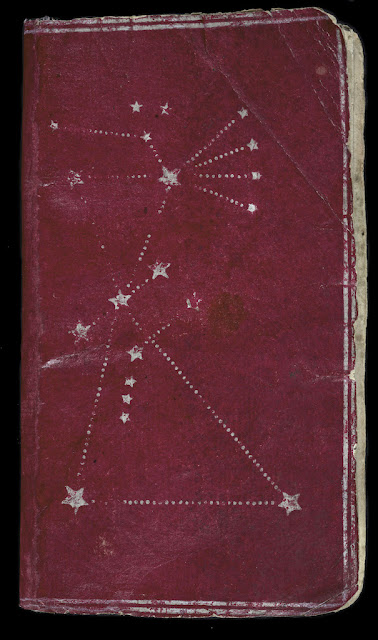
Almanach des bergers pour la Seconde Année Républicaine


Almanach des bergers pour la Seconde Année Républicaine : contenant deux méthodes faciles, l'une pour connoître l'heure de la nuit à l'aspect des étoiles, & l'autre pour connoître la position des planettes chaque jour de l'année : suivi d'un essai sur les moyens de se procurer les trésors du Perou

A Paris : Chez Pellier : et Demoraine, an deuxième de la République française [1793]

Almanac with instructions for finding the time of the night based on the stars. Each month also includes essays on astronomy. Final section includes instructions on procuring treasures of Peru by planting mulberry trees to encourage the culture of silk worms, whose silk may then be exchanged for gold. The almanac itself uses the ten new revolutionary months, with an explanation of the new calendar system. The star chart and planisphere, however, retain the traditional 12 month system. Later editions of the almanac, entitled L'horloge du labourer, have charts with the revolutionary months. The star chart and planisphere are also exceptional for joining constellations with solid or dotted lines, instead of using constellation figures. Non-pictorial star charts were thought not to occur until the nineteenth century. Cf. Nick Kanas. Star maps. Berlin ; New York : Springer, 2007

https://catalog.lib.unc.edu/catalog/UNCb8160272


Monday, January 2, 2023

Archaic Fragment


I was trying to love matter. 

I taped a sign over the mirror: 

You cannot hate matter and love form. 


It was a beautiful day, though cold. 

This was, for me, an extravagantly emotional gesture. 


.......your poem: 

tried, but could not. 


I taped a sign over the first sign: 

Cry, weep, thrash yourself, rend your garments— 


List of things to love: 

dirt, food, shells, human hair. 


....... said 

tasteless excess. Then I 


rent the signs. 


AIAIAIAI cried 

the naked mirror. 


Louise Glück 

Shepherds' Almanac


Winter Evening 2022

Acrylic, oil and gesso on wood 120 x 60 cm

120 x cm cm


Early Winter Morning, 2022 

Acrylic, oil and gesso on wood 

120 x 60 cm


#Τοημερολόγιοτωνβοσκών  #Almanachdesbergers #

#ShepherdsAlmanac #Almanac #almanach #Kalendrier #shepherds #bergers #βοσκοι #kostisvelonis  #book  #Seasons #Winter #January #

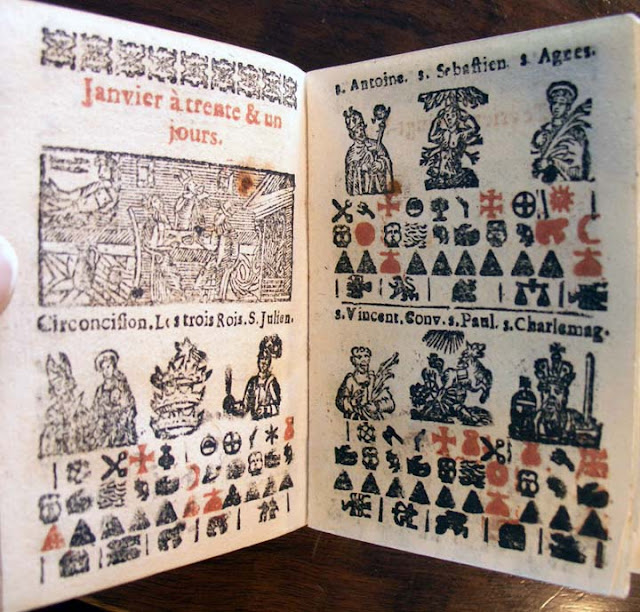
Almanach des Bergers (Shepherd’s Almanac)


Almanach des Bergers (Shepherd’s Almanac) 

pour l’année M.DCC.LIX (Liège: V. G. Barnabe, 1759)


According to the Cambridge History of English and American Literature (v. 18), the first Shepherds’ Calendar was printed in 1491 by Guyot Marchant, whose workshop was in the Latin Quarter of Paris. The work was entitled Kalendrier des Bergiers and it was the first illustrated French almanac. 

In Honoré de Balzac’s 1843 novel Illusions Perdues (Lost Illusions), the Shepherds’ almanac plays a small role: “After rummaging round the workshop Eve discovered a collection of figures required for the printing of a so-called Shepherds’ Almanac, in which objects are represented by signs, pictures, and symbols in red, black, and blue. Old Séchard, illiterate as he was, had formerly made a lot of money by printing this little book intended for equally illiterate people. An almanac of this kind costs only a penny and comprises a hundred and twenty-eight pages of very small format. Delighted at the success of her broadsheets—the sort of production which is a specialty with small provincial presses—Madame Séchard decided to print the Shepherds’ Almanac on a large scale by putting her profits into it.” (translated by Herbert James Hunt).

This book comes bound with Almanach pour cette Année M. DCC. LIX. Supputé par Mtte Mathieu Laensbergh Mathematicien (Liege: G. Barnabe, 1759); and Pronostication particuliere pour l’an de notre Seigneur 1759. Par M. Mathieu Laensbergh, Mathematicien (Liege: Guil. Barnabe, 1759); and Continuation des choses les plus remarquables arrivées par toute l’Europe & autres parties du monde, depuis le mois de Septembre de l’An 1757. jusqu’audit mois de l’An 1758 (Liege: V. G. Barnabe, 1759).

Posted by Julie L. Mellby on February 11 2011

https://www.princeton.edu/~graphicarts/2011/02/almanac.html 

Sunday, January 1, 2023

AUBADE


Εδώ δεν φτάνει ο πόλεμος· κοιτάζω:

ένας κοκκινολαίμης στο μπαλκόνι

τινάζει από πάνω του τον ύπνο

σε μια κηλίδα ήλιο κι ανασαίνουν

τα φύλλα της ελιάς μέσα στη γλάστρα

με την πνοή του αέρα· ξημερώνει.


Διονύσης Καψάλης, 2022 

Saturday, December 31, 2022

Almanach des bergers


Kostis Velonis is inspired by ephemeral shepherds’ diaries and almanacs such as forecasts and notes on astronomical and meteorological data for the coming year, as well as trivia around agricultural cultivation and rural life. In his recent large-scale sculptural installations which formed part of ‘Straw Falling on Concrete Floors’ organized by the '2023 Eleusis Cultural Capital of Europe', the artist confronted the challenges of the historical tradition of the city of Elefsina (Eleusis) through an amalgam of ecological and mythological narratives merging natural elements such as straw, animal nests and a submerged tree, with ancient Greek myths around fertility. For the exhibition 'The Shepherds' Diary', Velonis continues to pursue his interest in the interconnection between nature and culture, looking at how the erosion caused by weather elements may affect personal mood while global socio-political shifts are enforced by the climate crisis.


The gallery’s space is occupied by a large-scale sculptural installation that recreates the conditions of a gathering of shepherds consisting of hay bales and marble slabs. Much like a displaced environment in urban culture, it functions as a symbol of rural community raising questions around our relationship with nature anew. It invites the visitor to reflect upon man's connection with earth and the 'moods' of weather and to engage critically around human interaction with the natural environment. Meteorological fluctuations and the 'plasticity' of weather, the elements that make up the almanac of rural life, are mirrored here in a new series of wooden wall-works placed close to each other with references to season, month and the length of the day. Installed mainly in pairs, these aim to highlight the transition from one season to another, the succession of months and the alternation of day to night. Velonis's works return to an ongoing existential narrative related to the natural cycle of life and our relationship with earth's soil. These painting-sculptures, presented for the first time in the exhibition, reflect the artist's wider intention to formulate an artistic idiom that balances between the pastoral and the modern.


Duration:  19 November 2022 - 14 January 2023/Kalfayan Galleries 

Opening hours:

Monday 11.00 - 15:00 | Tuesday - Friday 11:00 - 19:00 | Saturday 11:00 – 15:00


Monday, November 7, 2022

Straw Falling on Concrete Floors (details)


            Thighs of Demeter, 2022 / 2.5 x 8,2 x 12 M