Monday, July 26, 2010

Governance by Everyone


Metahaven, Stadtstaat – Sozialstaat (Governance by Everyone), 2009, Poster 120x180 cm, screenprint courtesy Metahaven, Kunstlerhaus Stuttgart, and Casco Utrecht.

Sunday, July 25, 2010

Hon


Pontus Hultén Study Gallery at Moderna Museet. Based on an idea by Renzo Piano.


The cover of the folder that accompanied the Moderna Museet exhibition, showing a working drawing itemizing the interior of Hon playrooms, curated by Pontus Hulten.


Visitors to the Hon exhibition at the Moderna Museet in Stockholm, 1966.

Source : moremilkyvette.blogspot.com

The Original Copy


Bruce Nauman. Waxing Hot, from the portfolio Eleven Color Photographs. 1966–67/1970/2007. Inkjet print (originally chromogenic color print), 19 15/16 x 19 15/16" (50.6 x 50.6 cm).

The Original Copy presents a critical examination of the intersections between photography and sculpture, exploring how the one medium has been implicated in the analysis and creative redefinition of the other. The exhibition is organized by Roxana Marcoci, Curator, Department of Photography.

The advent of photography in 1839, when aesthetic experience was firmly rooted in Romanticist tenets of originality, brought into focus the critical role that the copy plays in the perception of art. But if the photograph's reproducibility challenged the aura attributed to the original, it also reflected a very personal form of perception and offered a model for dissemination that would transform the entire nature of art.

In his 1947 book Le Musée imaginaire, novelist and politician André Malraux famously advocated for a pancultural "museum without walls," postulating that art history, and the history of sculpture in particular, had become "the history of that which can be photographed." Sculpture was among the first subjects to be treated in photography. There were many reasons for this, including the immobility of sculpture, which suited the long exposure times needed with the early photographic processes, and the desire to document, collect, publicize, and circulate objects that were not always portable. Through crop, focus, angle of view, degree of close-up, and lighting, as well as through ex post facto techniques of darkroom manipulation, collage, montage, and assemblage, photographers have not only interpreted sculpture but created stunning reinventions of it.

The Original Copy looks at the ways in which photography at once informs and challenges our understanding of what sculpture is. Conceived around ten conceptual modules, the exhibition examines the rich historical legacy of photography and the aesthetic shifts that have taken place in the medium over the last 170 years through a superb selection of 300 pictures by more than 100 artists. Some, ranging from Eugène Atget and Walker Evans to Lee Friedlander and David Goldblatt, are best known as photographers; others such as Auguste Rodin, Constantin Brancusi and David Smith, are best known as sculptors; and others, ranging from Hannah Höch and Sophie Taeuber-Arp, to contemporaries such as Bruce Nauman, Fischli/Weiss, Rachel Harrison, and Cyprien Gaillard, are too various to categorize but exemplify how fruitfully and unpredictably photography and sculpture have combined.


Sibylle Bergemann. Das Denkmal, East Berlin (The Monument, East Berlin). 1986. Gelatin silver print, 19 11/16 x 23 5/8" (50 x 60 cm).

The exhibition will travel to Kunsthaus Zürich, where it will be on view from February 25 through May 15, 2011.
The Original Copy:
Photography of Sculpture,
1839 to Today
August 1 – November 1, 2010
The Museum of Modern Art, NY

Wednesday, July 21, 2010

Volax


Landscape with huge granite boulder formations around Volax village in Tinos Island, Greece. 2010

Thursday, July 15, 2010

Vila Hermina


Vila Hermina
since 2008 in construction
authors Petr Hajek, Tomas Hradecny, Jan Sepka

The building is situated on a sloping terrain on the outskirts of Cernin, taking the same slope into its internals for floors. The interior layout is based on alternating straight and sloping floor surfaces that create the overall spiralling character of the interior and define the building’s external appearance. However, the use of the sloping floor on the ground floor is not purposeless – it is there on investor/s reguest to accomodate movie projections as a small movie theatre. Windows and other openings are placed with respect of the external facade – each of the walls only has one opening. For thermal and water insulation a polyurethane spray with pink coat is used, meant as a credit to our favourite building of Versuchsanstalt fur Wasserbau und Schiffbau by Ludwig Leo.

Source: www.hsharchitekti.cz

Die Alpen


Jahr/Year 1930 Die Alpen - The Alps

Oberammergauer Holzschnitzerwerkstatt
Alois Lang
Christusdarsteller der Passionsspiele 1930

Wood-Carver's Workshop in Oberammergau
Alois Lang, the Representator of Christ in the Passion's Play 1930

Jesus, Jesus, Jesus

In the late 1950s, three men who identified as the Son of God were forced to live together in a mental hospital. What happened?


In the late 1950s, psychologist Milton Rokeach was gripped by an eccentric plan. He gathered three psychiatric patients, each with the delusion that they were Jesus Christ, to live together for two years in Ypsilanti State Hospital to see if their beliefs would change. The early meetings were stormy. "You oughta worship me, I'll tell you that!" one of the Christs yelled. "I will not worship you! You're a creature! You better live your own life and wake up to the facts!" another snapped back. "No two men are Jesus Christs. … I am the Good Lord!" the third interjected, barely concealing his anger.

Frustrated by psychology's focus on what he considered to be peripheral beliefs, like political opinions and social attitudes, Rokeach wanted to probe the limits of identity. He had been intrigued by stories of Secret Service agents who felt they had lost contact with their original identities, and wondered if a man's sense of self might be challenged in a controlled setting. Unusually for a psychologist, he found his answer in the Bible. There is only one Son of God, says the good book, so anyone who believed himself to be Jesus would suffer a psychological affront by the very existence of another like him. This was the revelation that led Rokeach to orchestrate his meeting of the Messiahs and document their encounter in the extraordinary (and out-of-print) book from 1964, The Three Christs of Ypsilanti.

Although by no means common, Christ conventions have an unexpectedly long history. In his commentary to Cesare Beccaria's essay "Crimes and Punishments," Voltaire recounted the tale of the "unfortunate madman" Simon Morin who was burnt at the stake in 1663 for claiming to be Jesus. Unfortunate it seems, because Morin was originally committed to a madhouse where he met another who claimed to be God the Father, and "was so struck with the folly of his companion that he acknowledged his own, and appeared, for a time, to have recovered his senses." The lucid period did not last, however, and it seems the authorities lost patience with his blasphemy. Another account of a meeting of the Messiahs comes from Sidney Rosen's book My Voice Will Go With You: The Teaching Tales of Milton H. Erickson. The renowned psychiatrist apparently set two delusional Christs in his ward arguing only for one to gain insight into his madness, miraculously, after seeing something of himself in his companion. ("I'm saying the same things as that crazy fool is saying," said one of the patients. "That must mean I'm crazy too.")
These tales are surprising because delusions, in the medical sense, are not simply a case of being mistaken. They are considered to be pathological beliefs, reflecting a warped or broken understanding that is not, by definition, amenable to being reshaped by reality. One of most striking examples is the Cotard delusion, under which a patient believes she is dead; surely there can be no clearer demonstration that simple and constant contradiction offers no lasting remedy. Rokeach, aware of this, did not expect a miraculous cure. Instead, he was drawing a parallel between the baseless nature of delusion and the flimsy foundations we use to construct our own identities. If tomorrow everyone treats me as if I have an electronic device in my head, there are ways and means I could use to demonstrate they are wrong and establish the facts of the matter—a visit to the hospital perhaps. But what if everyone treats me as if my core self were fundamentally different than I believed it to be? Let's say they thought I was an undercover agent—what could I show them to prove otherwise? From my perspective, the best evidence is the strength of my conviction. My belief is my identity.

In one sense, Rokeach's book reflects a remarkably humane approach for its era. We are asked to see ourselves in the psychiatric patients, at a time when such people were regularly locked away and treated as incomprehensible objects of pity rather than individuals worthy of empathy. Rokeach's constant attempts to explain the delusions as understandable reactions to life events require us to accept that the Christs have not "lost contact" with reality, even if their interpretations are more than a little uncommon.

But the book makes for starkly uncomfortable reading as it recounts how the researchers blithely and unethically manipulated the lives of Leon, Joseph, and Clyde in the service of academic curiosity. In one of the most bizarre sections, the researchers begin colluding with the men's delusions in a deceptive attempt to change their beliefs from within their own frame of reference. The youngest patient, Leon, starts receiving letters from the character he believes to be his wife, "Madame Yeti Woman," in which she professes her love and suggests minor changes to his routine. Then Joseph, a French Canadian native, starts receiving faked letters from the hospital boss advising certain changes in routine that might benefit his recovery. Despite an initially engaging correspondence, both the delusional spouse and the illusory boss begin to challenge the Christs' beliefs more than is comfortable, and contact is quickly broken off.

In fact, very little seems to shift the identities of the self-appointed Messiahs. They debate, argue, at one point come to blows, but show few signs that their beliefs have become any less intense. Only Leon seems to waver, eventually asking to be addressed as "Dr Righteous Idealed Dung" instead of his previous moniker of "Dr Domino dominorum et Rex rexarum, Simplis Christianus Puer Mentalis Doctor, reincarnation of Jesus Christ of Nazareth." Rokeach interprets this more as an attempt to avoid conflict than a reflection of any genuine identity change. The Christs explain one another's claims to divinity in predictably idiosyncratic ways: Clyde, an elderly gentleman, declares that his companions are, in fact, dead, and that it is the "machines" inside them that produce their false claims, while the other two explain the contradiction by noting that their companions are "crazy" or "duped" or that they don't really mean what they say.

In hindsight, the Three Christs study looks less like a promising experiment than the absurd plan of a psychologist who suffered the triumph of passion over good sense. The men's delusions barely shifted over the two years, and from an academic perspective, Rokeach did not make any grand discoveries concerning the psychology of identity and belief. Instead, his conclusions revolve around the personal lives of three particular (and particularly unfortunate) men. He falls back—rather meekly, perhaps—on the Freudian suggestion that their delusions were sparked by confusion over sexual identity, and attempts to end on a flourish by noting that we all "seek ways to live with one another in peace," even in the face of the most fundamental disagreements. As for the ethics of the study, Rokeach eventually realized its manipulative nature and apologized in an afterword to the 1984 edition: "I really had no right, even in the name of science, to play God and interfere round the clock with their daily lives."

Although we take little from it scientifically, the book remains a rare and eccentric journey into the madness of not three, but four men in an asylum. It is, in that sense, an unexpected tribute to human folly, and one that works best as a meditation on our own misplaced self-confidence. Whether scientist or psychiatric patient, we assume others are more likely to be biased or misled than we are, and we take for granted that our own beliefs are based on sound reasoning and observation. This may be the nearest we can get to revelation—the understanding that our most cherished beliefs could be wrong.

Text by Vaughan Bell

Source : www.slate.com

Monday, July 12, 2010

Affiche pour un droit inaliénable à l'IVG


Affiche pour un droit inaliénable à l'IVG
Source : http://imaginaction.over-blog.org

Friday, July 9, 2010

Civitas Veri

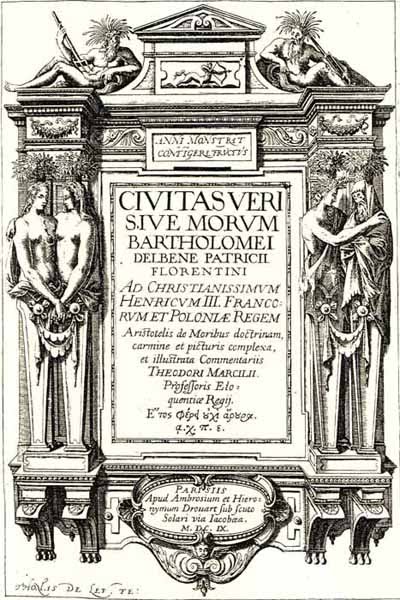
In Paris, in 1609, the printers Ambroise and Jérôme Drouart published a volume entitled Civitas Veri sive Morum (‘The City of Truth; or, Ethics’) on behalf of the recently-deceased Alphonse (or Alfonso) Del Bene (or Delbene: ca. 1538-1608), who had been bishop of Albi. The book comprised an allegorical, philosophical poem in Latin written by Alphonse’s uncle Barthélémy (or Bartolomeo) Del Bene (1515-1595), with a commentary and notes by the humanist scholar Théodore Marcile (1548-1617). Marcile’s introduction bears the date 1585, and it is likely that Del Bene’s verse was written earlier still, at some time in the 1560s, or early 1570s.


The text is illustrated by a few dozen curious engravings: it is not known whether versions of these images adorned Del Bene’s or Marcile’s manuscripts, or whether they were added later by the Drouarts. The decorated title-page was designed by a Dutch-born engraver named Thomas de Leu, so it is quite possible the remainder of the engravings were his work too; although Mario Praz, in mentioning Civitas Veri in his ‘Studies in Seventeenth-Century Literature,’ likens them to the emblems in Jan David’s Veridicus Christianus, which were apparently executed by Théodore Galle.


Del Bene’s poem is an allegorical recasting of Aristotle’s Nichomachean Ethics. It describes a month-long spiritual journey undertaken by his patroness, Marguerite, Duchess of Savoy, who travels through the City of Truth, from its five portals (one for each of the senses: see, for example, the portals of smell and taste, in the details above) through its various palaces, gardens, etc., to the five temples at its heart, culminating in visits to the Temple of Intelligence (where she meets and converses with Aristotle himself) and the Temple of Wisdom.


Del Bene’s City of Truth is presented as both a microcosm, and as an idealised locale, after the fashion of Thomas More’s Utopia and Kaspar Stiblin’s De Eudæmonensium Republica; and anticipating aspects of later works such as Johann Valentin Andreae’s Christianopolis,, Tommaso Campanella’s Civitas Sole, (‘City of the Sun’) and Bacon’s New Atlantis. The image above shows a detail of an elevated view of the City of Truth in its totality, which I spliced together from a pair of engravings on facing pages of the book.


I learned of the existence of Del Bene’s opus by way of an eye-catching engraving reproduced in John Manning’s book The Emblem: this was the depiction of ‘The Palace of Intemperance’—part of which is shown in the detail immediately above, wherein ‘Intemperance sits in a myrtle grove […] where she is regaled by Cupid and Bacchus. She spurns Right Reason under her naked foot. Before her are prepared three tables: one consecrated to Gluttony, the next to cures for her inevitable hangover, the last is furnished with incitements to Lust… An open grave lies at the foot of the plate.’ This was opposed to the altogether more seemly ‘Palace of Temperance’ as detailed in the first of two the images above.

The poem’s protagonist, Marguerite de France (or Marguerite de Valois), Duchesse de Berry, afterwards Duchesse de Savoie, 1523-74, was the youngest daughter of king François I., and sister to King Henri II. She was intellectually accomplished; conversant in Latin, Greek and Italian; and a defender at court of the Pleiade poets, in particular of Pierre de Ronsard. Praised as a new Minerva, she was seen as a successor to her aunt & namesake, Marguerite de Navarre (or Marguerite d’Angoulême), renowned author of the Heptameron.


Del Bene had entered Marguerite’s service as her secretary in 1554. Five years later, when, at the unusually late age of 36, she was married to Emmanuel-Philibert, Duc de Savoie, he moved with her to the ducal court at Turin. After Marguerite’s death, De Bene returned to the court of Henri III. of France, and was thereafter ‘charged several times with confidential missions for Emmanuel-Philibert and Catherine de Médicis’ (Henri’s mother). Besides his Civitas Veri, he wrote other Latin and Italian poetry, well-esteemed in his day.


The images above are details of scans from a reprint edition of Civitas Veri published in 2003 by Librissimo / Phénix Éditions, apparently exclusively distributed by alapage.com.


Source : Giornale Nuovo, www.spamula.net/blog

Friday, July 2, 2010

The Parallel Universe

At that time Superman was known as extremely friendly.
He would greet politely at the breakfast table,
pass the sugar when asked
and enjoy the breaktaking panorama.
He would play old music when making decisions
and afterwards phone his mother.

Until the night the windows of his birthplace were smashed
his balloon face hung like a boy's dream
throughout the town.
He asked: take pity on my situation,
but had to wave his fists
to keep people's attention.

He became The Great Absentee. He would sneak in
and sit on the back row of theatres
and roar for another encore, or grin for minutes on end
at women in the lift via mirrors
and bide his time.

He has done marvels by leaning forward
at unguarded moments
and whispering something into an ear,
by adding moustaches to unknown people's photos
in the scrapbooks he took with him to auditions.

He could actually fly. Whenever he felt bored
he simply rented a couple of comic films.

Alfred Schaffer
Translation: 2004, John Irons

Het evenwijdig universum

In die tijd stond Superman bekend als uiterst vriendelijk.
Aan de ontbijttafel groette hij beleefd,
gaf desgewenst de suiker door
en genoot van het adembenemende panorama.
Hij speelde oude muziek als hij besluiten maakte
en belde daarna zijn moeder.

Tot de nacht dat de ramen van zijn geboortehuis werden ingegooid
hing zijn ballongezicht als in een jongensdroom
door de hele stad.
Hij vroeg: heb medelijden met mijn situatie,
maar moest met zijn vuist zwaaien
om de aandacht vast te houden.

Hij werd De Grote Afwezige. In het geniep
zat hij op de achterste rij van theaters
en brulde om nog een toegift, of grijnsde minutenlang
naar vrouwen in de lift via spiegels
en wachtte zijn kansen af.

Wonderen heeft hij verricht door op onbewaakte momenten
voorover te buigen
en iets in een oor te fluisteren,
door snorren te tekenen op foto's van onbekenden
in de plakboeken die hij meenam naar audities.

Hij kon werkelijk vliegen. Wanneer hij zich verveelde
huurde hij doodgewoon een paar lachfilms.

2002, Alfred Schaffer
From: Dwaalgasten
Publisher: Thomas Rap, Amsterdam, 2002

Thursday, July 1, 2010

Usine occupée


Usine occupée
2010
201 x 32 x 85 cm
Wood, acrylic, varnish

iMarx Manifesto

The factory workers of Foxconn in China being forced to the edge of suicide will take little comfort from this, and it's certainly not what Karl Marx had in mind when he said the bourgeoisie creates its own gravediggers.


However, Apple's decision to free distribute free copies of The Communist Manifesto to millions of iPhone owners seems a curious twist as the firm now makes $5.7 billion in profits on annual turnover of $36.5 billion by exploiting cheap, ununionised workers in China.


Owners of the iPhone with the latest iOS4 can download iBooks without charge - allowing them to download the Communist Manifesto for free. The world's best selling political publication can be copied, pasted, highlighted and annotated.

The Condition of the Working-Class in England in 1844 by Friedrich Engels, Marx's sponsor, editor and closest associate - is also available for free. Marx's The Eighteenth Brumaire of Louis Bonaparte and Selected Essays are also free, along with selected extracts of Das Capital.

Lenin's State and Revolution has also gone on sale at £9.49 while the only Trotsky publication is An Appeal to the Toiling, Oppressed and Exhausted People's of Europe - a timely launch of the ebook - at £4.49. It would be interesting to know if this edition is available in China

Source: http://atthesauce.blogspot.com

Vanity Fairs

Shanghai Expo 2010 is the most recent incarnation of the Great Exhibitions that began in London in 1851


Bjarke Ingels Group, The Danish Pavilion for the Shanghai Expo, 2010
Douglas Murphy

A writer based in London, UK. He blogs at youyouidiot.blogspot.com. His first book, The Architecture of Failure (Zer0 Books) is forthcoming.

The Shanghai Expo marks the strange return to prominence of what had seemed to be a dead architectural tradition. Expos, or, as they were originally called, Great Exhibitions, Expositions Universelles or World Fairs, were huge temporary pageants dedicated to the notion of progress, but the last few generations have witnessed their slow decline into near insignificance. They have been the source of a great many of our most memorable architectural images, which is remarkable considering their highly ephemeral nature.

The very first world exhibition was the ‘Great Exhibition of the Works of Industry of All Continents’, held in London in 1851. It was organized, in the words of Prince Albert, ‘to give us a true test and a living picture of the point of development at which the whole of mankind has arrived’. The exhibition building, the Crystal Palace, was a gigantic crystalline web of mass-produced iron and glass, a vast display cabinet containing over 100,000 exhibits, ranging from industrial machinery to raw materials, from fabrics to furniture. More than six million people visited the exhibition in six months; it was one of the most significant early moments in mass culture.

On the one hand the Great Exhibition was a way of symbolically demonstrating Britain’s lead in the industrial race, but at the same time it was an event that was born from ruling-class anxieties about insurgency; conceived in the wake of the failed European revolutions of 1848 and the Chartists revolt, the Exhibition was partly designed to promote class harmony through distraction. Many opposed it on the grounds that it was a target for revolutionaries, but not only did the red hordes fail to materialize, the exhibition united the clashing aristocracy and bourgeoisie behind the banner of free trade, inaugurating a new regime of spectacular capitalism – Walter Benjamin wrote that at the Great Exhibition, ‘the masses, barred from consuming, learned empathy with exchange value’. At the same time, however, revolutionaries would see in the Crystal Palace a symbol of the future just society.

Both Paris and New York would hold their own exhibitions within the following five years, and they would soon be repeated the world over. The iron and glass architecture that accommodated these events reached its apotheosis at the 1889 Paris Exposition with the construction of the Galerie des Machines (the world’s largest room) and the Eiffel Tower, which was and would remain the world’s tallest structure for the next 40 years. But the revolutionary architecture of the exhibitions was soon subjected to a bourgeois aesthetic reaction – the 1893 World’s Columbian Exposition was entirely draped in beaux-arts frippery, prompting American Modernist architect Louis Sullivan to exclaim: ‘The damage wrought by the World’s Fair will last for half a century from its date, if not longer.’

Despite the wider rejection of the aesthetics heralded by the early Exhibitions, the Expos themselves were still opportunities to display the most modern styles. The 1900 Paris Exposition marked the brief flowering of Art Nouveau, still visible in the ironwork of Hector Guimard’s Métro stations, while early streams of Modernism were also prominently visible. Le Corbusier’s Pavilion de l’Esprit Nouveau was included in the 1925 Paris Exposition, along with the incredible Soviet Pavilion by Konstantin Melnikov, while Ludwig Mies van der Rohe’s seminal Barcelona Pavilion was the German Pavilion for the 1929 World Exhibition held in the Spanish city.

Although they were inextricably linked to ‘progress’, the Expos could also be scenes of tragic regression. There is hardly a more poignant architectural image than that of the 1937 Paris Exposition, postcards of which show the ghastly kitsch of Albert Speer’s German Pavilion and Boris Iofan’s Soviet Pavilion practically head-butting each other across the Champs de Mars, as the Eiffel Tower looks down sadly, its Utopia in peril. At the same Expo, in the Republican Spanish Pavilion, Picasso’s Guernica (1937) was hung for the first time.

After World War ii, the Great Exhibitions never attained the same level of cultural prominence that they had before; the immaterial qualities of both electronic media and atomic science did not lend themselves to large-scale spectacles of this type. Nevertheless Expos would continue, occasionally still creating seminal works of architecture; Le Corbusier and Iannis Xenakis’ Philips Pavilion from the 1958 Brussels World’s Fair, for example, was a unique, immersive audio-visual environment without equal. Generally however the tendency was that of decline, with some Expo sites even turning into futuristic ruins. The sight of Buckminster Fuller’s geodesic dome from Montreal 1967 transformed into an overgrown skeleton after a fire in 1976, or mvrdv’s now dilapidated Dutch Pavilion from Hannover 2000, is uncanny; the disappearance of something that hadn’t had a chance to properly arrive.

The cultures that the Expos gave original spatial form to are now so ubiquitous as to be almost invisible; both vast shopping malls and super-museums (supermarkets of culture) are typologies that were first accommodated in Great Exhibition buildings. With this in mind the Shanghai Expo seems anachronistic, an old fashioned spectacle of a kind that no longer has purpose – the presentation-as-new of old space. But this is strangely appropriate: the architecture of the Shanghai Expo, its individualism and flamboyance, is eclectic in a way that is almost Victorian in its stylistic incoherence.

Text by Douglas Murphy
Source : www.frieze.com

Friday, June 25, 2010

Moroseness


Jean-Jacques Feuchere
Satan, circa 1836

Thursday, June 24, 2010

Angels Of The Love Affair

"Angels of the love affair, do you know that other,
the dark one, that other me?"

1. ANGEL OF FIRE AND GENITALS

Angel of fire and genitals, do you know slime,
that green mama who first forced me to sing,
who put me first in the latrine, that pantomime
of brown where I was beggar and she was king?
I said, "The devil is down that festering hole."
Then he bit me in the buttocks and took over my soul.
Fire woman, you of the ancient flame, you
of the Bunsen burner, you of the candle,
you of the blast furnace, you of the barbecue,
you of the fierce solar energy, Mademoiselle,
take some ice, take come snow, take a month of rain
and you would gutter in the dark, cracking up your brain.

Mother of fire, let me stand at your devouring gate
as the sun dies in your arms and you loosen it's terrible weight.


2. ANGEL OF CLEAN SHEETS

Angel of clean sheets, do you know bedbugs?
Once in the madhouse they came like specks of cinnamon
as I lay in a choral cave of drugs,
as old as a dog, as quiet as a skeleton.
Little bits of dried blood. One hundred marks
upon the sheet. One hundred kisses in the dark.
White sheets smelling of soap and Clorox
have nothing to do with this night of soil,
nothing to do with barred windows and multiple locks
and all the webbing in the bed, the ultimate recoil.
I have slept in silk and in red and in black.
I have slept on sand and, on fall night, a haystack.

I have known a crib. I have known the tuck-in of a child
but inside my hair waits the night I was defiled.


3. ANGEL OF FLIGHT AND SLEIGH BELLS

Angel of flight and sleigh bells, do you know paralysis,
that ether house where your arms and legs are cement?
You are as still as a yardstick. You have a doll's kiss.
The brain whirls in a fit. The brain is not evident.
I have gone to that same place without a germ or a stroke.
A little solo act--that lady with the brain that broke.

In this fashion I have become a tree.
I have become a vase you can pick up or drop at will,
inanimate at last. What unusual luck! My body
passively resisting. Part of the leftovers. Part of the kill.
Angels of flight, you soarer, you flapper, you floater,
you gull that grows out of my back in the dreams I prefer,

stay near. But give me the totem. Give me the shut eye
where I stand in stone shoes as the world's bicycle goes by.


4. ANGEL OF HOPE AND CALENDARS

Angel of hope and calendars, do you know despair?
That hole I crawl into with a box of Kleenex,
that hole where the fire woman is tied to her chair,
that hole where leather men are wringing their necks,
where the sea has turned into a pond of urine.
There is no place to wash and no marine beings to stir in.

In this hole your mother is crying out each day.
Your father is eating cake and digging her grave.
In this hole your baby is strangling. Your mouth is clay.
Your eyes are made of glass. They break. You are not brave.
You are alone like a dog in a kennel. Your hands
break out in boils. Your arms are cut and bound by bands

of wire. Your voice is out there. Your voice is strange.
There are no prayers here. Here there is no change.


5. ANGEL OF BLIZZARDS AND BLACKOUTS

Angle of blizzards and blackouts, do you know raspberries,
those rubies that sat in the gree of my grandfather's garden?
You of the snow tires, you of the sugary wings, you freeze
me out. Leet me crawl through the patch. Let me be ten.
Let me pick those sweet kisses, thief that I was,
as the sea on my left slapped its applause.

Only my grandfather was allowed there. Or the maid
who came with a scullery pan to pick for breakfast.
She of the rolls that floated in the air, she of the inlaid
woodwork all greasy with lemon, she of the feather and dust,
not I. Nonetheless I came sneaking across the salt lawn
in bare feet and jumping-jack pajamas in the spongy dawn.

Oh Angel of the blizzard and blackout, Madam white face,
take me back to that red mouth, that July 21st place.


6. ANGEL OF BEACH HOUSES AND PICNICS

Angel of beach houses and picnics, do you know solitaire?
Fifty-two reds and blacks and only myself to blame.
My blood buzzes like a hornet's nest. I sit in a kitchen chair
at a table set for one. The silverware is the same
and the glass and the sugar bowl. I hear my lungs fill and expel
as in an operation. But I have no one left to tell.

Once I was a couple. I was my own king and queen
with cheese and bread and rosé on the rocks of Rockport.
Once I sunbathed in the buff, all brown and lean,
watching the toy sloops go by, holding court
for busloads of tourists. Once I called breakfast the sexiest
meal of the day. Once I invited arrest

at the peace march in Washington. Once I was young and bold
and left hundreds of unmatched people out in the cold.

Anne Sexton

Monday, June 21, 2010

The Museum Revisited


Ines Doujak, Sin título, 2002, color photograph. From “How Do We Want to Be Governed?”

IT IS BY PUTTING THE MUSEUM in the context of radical democratic politics that I wish to address the question of its role today, considering in particular ways in which art institutions could foment new subjectivities critical of neoliberal consensus. More generally, I want to take issue with the negative way public institutions are perceived by the mode of radical critique fashionable today: Celebrating “desertion” and “exodus,” to use the terminology of Michael Hardt and Antonio Negri—whose writing recently appeared in these pages—such critique asserts that political action should withdraw from existing institutions so that we might free ourselves from all forms of belonging. Institutional attachments are presented here as obstacles to new, nonrepresentative forms of “absolute democracy” suitable for the self-organization of the multitude. Yet such an approach forecloses any immanent critique of institutions—critique with the objective of transforming institutions into a terrain of contestation of the hegemonic order. Instead, all institutions are perceived as monolithic representatives of forces to be destroyed, every attempt to transform them dismissed as reformist illusion. The very possibility of disarticulating their constitutive elements, with the aim of establishing a different power configuration, is precisely what is rejected by the exodus approach.

In the artistic and cultural domain, this perspective suggests that critical artistic practices can have efficacy only if they take place outside cultural institutions. To imagine that museums, for instance, could provide sites for critical political intervention today is, according to such a view, to be blind to the manifold of forces—economic and political—that make their very existence possible. The strategy, here again, is to ignore them and occupy other spaces, outside the institutional field. But endorsing this course of action is, in my view, profoundly mistaken and clearly disempowering, because it impedes us from recognizing the multiplicity of avenues that would otherwise be open for political engagement. Indeed, it is to ignore the tensions that always exist within a given configuration of forces and the possibility of subverting their form of articulation. By contrast, I am convinced that fostering a strategy of “engagement with institutions” is absolutely crucial for envisioning democratic politics today. We must acknowledge that what is called “the social” is the realm of sedimented political practices—practices that conceal the originary acts of their contingent political institution—but recognize as well that such moments of political institution can always be reactivated. Every order is predicated on the exclusion of other possibilities, but as the temporary and precarious articulation of contingent practices, each order is always the expression of a particular structure of power relations. Things could have been otherwise. And so every hegemonic order is susceptible to being challenged.

The success of counterhegemonic practices depends on an adequate understanding of the relations of forces structuring the key institutions in which the political antagonist is going to intervene. With respect to artistic and cultural practices, then, counterhegemonic interventions must first and foremost recognize the role of the culture industry in capitalism’s transition to post-Fordism. To mention just a few familiar yet central features of the current dispensation: the blurring of the lines between art and advertising, the exponential development of “creative industries” dominated by the media and entertainment corporations, and the reduction of cultural institutions into entertainment centers—all these can only be understood in the context of the post-Fordist stage of capitalism. Today’s capitalism relies increasingly on semiotic techniques to create the modes of subjectification necessary for its reproduction, and cultural production plays a central role in the process of valorizing capital. The old forms of exploitation, characteristic of the times when manual labor was dominant, have been replaced by new ones that call for the incessant creation of needs and insatiable desires for the acquisition of goods. They rely on the joint forces of advertising and the “creative industries” for producing fantasy worlds through which the identity of the consumer is constructed. To buy something today is to gain entrance into a specific world, to identify with a certain culture, to become part of an imagined community. To maintain its hegemony, the neoliberal system needs to permanently mobilize people’s desires and shape their identities, and the cultural terrain, with its various institutions, occupies a strategic place in this absolutely vital process of commodification and subjectification. To challenge this system, a counterhegemonic politics must engage this terrain and target the forms of identification that are the conditions for the reproduction of post-Fordist capitalism. Thus, the museum—far from being an institution to be deserted posthaste—becomes a crucial site of political contestation.

How to visualize the future of the museum within such a framework? Could the institution contribute to undermining the imaginary environment of the consumer society? To be sure, the history of the museum has been linked since its beginning to the construction of bourgeois hegemony, but in my view this function can be altered. As Wittgenstein has taught us, signification is always dependent on context, and use determines meaning. This is also true for institutions, and we should discard the essentialist idea that some institutions are destined to fulfill one immutable function. In fact, we have already witnessed how, following the neoliberal trend, many museums have abandoned their original purpose of educating citizens into the dominant culture and have instead transformed themselves into sites of entertainment for a public of consumers. The main objective of those “postmodern” museums is to make money through blockbuster exhibitions and the sale of merchandise to tourists. The type of “participation” they promote is based on consumerism, and they actively contribute to the commercialization and depoliticization of the cultural field.

However, this neoliberal turn is not the only possible form of evolution open to the museum; another path can be envisaged, leading in a progressive direction. There may have been a time when it would have made sense to abandon the museum in order to nurture the development of novel artistic practices. But under present conditions, with the art world almost totally colonized by the market, the museum could become—indeed is uniquely positioned to become—a sanctuary from commercial interests. As several theorists have pointed out, the museum, which has been stripped of its normative role, might now be seen as a privileged place for artworks to be presented in a context that allows them to be distinguished from commodities. Visualized in such a way, the museum would offer spaces for resisting the effects of the growing commercialization of art.¹

To rethink the function of the museum along those lines would be a first step toward envisaging the institution as a possible site for countering the dictatorship of the global media market. It is interesting to note that such a move dovetails with other attempts to reclaim public institutions targeted by neoliberalism in recent years. Think, for instance, of the change of attitude of a part of the European Left with respect to the institutions of the welfare state, whose bureaucratic nature they used to criticize. This was no doubt a justified critique, but in the wake of the dismantling of these institutions by neoliberal governments, many people have begun to realize that they also constituted important forms of protection against market forces, and that their privatization has not represented a democratic advance. Similar considerations could be made with respect to the role of the state, which, after years of being demonized, has recently been reevaluated. The conclusion to draw from this new perception of the nature of public institutions is that, instead of celebrating the destruction of all institutions as a move toward liberation, the task for radical politics is to engage with them, developing their progressive potential and converting them into sites of opposition to the neoliberal market hegemony.

As far as museums are concerned, already one can point to several successful examples of this strategy of “engagement with” that I am proposing. One of the best known is the Museu d’Art Contemporani de Barcelona, which, under the direction of Manuel Borja-Villel (who now heads the Reina Sofía in Madrid), succeeded in creating a new model of museum.² Between 2000 and 2008, MACBA launched various projects informed by critical pedagogy to recover the educational role of the museum and to reestablish the institution as a constituent part of the public sphere. With the aim of proposing an alternative reading of modern art, MACBA began developing a collection and organizing exhibitions privileging artists and art scenes typically neglected by the dominant discourse on artistic modernity. Among the many notable shows the museum mounted during this period were “Philippe Thomas: Readymades Belong to Everyone” (2000); “Art and Utopia: Restricted Action” (2004); “A Theatre Without Theatre” (2007); and “Be-Bomb: The Transatlantic War of Images and All That Jazz. 1946–1956” (2007–2008). Another of MACBA’s objectives was to establish a vibrant relationship between the museum and the city and to provide a space for debate and conflict. Looking for ways in which art could make a significant contribution to the multiplication of public spheres, MACBA encouraged contact between different social movements. For example, “Of Direct Action Considered as One of the Fine Arts,” a series of workshops organized in 2000 (and coordinated by Jordi Claramonte), brought together artists’ collectives and social movements to explore possibilities for connecting local political struggles with artistic practices. Workshops were organized around topics such as precarious labor, borders and migrations, gentrification, new media, and emancipatory strategies. A further example of collaboration with the new social movements was the “How Do We Want to Be Governed?” project, which was conceived as a countermodel to the Universal Forum of Cultures launched by the city council of Barcelona in 2004. While taking culture as an alibi, the real objective of the government forum, critics argued, was to promote a major urban renewal project planned for the city’s seafront—to pave the way, in other words, for a massive real estate deal. Organized by Roger M. Buergel (then a curator at MACBA), “How Do We Want to Be Governed?” presented a series of exhibitions and public programs—talks, colloquia, screenings, performances, and debates—in venues within the industrial zones and working-class neighborhoods scheduled for demolition or radical reconfiguration. It was an exhibition in process, combining artistic work and social dynamics and providing a platform for various neighborhood movements.

The program at MACBA since the turn of the millennium represents a radical alternative to both the modern and the postmodern museum, but many other types of initiatives are worth mentioning. Of particular interest in this regard is the recently established consortium L’Internationale, a long-term collaboration among five progressive European art institutions—the Moderna Galerija in Ljubljana, Slovenia; the Július Koller Society in Bratislava, Slovakia; MACBA; the Van Abbemuseum in Eindhoven, the Netherlands; and the Museum van Hedendaagse Kunst Antwerpen (MUHKA) in Belgium—seeking to collectively use their collections and archives to challenge art-historical master narratives and to construct multiple alternative, transnational narratives. L’Internationale’s proposed network is only now in its first stages, and needs to be enriched by partners outside Europe, but it suggests a promising way for art institutions to join together in the ongoing struggle against the hegemonic discourse.

What is really at stake in this debate about ways to deal with institutions such as the museum is the political and its relation with artistic practices. The modernist view, which postulates a structural affinity between the political and the artistic avant-garde, needs to be relinquished. Its claim that the radical move consists in destruction and radical negation of tradition and that it requires exit from all institutions, political as well as artistic, is not suitable for the task facing radical politics today. As Luc Boltanski and Ève Chiapello persuasively demonstrated in The New Spirit of Capitalism (1999/2005), the managerial class successfully co-opted the various demands for autonomy of social movements that arose in the 1960s, harnessing them only to secure the conditions required by the new, postindustrial mode of capitalist regulation. Capital was able, they showed, to neutralize the subversive potential of the aesthetic strategies and ethos of the counterculture—the search for authenticity, the ideal of self-management, and the antihierarchical imperative—transforming them from instruments of liberation into new forms of control that would ultimately replace the disciplinary framework of the Fordist period. To this hegemonic move by capital, it is urgent to oppose a counterhegemonic one, which opposes the program of total social mobilization of capitalism. Instead of deserting public institutions, we must find ways to use them to foster political forms of identification and make existing conflicts productive. By staging a confrontation between conflicting positions, museums and art institutions could make a decisive contribution to the proliferation of new public spaces open to agonistic forms of participation where radical democratic alternatives to neoliberalism could, once again, be imagined and cultivated.

Text by Chantal Mouffe
Professor of Political Theory, University of Westminster

NOTES

1. See, e.g., Boris Groys, “The Logic of Equal Aesthetic Rights” in his Art Power (Cambridge, MA: MIT Press, 2008), pp. 13–22.

2. An excellent overview of the activities of MACBA during those years is found in Jorge Ribalta, “Experiments in a New Institutionality,” in Relational Objects, MACBA Collections 2002–2007 (Barcelona: MACBA Publications, 2010).

Source: Art Forum Magazine, Summer 2010

Monday, June 14, 2010

Las Vegas Studio: Images From the Archive of Robert Venturi and Denise Scott Brown


Studies of Billboards, Office of Venturi and Rauch Architects, Philadelphia,1968


Fremont Street, Las Vegas, 1968


Stardust Hotel and Casino, Las Vegas, 1968


Las Vegas strip,1966


In 1968, American architects Robert Venturi, Denise Scott Brown, and Steven Izenour, together with students from Yale University, made the city of Las Vegas the object of their study. Their findings, published in the 1972 book, Learning from Las Vegas, are legendary, extending the categories of the ordinary, the ugly, and the social into architecture. Offering great insight into the creation of this groundbreaking publication, Las Vegas Studio: Images from the Archives of Robert Venturi and Denise Scott Brown presents original research materials from the archives of Venturi Scott Brown Associates, including over 80 photographs and a selection of films shot during the authors' research that were a crucial aspect of their architectural study. Las Vegas Studio: Images from the Archives of Robert Venturi and Denise Scott Brown is curated by Martino Stierli and Hilar Stadler in collaboration with artist Peter Fischli. MOCA's presentation, organized by MOCA Curator Philipp Kaiser, follows presentations at Museum im Bellpark, Kriens, Switzerland; Deutsches Architekturmuseum, Frankfurt, Germany; and Yale School of Architecture, Connecticut.

Las Vegas Studio: Images From the Archive of Robert Venturi and Denise Scott Brown is organized by The Museum im Bellpark, Kriens.
03.21.10 - 06.20.10
MOCA Pacific Design Center
Source: Moca.org

"How one Can Think Freely in the Shadow of a Temple" Pop Up Catalog


"How one Can Think Freely in the Shadow of a Temple"
Pop Up Catalog by Kunstverein in Hamburg, Editor :Florian Waldvogel, Graphic Design: Christoph Steineggerl, Interkool. Hamburg, 2010.

Source:www.kunstverein.de

Wednesday, June 2, 2010

Marcel Broodthaers - Interview With A Cat


Ceci est une interview recueillie au Musée d'Art Moderne, Département des Aigles, 12 Burgplatz, Düsseldorf, 1970

Tuesday, June 1, 2010

Memorial to Collective Utopia


Memorial to Collective Utopia,2010
141 x 80 x 54 cm
Wood, acrylic, watercolor

For When We May Merely Speak.Hey Love

I Suppose I do believe in nothing, except we are briefly here and beauty does occur for us. I’ll try as an answer a little while, though I also hope for desire and its coming in clearly, and fulfillment, a collection of cells, geology and weather, desire actual as weather. Everything is going soon, so what if I walk like a fisherman. I’ve walked like an ocean, too, like an oar. It converts one into a belief which is shaking. Everything permeated, permanent. Nothing really ends or stays, you know. Though there will be a time when we may merely speak, as breath admits, as the admissions of breath, so what if this season euphoria comes, the mood equivalent to wet dreams, in the oddest hours of one’s living through.

Zach Savich, 2010.

Scarecrow


Nikolai Suetin, Scarecrow, 1929
Watercolor, ink, pencil on paper, 48.4x38.6 cm.
Private collection, St. Petersburg.

My Mistake

The ICA is proud to present the first solo exhibition in a British public gallery of Oscar Tuazon, a US-born, Paris-based artist, writer and curator. Tuazon's artwork is largely sculptural in nature, taking on a formal language situated between architecture, Minimalist art and an aesthetic peculiar to the utilitarian constructions of outsider communities. Comprised of a combination of natural and industrial materials, Tuazon's structures create tension both between their physical parts and with the spaces they inhabit.


Oscar Tuazon, Untitled, 2010
Installation view, Kunsthalle Bern

Adopting the problems and materials of structural engineering and hands-on construction, Tuazon's intervention in the ICA building will be comprised of a number of repeating modular units, made from large wooden beams. The structure will push the physical boundaries of the gallery space, forcing it to adapt and to reengineer itself in order to accommodate the work. Built on site and without plans, the resulting mesh of struts and columns will have an improvised, precarious quality that, in its disregard for the conventional boundaries between the ICA gallery and its other public spaces, suggests the artwork's struggle for autonomy. This will be an object potentially freed from the constraining rules of architecture and art, an object that can survive on its own, without a roof overhead or a structure to house it, or even someone to see it.

The ICA installation is an extension of Tuazon's long-standing interest in how the built environment is redefined and redesigned by the act of inhabitation. Drawing on the methodology of Henry David Thoreau, put forward in his philosophical treatise, Walden (1854), Tuazon's previous works have confronted nature and architecture to suggest that a particular lifestyle can manufacture the space around it. The development of a structure that surrounds the viewer, as opposed to existing on a human scale, constitutes a new trajectory for Tuazon that he first fully explored in an exhibition at the Kunsthalle Bern in Switzerland earlier in 2010. At the ICA, this strand of his work will continue to grow, with the structure evolving in and negotiating with the space in which it is situated.

Oscar Tuazon was born in 1975 in Seattle, Washington, USA. He moved to Paris in 2007 and co-founded the artist-run collective and gallery, castillo/corrales. His numerous solo shows include Kunsthalle Bern (2010), Künstlerhaus Stuttgart (2009), David Roberts Foundation, London (2009) and Palais de Tokyo, Paris (2007).

The exhibition, curated by the ICA's Charlotte Bonham-Carter, will coincide with the release of a comprehensive catalogue on Tuazon's work, published by Kunsthalle Bern, Do.Pe. Press, Paraguay Press, Centre international d'art et du paysage de l'île de Vassivière and Parc Saint Léger – Centre d'art contemporain.

Oscar Tuazon
My Mistake
4 June – 15 August 2010
Institute of Contemporary Arts, 
London. 

www.ica.org.uk/oscartuazon

Friday, May 28, 2010

One Man’s Trash . . .

Working with a patient he calls Debra, a compulsive hoarder, the psychologist Randy O. Frost tried a simple experiment. Frost proposed sending Debra a postcard, blank but for the name and address. Debra’s assignment was to throw it away.

Days later, Debra complained that she had not had enough time with the card. She described the stamp and the postmark. When she finally let go, she pictured the card’s position in the trash. Later, she confessed she had cheated by writing down everything about the card she could remember and then saving the notes.


Illustration by R. O. Blechman

In “Stuff: Compulsive Hoarding and the Meaning of Things,” Frost, a professor at Smith College, and Gail Steketee, a professor and dean of the school of social work at Boston University, invite us graciously into territory that might otherwise make us squirm. They have spent nearly 20 years working with hoarders, sometimes in settings where tunnels lead through trash and roaches roam freely. Frost and Steketee introduce collectors who acquire through shopping, Dumpster diving and stealing. The resulting assemblages encompass broken machines and living things (cats and dogs, mostly).

People justify hoarding as curating and recycling, deeming odd objects beautiful and useful. Sometimes they act as if history were at stake. Andy Warhol, “straddling the border between eccentricity and pathology,” the authors write, would periodically sweep everything — cash, artwork, apple cores — off his desk and into a cardboard box. He stored hundreds of these “time capsules.”

To characterize hoarding, Frost and Steketee select what they call a “prototype” case involving a woman named Irene. Irene’s home is filled with seemingly random items: newspapers, children’s games, empty cereal boxes, expired coupons. The mess has driven Irene’s husband from the house, and she worries that he will seek custody of their children, including a daughter whose dust allergies make it hard for her to live there.

To Frost and Steketee, patients like Irene demand a new understanding of hoarders. Past experts have depicted sufferers as isolated and paranoid — deprived in childhood and now unable to discard worthless junk even when it bears no sentimental value. But Irene’s parents were comfortable financially. She has many friends. She treasures each item she owns and anticipates putting it to future use.

Hoarding has been linked to obsessive-compulsive disorder and its variants, and Irene, who displays contamination fears, probably meets criteria for O.C.D. But studies show that the genetics of hoarding differ from the genetics of obsessing. And while obsessionality is painful, Irene finds enjoyment in acquiring and revisiting her holdings. It is this pleasure in objects (think of Debra and the postcard) that distinguishes hoarding, in Frost and Steketee’s view. They suggest that hoarders may “inherit an intense perceptual sensitivity to visual details,” and speculate about “a special form of creativity and an appreciation for the aesthetics of everyday things.”

This upbeat account of hoarding’s basis has a humane ring: hoarders are discerning. But then, Irene can be indiscriminate, according every possession equal worth, whether it’s a newspaper clipping or a photograph of her daughter. Frost and Steketee are too thoughtful to give a simple account of what drives Irene. Possessions help her preserve her identity and relive past events. The objects make her feel safe and allow her to express caring. Newspaper clippings point outward, speaking to Irene of opportunities in the wider world. Irene is depressed; collecting promises relief. Irene displays perfectionism and indecisiveness, character traits that have been linked to hoarding. When there are so many motivations, no single one seems central.

Hoarding can also arise in connection with senility, injuries to the brain’s frontal lobes and Prader-Willi syndrome, a genetic disorder whose symptoms may include low intelligence. Ideally, any theory that ascribes a special aesthetic sensibility to hoarders would need to take account of patients whose thought processes are impaired. And as Frost and Steketee demonstrate, there is no end to competing explanations of how hoarding arises. The “terror management theory” holds that collecting mitigates fears of death, via the fashioning of a form of immortality. The “compensation theory” postulates that objects can provide reassurance to those who question their self-worth. Hoarding has been linked to gambling addiction; acquisition is a matter less of compulsion than of impulsivity. Frost and Steketee also connect hoarding with modern materialism and advertising (though they stress that materialism is associated with display and hoarding with secrecy); then again, they emphasize the condition’s universality.

Certainly, collecting is a common human activity. One hoard, 1,100 seal impressions on clay from the Fertile Crescent, has survived 25 centuries. As many as 90 percent of children collect something, Frost and Steketee report, and two-thirds of American households include a collector.

What separates pastime from disorder? Frost and Steketee rely on distress and impairment, criteria that psychiatry employs to delineate diagnoses. But some of the subjects Frost and Steketee discuss function well enough. What of the wealthy, cultured twins, each of whom has stuffed a hotel penthouse with moldering artwork? Both brothers have friends. Both can afford to move to new apartments as old ones fill up. Both take pride in their collections. Are the twins ill? If not, is it resources that set them apart from Irene, who is struggling to hold on to her children? It seems paradoxical that if one twin were to become desperate because he recognized that he had lost control, he might be labeled a pathological hoarder, while his brother, blithely rationalizing his purchases, would be deemed healthy.

As Frost and Steketee’s examples multiply, hoarding comes to seem an ever more diffuse concept. A majority of the subjects the authors study are clinically depressed. Frost and Steketee believe that hoarding causes the mood disorder. Working in different terrain, I see patients who complain first of depression. Twice, I have treated women who lived amid clutter because they could not discard the detritus of daily life, be it magazines or pay slips. I had no success with the filled rooms. But both times we made progress with the depression, and both times the patient moved, for business reasons. In the new house, each managed to keep up with the flow of paper.

Frost and Steketee, with their active collectors, do not see this sort of result. Forced clean-outs don’t work; hoarders restock houses quickly, and the sudden loss of objects causes rage and anxiety. (Nantucket, we learn, stopped town-­ordered cleanups when three hoarders died shortly after the interventions.) Frost and Steketee recommend self-help groups and variants of cognitive therapy to treat hoarding. Success is mixed. Clients report improvement, but their homes remain cluttered. One O.C.D. researcher tells Frost and Steketee that she excludes hoarders from her samples because they make therapy outcomes look bad — quite a statement when you consider that she is confronting a notoriously unyielding disease.

If Frost and Steketee have difficulty constructing a coherent new vision of compulsive hoarding, it is because they are too observant and too dedicated to the relief of suffering to make a complex phenomenon simple. They are collectors in their own right, stocking a cabinet of curiosities with intimate stories and evocative theories. To those who need to understand hoarders, perhaps in their own family, “Stuff” offers perspective. For general readers, it is likely to provide useful stimulus for examining how we form and justify our own attachments to objects.

Text by Peter D. Kramer

Source: The New York Times, published: April 23, 2010

Monday, May 17, 2010

Another Sun


Another Sun
2010
Wood, acrylic

Alle Wege sind verschlossen


Lydia Dampasina
Alle Wege sind verschlossen
All ways are closed
2010
170X125cm
Exhibited in the Kunsthalle Athena

Friday, May 14, 2010

Slovakian Covers


1952, cover for Ďaleko od Moskvy by Vasilij Ažajev


1961, cover for Ebenová karavána by Mirko Pašek

Courage !!!

The IKT (International Association of Curators of Contemporary Art) Congress 2010 will take place between May 13th and May 16th 2010 in Athens, Greece.

The IKT Congress will bring together more than 150 curators from over 20 countries in Athens. Co-organized by the Athens Biennale, the Congress is an opportunity for curators from all over the world to come in contact with the Athenian contemporary art scene. The four-day event includes a programme of visits to most visual arts organizations in the city, as well as a theoretical Symposium entitled "COURAGE!!!" that is open to the public.

Speakers: Costas Douzinas, Professor of Law, Pro-Vice Master for International Relations and Director, Birkbeck Institute for the Humanities, University of London | Markus Steinweg, philosopher | Sarat Maharaj, Professor of Visual Art & Knowledge Systems, Lund University & the Malmo Art Academies, Sweden | Jalal Toufic, artist | Presenter & moderator: Chantal Pontbriand, independent curator and critic, member of the Board of IKT

Benaki Museum Pireos Street | Saturday, May 15th 2010, 10.00 – 14.00

Stella


F. Crommelynck's Play The Magnanimous Cuckold. Stage Set Design and costumes: L.Popova. Directed by Meyerhold, Actor's Theatre, 1922.
The role:Stella, the Actor : M.Babanova
Photograph courtesy of A.A Bakhrushin Central State Theatrical Museum, Moscow

We Need a General Theory of Individuality

Needed, an oxymoron: a general scientific theory of individual differences. To focus upon individuality is to celebrate particularity, whereas any general theory must, by definition, submerge the individual case in a wider sea of pattern. Each of us cherishes our own separate, individual personhood, making much of the "fact" that we are different from everyone else (while also insisting, of course, that we aren't all that different). But attention to individual differences runs the risk of being unscientific, insofar as science aims at generalizing, raising our heads above the individual trees to recognize the forest. Yet the need is there. When Kierkegaard insisted that his tombstone say "That Individual," he was identifying both an existential truth and a profound scientific dilemma.

One of the unspoken secrets in basic scientific research, from anthropology to zoology (with intervening stops at physiology, political science, psychology, psychiatry, and sociology) is that, nearly always, individuals turn out to be different from one another, and that—to an extent rarely admitted and virtually never pursued—scientific generalizations tend to hush up those differences. It can be argued that that is what generalizations are: statements that apply to a larger class of phenomena and must, by definition, do violence to individuality. But since science seeks to explain observed phenomena, it should also be able to explain the granular particularity of such phenomena. In fact, generalities lose potency if they occur at the cost of artificially leveling otherwise significant features of reality.

No geneticist would dispute that in every sexually reproducing species, individuals possess distinct genotypes (monozygotic twins excepted). In the best-studied species, Homo sapiens, we know that individuals differ apparently even in traits that don't provide an adaptive advantage, like fingerprints, as well as in physical appearance and personality. Field biologists can often distinguish individuals among their study animals by distinct physical and/or behavioral traits. Almost certainly such individuality is at least as apparent to the animals themselves. Every pet owner knows, moreover, that individual dogs, cats, or horses are not interchangeable, yet theoretical constructs in biological science, in particular, often proceed as though they were. Thus biologists theorize about adaptive traits for "the" adult male or "a" juvenile female, knowing full well that there are only individual adult males and juvenile females—each of them distinct, albeit similar enough to be grouped together.

Medical science, by contrast, is unusual in that it has long acknowledged the importance of individuality among its subjects. Thus, in their training, physicians are repeatedly urged to treat the patient, not the disease. Although there are typical syndromes and basic commonalities among organ systems and ailments, good doctors know that individual Homo sapiens may, for example, develop tuberculosis without fever, or idiosyncratic unresponsiveness or hyper-responsiveness to certain drugs. That is why The New England Journal of Medicine and most medical-specialty journals devote considerable space to individual case reports, something rarely found in other sciences. One of the hottest current areas at the interface of medical genomics and pharmacology concerns the prospects of directing particular pharmaceuticals and their optimal dosages, not to Homo sapiens generally, but rather to the DNA profile of each individual patient.

One of the frustrating things about reading older classics of natural history is the extent to which observers like Ernest Thompson Seton and C. Hart Merriam reported on prey-catching behavior of "the" lynx, or vocalizations of "the" golden eagle, without specifying whether the subject in question was male or female, juvenile or adult. Modern biologists demand that information because we recognize that neither "the" lynx nor "the" golden eagle exists; rather, there is only this lynx and that golden eagle. In fact, one of the triumphs of modern biology has been precisely the overcoming of a tendency to think in something like Platonic ideals. Taxonomists no longer concern themselves with the "type species" of a genus, implicitly recognizing the crucial role of individual variation.

Yet even as we yearn for more-detailed identifying information about lynxes and golden eagles, we do so to combine them into yet another conceptual group, smaller than the species but larger than the individual, like "the" adult male lynx or "the" juvenile female golden eagle. Most textbooks in animal behavior, including my own, contain extensive material, both descriptive and theoretical, concerning the behavior of such larger categories, but not a single entry for behavioral individuality. Generalization thrives, but individuality suffers.

Whether they are comparative psychologists looking for laws of learning, ethologists seeking to identify species-typical behaviors, or evolutionary psychologists concerned with the adaptive value of behavior, researchers in behavioral biology typically view deviations from the statistical norm as aberrant, either genetically or experientially. And for good reason. Few of us would credit as "science" a lengthy rendition of seemingly disconnected anecdotal accounts of individual cases. Furthermore, such detailed descriptions quickly become downright boring to anyone not intimately concerned with the individuals in question.

Accordingly, scientists try to reveal underlying processes, to identify and enunciate principles, to go inductively from the specific to the general. Yet, especially when it comes to living things, each specific case really is distinct. That is why the biological (and social) sciences are so involved with statistics. Chemists can concern themselves with "the" sulfuric acid molecule, or physicists with "the" neutron, confident that having seen one, they have pretty much seen them all. But students of the life and social sciences are always confronted with diversity. As a result, we lean heavily on complex mathematical techniques that tell us whether it is safe to generalize and, if so, how far we can go, and with how much confidence. That is what statistics is all about, and no reputable report in biology or the social sciences will present empirical data without accompanying confidence limits, correlation coefficients, or similar attempts to aggregate findings in a meaningful way—which means, subject to valid generalizations.

Just as Galileo, in the course of his enforced recantation, is said to have muttered of the Earth, "Nonetheless, it moves," many a researcher, considering the homogenization of disparate data so neatly massaged into a satisfying generalization, is likely to have muttered, of the various individuals thereby erased, "Nonetheless, they are different."

Which leads us to ask: Why are they different?

For biologists, understanding ideally takes place at both the proximate (immediate) and ultimate (evolutionary) levels of causation. On the proximate level, several factors appear likely. Genetic differences among individuals are obvious sources of individual variability, such differences being produced by mutation as well as (in sexually reproducing species) meiosis and sexual recombination, the basic processes whereby novel DNA is produced and then rearranged as each new individual is formed.

Proximate causes of individual differences must also include the different environments experienced by each individual, with "environment" defined broadly to include all experiences, personal and social. Age-related effects would thus also be expected, as the passage of time provides an opportunity for both genetic and environmental influences—not to mention their interaction—to be more thoroughly expressed. A newborn deer hiding in the brush, for example, will become immobile in response to almost any intruder, whereas adult males' response will depend on whether that intruder is another buck or a cougar.

Individual differences should probably be distinguished, however, from differences based on distinctive biological and social roles. Thus, among the hoary marmots, Marmota caligata, which I have studied extensively, adult males are typically either socially dominant within their colony, or clearly subordinate to a dominant individual. In a sense, the differences between dominant and subordinate males reflect important aspects of their behavioral individuality. When and if a satellite male assumes the role of dominant male, his behavior becomes that of such males generally. Reproductive females, for their part, are more aggressive than their nonreproductive counterparts, spending more time near their burrows; those roles switch when their reproductive roles reverse. Although social and biological roles are crucial to each specific behavior, it seems most useful to control for "role effects," and to restrict the concept of behavioral individuality to distinctions among individuals that are socially and biologically as similar as possible in all other respects, notably age, sex, social status, physical health, residence situation, and reproductive state.

Even in cases of genetically identical individuals, idiosyncratic differences in personal experiences can nonetheless be expected to generate a gap in observable characteristics among individuals. Such experiences may begin quite early in life: Intrauterine positioning, for example, can influence phenotypic variation among rodents. A fetus surrounded by males on either side is liable to be androgenized compared with one surrounded by two females. Despite extensive and intensive studies of behavioral development, we still know remarkably little about how individual differentiation actually occurs.

At the ultimate, or evolutionary level, individual differences are even more problematic. One deceptively simple explanation is that the adaptive significance of individual differences is directly equivalent to the adaptive significance of sexual reproduction itself, a subject that has received substantial attention from evolutionary biologists, but that still remains oddly resistant to straightforward explanation. Here is the problem: Given the many costs of reproducing sexually compared with asexually, it isn't clear why so many creatures opt for the former. A sexually reproducing individual projects only 50 percent of its genes into each offspring, while for asexual creatures, it is 100 percent. That would seem to convey a twofold benefit to any organism whose ancestors opted out of sexual reproduction.

It seems increasingly likely that sexual reproduction enhances the fitness of its practitioners by generating an array of offspring, at least some of which are likely to be adapted to an ever-changing environment, and/or by keeping ahead of parasites and other disease-causing organisms. In any event, a common thread amid diverse theories is that the adaptive significance of sex relates to the production of genetic diversity.

But in order for such genotypic diversity to convey a fitness benefit, it must be reflected in phenotypic diversity, which is to say, it must have some demonstrable effect on the way each individual looks, acts, or responds physiologically. In other words, there must be individual differences. It is therefore ironic that many biologists who are quite familiar with the theoretical dilemma associated with sexual reproduction, and with the received wisdom as to its adaptive significance, nonetheless tend to disregard the existence of substantial individual differences among their research subjects, or scratch their heads when asked to explain its prevalence.

Before biologists fully appreciated—and were confounded by—the genetics of sexual reproduction, Charles Darwin recognized individual differences as essential to the process of natural selection itself. Thus differential reproduction produces evolutionary change only if the more fit are different in ways that can be inherited from the less. Individuality therefore occupies a fundamental place in our understanding of basic evolutionary biology, italicizing the paradox that it has been so rarely investigated.

There are other possible ultimate explanations for the existence of individuality. In some cases, at least, it might be neutral or nonadaptive, a byproduct of selection that maintains genotypic differences for other reasons, such as the well-known case of sickle-cell anemia's being maintained in the human population because of a benefit conferred upon individuals whose sickle-cell gene is obscured by its genetically dominant alternative. Or it might be the unavoidable result of genetic "noise" that simply has not been selected against. It may even be maladaptive, although it stretches credulity that so fundamental characteristics of living things should carry a pervasive evolutionary cost. On the other hand, individual differences may persist, at least in certain cases, because, even though a "best" behavior or anatomy or physiology might exist, the vagaries of genetics combined with experience necessarily cause random and idiosyncratic departures from that ideal. It would presumably be adaptive, for example, for everyone to be well coordinated, but some are more so than others. In all probability, that isn't because of an evolutionary payoff to being a klutz, but because in the trajectory from one-celled zygote to adult human being, there are lots of opportunities for things to go at least somewhat awry.

It may also be that individual differences are directly selected if individuals benefit by being distinct from others. For example, when predators develop a "search image" of particular prey, individuals that differ from the most abundant form(s) of such images can experience an advantage. Selection of that sort could favor a continuously varying array of phenotypes, behavioral no less than physical. Individual differences could also be the result of sexual selection, if mate choice favored individuals who differ from the chooser, as a means of reducing inbreeding and its attendant disadvantages in fitness.

Several other factors could select for behavioral individuality, and (along with those described above) they are not mutually exclusive. Thus individual recognition between parent and offspring appears to be adaptive, predictable, and widespread. Especially when possible mix-ups could occur, selection should favor parents whose offspring are distinctive, hence not easily mistaken for a nonrelative. The inclusive fitness benefits of being able to identify kin beyond offspring/parents could also select for individual differences. The study of "kin recognition" has, in fact, become a cottage industry among students of animal behavior. When such recognition is demonstrated, attention is then typically directed to the mechanism whereby it is achieved, whether based on instinctive identification, imprinting from early experience, or simple physical proximity. Only rarely, however, does the chain of causation run the other way, to the possibility that individual differences may have been selected as a means of providing for the adaptive dispensing of nepotistic benefits.

It is also possible that the exigencies of reciprocal altruism have selected for individual differences among would-be reciprocators, as in the case of vampire bats, in which well-fed individuals donate blood meals to those less fortunate. In such cases, selection would probably be especially intense on the ability of initial donors—whether bat or human—to discriminate among their beneficiaries, all the better to insist upon subsequent recompense. By the same token, since the donor could subsequently be identified by the beneficiary, the donor is more likely to be paid back, and therefore more prone to benevolence.

Finally, environmental heterogeneity—defined broadly to include social as well as biological and physical environments—could result in proportionately more individual differences, both through simple adaptation to diverse experiences and through the selection of behavioral flexibility to exploit diverse environments. We might consider shared traits of a species or population as a kind of coarse adjustment in pursuit of fitness, and individual differences—however achieved—as the fine tuning.

Generalizations about behavioral individuality are, at this stage in our knowledge, difficult to support. It is tempting, for example, to suggest that "higher" animals with more-complex brains exhibit more individual variability than do their "lower" counterparts, which rely more on automatic, species-typical reactions to a narrow range of fixed stimuli. It would be surprising if jellyfish or barnacles turn out to demonstrate as much behavioral individuality as elephants or human beings do.

It may thus be significant that some of the most effective portrayals of behavioral individuality come from studies of large-brained animals like chimpanzees and gorillas. And yet, in their basic morphology, two oak trees are also likely to differ more from each other than two elephants are, at least in their physical structure, although we may assume that the inverse is true when it comes to behavior. Our inattention to such matters is emphasized by the fact that no common metric exists with which to make such comparisons.

When seeking to extrapolate from a sample to a larger population, life scientists typically present research results in terms of either mean or median, all the while knowing that there is no "average" individual. (Since there are roughly equal numbers of men and women, the average human being would have one ovary and one testicle.) The nature of statistical inference is such that results must be accompanied by measures of variation. It might seem that such measures effectively take notice of individual variability. But let's face it: We are overwhelmingly more interested in measures of central tendency, whether it be the area of a panda's paw, the alarm-calling frequency of a scrub jay, or the incarceration rates of young, unmarried men. We give at best only passing attention to statistical measures of dispersion, largely as unavoidable indices of irrelevant noise. Or—especially if one's own data are at issue—such measures are considered with trepidation, since if too great, they threaten to keep the results from "reaching significance." Very rarely are such indicators of individual differences seen as significant in themselves.

Like it or not, however, it is clear that individuality exists, and that it matters. The social structure of coyotes (Canis latrans), for example, is apparently influenced by interactive patterns among littermates; it has also been suggested that wolves (Canis lupus) are predisposed to social niches in their packs by individual traits that characterize them as pups. In yellow-bellied marmots (Marmota flaviventris), interactions among the young born in the same year are strongly influenced by their individual behavioral profiles, which in turn appear to be more consequential than patterns of genetic relatedness per se. Similarly, the greatest part of the variance in female reproductive success is explained by variance among individual females, rather than by the variance among different social groups or different genetic lines.

The impact of individual variability is probably especially great in highly social species (chimpanzees, elephants, human beings, hoary marmots) as opposed to relatively solitary ones (aye-ayes, rhinoceroses, woodchucks), which are less likely to encounter diversity. On the other hand, the fact that a species experiences a high level of social integration may suggest that individuals of the species are relatively unaffected by social vagaries, which may explain why they are capable of getting along in proximity. Species that are comparatively social might possibly develop greater behavioral individuality, since they are likely to occupy social roles that are more clearly defined. We simply do not know, for example, how eusocial versus solitary bees compare in their individuality. Nor, at this stage, can we even make cogent predictions.

I want to urge acknowledgment of the existence and importance of individual differences, and to disagree with Goethe's maxim "Individuum est ineffabile" (Individuality cannot be explained). Individual differences, I am confident, will eventually be explained. First, however, they must be recognized.

In part, the resistance encountered by human sociobiology, Darwinian psychology, evolutionary psychology—call it what you will—may reflect that none of the "ultimate" interpretations thus far offered account for the enormous amount of (perceived or actual) individual variation that human beings identify among themselves. Perhaps there is something about the human psyche that believes a theory of individuality will do insufficient justice to our own deeply cherished individuality.

The animated movie Antz begins with a hilarious scene in which Z, a troubled ant, is speaking (with the voice of Woody Allen) to a therapist about his feelings of "insignificance." To Z's consternation, however, the therapist approves enthusiastically: "Being an ant is being able to say, 'Hey-I'm meaningless, you're meaningless.' ... Remember—let's be the best superorganism we can be!" The reality is that the best superorganism a person can be is a terrible letdown for a species that has a hard time reconciling social homogenization with its insistence on being "me."

The current dearth of "individuality theory" may thus reflect the fact that, until recently, advances in applying evolutionary biology to human behavior have been almost entirely the work of biologists, who typically have given individuality short shrift. By contrast, psychologists—stimulated in part by the early work of Darwin's cousin, Francis Galton—have generally been more receptive to individual differences, with anthropologists occupying a more or less intermediate position (although with no small amount of individual differences!). Perhaps the growing involvement of the latter disciplines in attempts to flesh out a truly evolutionary theory of human nature will result in fuller incorporation of behavioral individuality.

Western science since Aristotle has sought to identify and understand classes of phenomena, looking beyond the particular to organize knowledge into general categories. Accordingly, my request for greater attention to individual differences may seem strangely retrograde. Maybe the best way to justify so perverse a preoccupation is to substitute individual differences for the famed question about climbing mountains: Why study individual differences? Because they are there.

Text by David P. Barash
Source: The Chronicle Review, May 2010