Wednesday, December 30, 2015

Language of the Birds: Occult and Art


Panos Tsagaris, Untitled2015, leaf, acrylic and silkscreen on canvas , 32.5"x21" (82x53cm)

Language of the Birds: Occult and Art considers over 60 modern and contemporary artists who have each expressed their own engagement with magical practice. Beginning with Aleister Crowley's tarot paintings and Austin Osman Spare's automatic drawings of the 1920s, the exhibition traces nearly a century of occult art, including Leonora Carrington and Kurt Seligmann's surrealist explorations, Kenneth Anger and Ira Cohen's ritualistic experiments in film and photography, and the mystical probings of contemporary visionaries such as Francesco Clemente, Kiki Smith, Paul Laffoley, BREYER P-ORRIDGE, and Carol Bove.

The concerns and influences of each of these artists are as eclectic as the styles in which they work. While several of the pieces deal with "high" or ceremonial magic, others draw from so-called "low magic" practices and have deeply chthonic roots. The approaches in technique are varying as well, with some doing years of research and preparation for the act of creation, and others working entirely intuitively. Regardless of method, Language of the Birds suggests that all are part of the same lineage: one that pulls on threads from the esoteric web of alchemy, Hermeticism, Spiritualism, Theosophy, divination and witchcraft. The exhibition takes its name from the historical and cross-cultural notion that there is a magic language via which only the initiated can communicate. Often referred to as the "language of the birds," it is a system rumored to operate in symbols, and to be a vehicle for revealing hidden truths and igniting metamorphic sparks. 

The artists in Language of the Birds can be considered magicians, then, when seen through this mythopoeic lens. A visual vocabulary is offered up by them, so that we all might be initiated into their imaginal mystery cults and dialog with the ineffable. They speak to us in secret tongues, cast spells, and employ pictures for the purpose of activating profound change in both themselves and in us. By going within, then drawing streams of imagery forth through their creations, each of these artists seeks to render the invisible visible, to materialize the immaterial, and to tell us that we, too, can enter numinous realms.

Curated by Pam Grossman

Artists:Kenneth Anger * Anohni (FKA Antony Hegarty) * Laura Battle * Jordan Belson * Alison Blickle * Carol Bove * Jesse Bransford * BREYER P-ORRIDGE * John Brill * Robert Buratti * Elijah Burgher * Cameron * Leonora Carrington * Francesco Clemente * Ira Cohen * Brian Cotnoir * Aleister Crowley * Enrico Donati * El Gato Chimney * Leonor Fini * JFC Fuller * Helen Rebekah Garber * Rik Garrett * Delia Gonzalez * Jonah Groeneboer * Juanita Guccione * Brion Gysin * Frank Haines * Barry William Hale * Valerie Hammond * Ken Henson * Bernard Hoffman * Nino Japaridze * Gerome Kamrowski * Leo Kenney * Paul Laffoley * Adela Leibowitz * Darcilio Lima * Angus MacLise * Ann McCoy * Rithika Merchant * William Mortensen * Rosaleen Norton * Micki Pellerano * Ryan M Pfeiffer & Rebecca Walz * Max Razdow * Ron Regé, Jr. * Kurt Seligmann * Harry Smith * Kiki Smith * Xul Solar * Austin Osman Spare * Charles Stein * Shannon Taggart * Gordon Terry * Scott Treleaven * Panos Tsagaris * Charmion von Wiegand * Robert Wang * Peter Lamborn Wilson


January 12 - February 13
80WSE Gallery, NY
New York University

Wednesday, December 23, 2015

Eduardo Viveiros de Castro: Some Reflections on the Notion of Species in History and Anthropology

The text that follows was written by the Brazilian anthropologist Eduardo Viveiros de Castro (Rio de Janeiro, 1951) in response to a questionnaire regarding the problem of species prepared and sent to him by Álvaro Fernández-Bravo, for e-misférica 10.1. The recent work of Viveiros de Castro is not too well known by American [English] readers. His most important English-language book came out twenty years ago, From the Enemy’s Point of View: Humanity and Divinity in an Amazonian Society (The University of Chicago Press, 1992). He recently published The Inconstancy of the Indian Soul: The Encounter of Catholics and Cannibals in 16-century Brazil (Prickly Paradigm Press, 2011), which is a translation of his previously published work. Among his most important recent works are A inconstância da alma selvagem e outros ensaios de antropologia (São Paulo: Cosac & Naify, 2000), Métaphysiques cannibals. Lignes d’anthropologies post-structurale (Paris: Presses Universitaires de France, 2009), and the Spanish version of the same book, Metafísicas caníbales. Líneas de antropología postestructural (Buenos Aires: Katz, 2010). He has taught at the University of Chicago, Cambridge University, University of Manchester, École des Hautes Études en Sciences Sociales, Paris, Universidade de São Paulo, Universidade Federal de Minas Gerais, Brazil and is currently professor of Anthropology at the National Museum, Federal University of Río de Janeiro as well as researcher at CNRS, France.
The focus of the questions addressed to the author was organized around the topic of Multinaturalist Perspectivism, a concept developed in his work that emphasizes the point of view of Amazonian Indigenous peoples. Viveiros de Castro’s argument is to move out from the Amerindian world as an object of observation/study into an effort to look to the world (including its non-human components) from an Indigenous point of view. Not the return of the native, but the turn of the native, as he has stated. Amerindian perspectivism is a theory and vision of the world with a strong connection to “multinaturalism”, a category opposed to multiculturalism that assumes the coexistence of different “natures” as in Amazonian cosmology. These “natures” include non-human animal perception along with a human one, all of them sharing a common perspective or affinity. As the author put it, what matters is no longer to classify the species in which nature is divided, but to know how the species themselves take over this task (2010: 69), producing images of nature according to their perspective. In his books and articles, in active dialogue with Deleuzian philosophical positions, Viveiros de Castro refers in many opportunities to “species”, particularly in relation to the human-animal pair. Animals and humans share a common point of view, according to which different and moving “natures” are conceived.
The questions addressed to Eduardo Viveiros de Castro asked him to develop some of his concepts, particularly the relationship between Multinaturalist Perspectivism and species. Is the category of “species” still useful to understand the world? What is its value to produce knowledge? Is it possible to avoid the epistemic violence that has characterized taxonomies and racialist hierarchies in the History of Science in the West and continue thinking with “species”? Shall we preserve “species” as a conceptual tool or should it be abandoned at all? Is it possible to capture “species” and assign them an emancipatory function?
Text by Álvaro Fernández Bravo


Sunday, December 13, 2015

Birth of Coexistence


The Hellenic American Union and Hellenic American College (HAEC) in cooperation with Hellenic American University (Manchester, NH, USA) present a visual arts exhibition curated by Hara Piperidou.

In regards to the art, the semantic, political and aesthetic load that the prefix "co" bears, is located predominantly within the project itself. Structured in a dialectical moment, it is the element that manages to give birth to new contours and meanings. The "birth of coexistence" implies that artistic creation does not simply produce an object: it created identities, relationships and reflections, strings that derive from a chore to connect the objects that surround it with new forms of attraction or repulsion, reconciliation or violence.

Participating artists: Ameladiotis Dimitris, Charalambidis Nikos, Dimitropoulou Martha, Douka Anastasia, Kanarelis Nikos, Kafouros Elias, Papailiakis Ilias, Piperidou Hara, Sachini Nana, Tserionis Giorgos, Velonis Kostis, Tsitsopoulos Filippos, Performance: ntilit Exhibition text: Theophilos Tramboulis

Γιατί γράφω ποίηση


Χάρης Βλαβιανός, 2015

Monday, December 7, 2015

Black Sheep

The black sheep of the family!
10 Oct-6 Jan. 2016 “Super Superstudio” PAC-Padiglione Arte Contemporanea, cur. by Andreas Angelidakis, Vittorio Pizzigoni, Valter Scelsi

100 Years of Suprematism


View of The Last Futurist Exhibition of Painting 0.10 (Zero-Ten). Petrograd, 1915

The Malevich Society would like to invite you to attend “100 Years of Suprematism,” a conference organized in celebration of the centenary of Kazimir Malevich’s invention of Suprematism and the first public display of his Suprematist paintings in December 1915. The two-day conference, organized in association with the Harriman Institute, the Lazar Khidekel Society, and SHERA, will be held on Friday and Saturday, December 11–12, at the Davis Auditorium, Schapiro Center, Columbia University. The conference promises to be an historic event, featuring presentations by an international and renowned group of scholars. Among them are leading researchers in the field from the United States, Russia, and the United Kingdom. The event will also include a presentation of Kazimir Malevich: Letters and Documents, Memoirs and Criticism (London: Tate, 2015).

About the Malevich Society 
The Malevich Society is a private American not-for-profit organization, established by members of the family of the Russian artist Kazimir Malevich, and dedicated to advancing knowledge about Kazimir Malevich and his work. In the belief that Malevich was a pioneer of modern art and should be better recognized for his key contributions to the history of Modernism, the Malevich Society awards grants to encourage research, writing, and other activities relating to the history and memory of Kazimir Malevich. The Society welcomes applications from scholars of any nationality. Proposed projects should increase the understanding of Malevich and his work, or augment historical, biographical, or artistic information about Malevich and/or his artistic legacy. The Society also supports translations and the publication of relevant texts.

December 11–12, 2015
Davis Auditorium
Schapiro Center
Columbia University
New York City

Saturday, November 21, 2015

Mount the Air


Species Speech


Species Speech, 2015
marble, wood, acrylic
97 x 55 x 15 cm

Unité ouvriers paysans

Unité ouvriers paysans, Poster, 98 x 65 cm,1968

Sunday, November 15, 2015

Why Jihadists Write Poetry


On October 11, 2014, according to Islamic State-affiliated Twitter accounts a woman going by the name Ahlam al-Nasr was married in the courthouse of Raqqa, Syria, to Abu Usama al-Gharib, a Vienna-born jihadi close to the movement’s leadership. ISIS social media rarely make marriage announcements, but al-Nasr and al-Gharib are a jihadi power couple. Al-Gharib is a veteran propagandist, initially for Al Qaeda and now for ISIS.

His bride is a burgeoning literary celebrity, better known as “the Poetess of the Islamic State.” Her first book of verse, “The Blaze of Truth,” was published online last summer and quickly circulated among militant networks. Sung recitations of her work, performed a cappella, in accordance with ISIS’s prohibition on instrumental music, are easy to find on YouTube. “The Blaze of Truth” consists of a hundred and seven poems in Arabic—elegies to mujahideen, laments for prisoners, victory odes, and short poems that were originally tweets. Almost all the poems are written in monorhyme—one rhyme for what is sometimes many dozens of lines of verse—and classical Arabic metres.

By Robyn Creswell and Bernard Haykel

Read more :

Thursday, November 12, 2015

What Foundations Have Been Laid for Them: The Building and Burning of Knowledge


We are accustomed to equating literature and architecture—a stanza, the basic unit of poetry, is, after all, a “room” in Italian. But in the case of the edifices built to hold books, this relationship is more intimate, not just linguistic or metaphoric but concrete (often marble). If a stanza is a room for words on the page, a library is a series of rooms for words—and the books that hold them—on the ground. And ground is often disputed, desecrated, possessed and dispossessed. It is always political: just as it is the site for the building and projecting of knowledge, it is often the site of its destruction as well. Consider three examples:

The Fridericianum in Kassel, Germany, opened in 1779 as a library and public museum, one of Europe’s earliest. Along with the art collections of the Hessian landgraves, it held more than 100,000 books. The Fridericianum’s construction was funded by Friedrich II, Landgrave of Hesse-Kassel, who made his fortune by selling local mercenaries to Great Britain to fight in the American Revolution. After briefly becoming a parliamentary building under Napoléon’s brother Jérôme, then King of Westphalia and Kassel, the Fridericianum was returned to its original function; Jacob and Wilhelm Grimm would work at the library there. The museum’s collections were relocated to Berlin under Prussian rule, and by the early twentieth century the building became a state library only. Thus marks some of the nascent stages of Fridericianum’s building of knowledge, but burning would come.
On May 19, 1933, approximately 2,000 books were burned on Friedrichsplatz, reportedly attended to by enormous crowds. The bonfire was held in conjunction with book burnings in university towns across the country, a nation-wide “Action Against the Un-German Spirit,” as it was termed, that aimed to rid Germany of “Jewish intellectualism.” Nearly a decade later, in 1941, the Fridericianum—still a library at the time—caught fire during the Allied bombing raids that flattened Kassel. In images taken after the bombing, we notice not just the thousands of burned volumes leafing out palely from the dark rubble, but the now naked Neoclassical armature of the building’s columns; indeed, the eighteenth-century structure was designed in the “spirit of the Enlightenment” by Huguenot architect Simon Louis du Ry.

The main architectural embodiment of that spirit, and of the classical ideal more generally, was, of course, the Parthenon in Greece. Built during the rule of Pericles in Athens between 447 and 432 BC, the temple was dedicated to Athena, the goddess of wisdom, civilization, justice, and war, among other attributes. And the Parthenon would become the architectural model that has most often inspired the shape of Western public institutions’ edifices of knowledge, among them libraries, museums, universities, government buildings, courts, and banks. Though built to shelter a monumental gold-and-ivory statue of Athena, the Parthenon would also house the city’s treasury. Indeed, the temple was funded by taxes derived from both the Athens treasury and tribute from cities across the Aegean after the Athenian victories in the Persian Wars (Plutarch famously offers a story about Pericles wasting allies’ money on “sacred buildings”). Transformed into a mosque during the Ottoman Empire, and partially destroyed and rebuilt many times in the interim, the deconsecrated Parthenon of the modern period became an emblem of Western cultural hegemony, not exclusively democratic.

Text by Pierre Bal-Blanc, Marina Fokidis, Quinn Latimer, Yorgos Makris, Marta Minujín

Tuesday, November 10, 2015

Assembly Line


Assembly Line, 2015
MDF, wood, acrylic
145 x 207 x 6 cm

Architecture and Labour


We must start speaking about workers again, with programmes and projects that concern them directly, existentially.
Mario Tronti, ‘Politics at Work’, 2008

In her book The Human Condition, Hannah Arendt distinguishes labour from work. While work is the production of things that may be more enduring than the life of its producer (like a pot or a poem), labour is the sheer unending business of life reproduction: cooking, cleaning, giving birth, raising kids, taking care of the household. According to Arendt, labour is merely a performative activity confined within the space of the house that does not leave anything material behind. With the rise of industrialisation and the increasing division of labour, the distinction between labour and work does not exist anymore and the subjectivity of animal laborans becomes the fundamental datum of modern society. Within modernity labour no longer addresses a specific sphere of the human condition but the totality of life, since under capitalism it is life as bios that is put to work and made productive. As Karl Marx wrote in a crucial passage of Das Kapital ‘labour power is the aggregate of those mental and physical capabilities existing in the physical form, the living personality, of a human being’. This means that what is at stake in the concept of labour is not the production of things, but the production of the most crucial commodity within a capitalistic economy: subjectivity. Production of subjectivity becomes the fundamental goal of a capitalistic economy.
In this sense it is impossible to define the modern city and its architecture without understanding it through the lens of labour. And yet until today, with very few notable exceptions, very little has been written on the relationship between labour and architecture. While issues such as public space, politics, capitalism, neoliberalism and the commodification of the built environment are widely discussed, labour has rarely been confronted by the culture of architecture. The reason for this lack of discussion may be the ubiquity of labour itself as both spatial and social condition of our life. The symposium gathers for the first time a group of researchers who will attempt to read the relationship between labour and architecture in different contexts, from the intimacy of domestic space to the abstraction of post-industrial forms of production, to the role of the architect as producer. Rather than offering a comprehensive historical mapping, the symposium will offer critical insights towards a new understanding of architecture through the concept of labour.

  • Pier Vittorio Aureli

A Symposium organised by Pier Vittorio Aureli and the PhD programme ‘City/Architecture’
Pier Vittorio Aureli, Fabrizio Ballabio, Peggy Deamer, Fabrizio Gallanti, Maria S. Giudici, Peer Ilner, Francesco Marullo, Andreas Rumpfhuber

13/11/2015, Architectural Association School of Architecture

Thursday, November 5, 2015

House Model


House Model, 12th - 13th century. Ceramic; fritware, molded with a turquoise glaze, 3.8 x 9.5 x 14.3 cm. Brooklyn Museum.

Monument Dedicated to the Exercise of Sovereignty of the People in Primary Assemblies


This design for a monument to popular sovereignty was produced by the French artist and designer Jean Jacques Lequeu (1757–1826) at the time of the French Revolution. After gaining a solid education as an architect and making a promising start to his career, Lequeu failed to channel his architectural and philosophical ideas into concrete projects that would ensure him fame. Lequeu was a man of his times in his faith in science and his religious eclecticism, but he was also a troubled visionary, known to be unorthodox and eccentric. He designed several projects that were inspired by the new revolutionary era, none of which he managed to complete. Lequeu’s semicircular design is dated, in the title above the design, June 24, 1793, and, in the lower right-hand corner, Messidor 9, Second Year of the Republic. In its efforts to eliminate traditional influences from French life, the French Revolution instituted a new calendar that featured a set of renamed months, divided into three ten-day weeks. “Messidor 9” refers to the ninth day of the month of Messidor, the first month of the summer, named after the Latin word messis, meaning harvest. Years were numbered starting with the proclamation of the French Republic in September 1792. Napoleon abolished this system and restored the Gregorian calendar with effect from January 1, 1806.

Monday, November 2, 2015

Unions (Life Without Tragedy Series)


Unions (Life Without Tragedy Series) 2015
Plywood, wood, acrylic
63 x 19 x 19 cm

Brotherhood


Each and every thing cuts wounds,
and neither of us has forgiven the other.
Hurting like you and hurtful,
I lived towards you.

Every touch augments
the pure, the spiritual touch;
we experience it as we age,
turned into coldest silence.

Ingeborg Bachmann

Bruderschaft


Ingeborg Bachmann

Wednesday, October 28, 2015

La Materia emancipada


La exposición busca evidenciar cómo las más representativas tendencias pictóricas ligadas al informalismo internacional arribaron a la escena artística mexicana y de qué manera este estilo de la abstracción tuvo resonancias, tanto en el trabajo de artistas mexicanos, como en el desarrollo de las colecciones de arte y de sus prácticas artísticas y expositivas. La muestra presentará a través de obras, publicaciones y documentos una sucesión de eventos y expresiones en las cuales se ponen de manifiesto interesantes puntos de contacto entre grandes creadores y teóricos ligados al informalismo y artistas e intelectuales mexicanos, quienes de manera sincrónica realizaron obras dentro de esta tendencia artística.
La exposición incluirá un conjunto muy puntual de piezas seleccionadas que dialogarán entre ellas y con diversos documentos y materiales referenciales. La muestra está organizada  a partir de tres núcleos curatoriales muy precisos. El primero presenta las corrientes españolas del informalismo, ya que fueron los artistas de este país y ligados a esta tendencia quienes tuvieron mayor presencia en México. El segundo núcleo expondrá ejemplos de otros informalismos europeos y americanos en la escena artística local y, finalmente, el tercer núcleo pondrá de manifiesto los reflejos de esta práctica pictórica en el arte mexicano del siglo XX.º

El Museo de Arte Carrillo Gil
30 Oct- 10 Ene., México D.F


Monday, October 26, 2015

The Barricade and the Dance Floor: Aesthetic Radicalism and the Counterculture

Whole Earth Catalogue, July 1970

In Hjorvardur Harvard Arnason’s sweeping survey History of Modern Art, first published in 1968, a brief entry on psychedelic art completes his six-hundred-page tome. It seems a fitting way to conclude the book’s march through modernism, focusing as it does on the au courant style of the moment. As Arnason explains, “The recent appearance of psychedelic art may be accounted for in several ways: the easy availability and enormously increased use of psychedelic drugs; the mixture and confusion of appeals to several senses simultaneously in the so-called mixed media performances; the ethos of the hippies and flower-children; and the prevalent atmosphere of rebellion against ‘the establishment,’ whether in society in general or in art specifically.” 1 Arnason does not elaborate on these causalities, which, nevertheless, are instructive in their range of positions. The use of mind-altering and consciousness-expanding drugs such as LSD, mescaline, and psilocybin on the part of artists would seem to be an expected foundational definition of a psychedelic art. This “art under the influence” approach applied not only to some artists whose work was produced during drug-induced sessions but also for the many more who drew upon such episodes and experiences more symbolically or referentially, giving psychedelic art currency as both a form of process and representational art. Interestingly, Arnason does not parse the difference between the artist and the audience undergoing an altered state of consciousness, rendering psychedelic art also possible in the mind’s-eye of the beholder.


Text by Andrew Blauvelt

Read more : http://www.walkerart.org/feature/2015/aesthetic-radicalism-counterculture


"The Barricade and the Dance Floor: Aesthetic Radicalism and the Counterculture" is republished from Hippie Modernism: The Struggle for Utopia (Walker Art Center, 2015; Andrew Blauvelt, ed.). The exhibition is on view October 24, 2015 through February 28, 2015, before traveling to the Cranbrook Art Museum and University of California, Berkeley Art Museum and Pacific Film Archive.


Thursday, October 22, 2015

Three-toed Gull, Sighted Near the Lighthouse of Kullen

I was familiar with the sense of soaring from the music
of Lars-Erik Larsson: he must have seen
the same water surfaces as I, been filled by the same light
along the same curving coastline,
and felt the slowly rising movement of the summer
in an outer world which already was an inner one:
it was as if one stood and looked northwest
where the northern Sound has imperceptibly become the Kattegat
on a day when all the sea is placid and the sky light-blue
and a hazy fog seals the horizon –
the blank shining ground-swell
with a single floating tuft of seaweed
or a bit of plank which heaves, heaves
slowly mirroring itself, while the sea’s
cool and intensely shining mist
rises up in microscopic crystals of salt –
soaring in the air where the Sound opens out
on an unfathomable beyond and a single three-toed gull
which, battered from some afterworld of flight,
comes in view as flying’s sole survivor
gliding inland towards the lighthouse at Kullaberg –
Winddriventhing at rest in the bluest of hazes
or perhaps an optical illusion in the prisms of the lighthouse
open toward monotony of air –
all alone on a summer’s day,
which sees the loss of the horizon,
takes a giddy gyroscopic turn and topples over in memory
without a sense of anything but height and depth
as if shutting its eyes to the infinite
with wings spread wide, rising and sinking and soaring
seems to free itself at last
from the immense and sparkling blue. 

Jesper Svenbro, from Three-Toed Gull: Selected Poems. Translated by John Matthias and Lars-Hakan Svensson. Evanston: Hydra Books/Northwestern University Press, 2003


Sunday, October 18, 2015

ΑΙΓΑΙ-Ω: Τραγούδια


"Το ποίημα είναι λοιπόν μία λέξη για παραπάνω από έναν, ένας λόγος που το τώρα του συγκρατεί παραπάνω από έναν μέσα του, μία ομιλία που συλλέγει παραπάνω από έναν στο εσωτερικό της", γράφει ο Jacques Derrida για την ποίηση με αφορμή τον Paul Celan στις διαλέξεις του 2002 με θέμα "Το κτήνος (σε θηλυκό γένος) και ο κυρίαρχος".
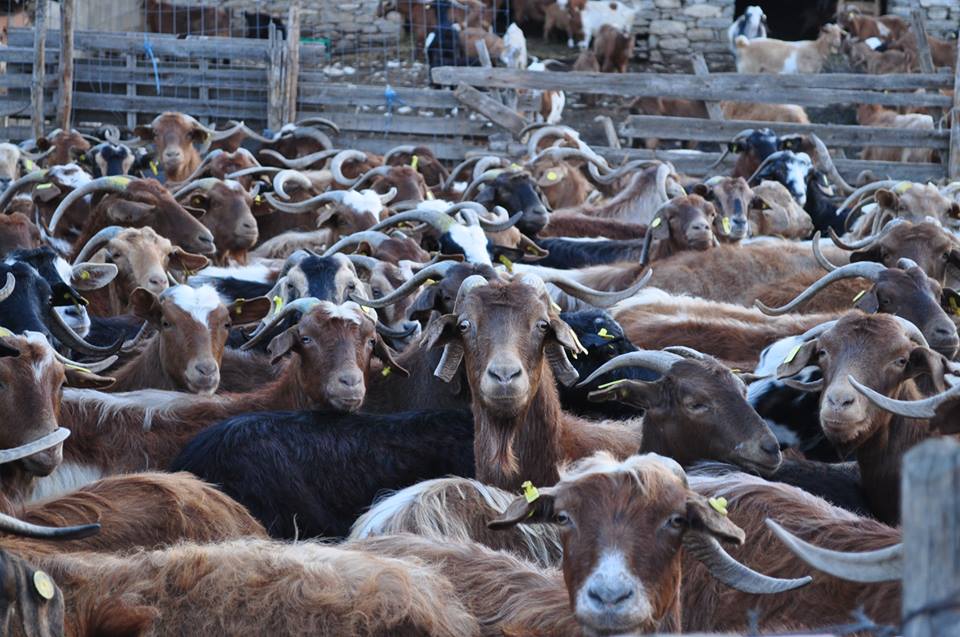
Το έργο ΑΙΓΑΙ-Ω εκπηγάζει από μία έρευνα που η Φοίβη Γιαννίση και η Ίρις Λυκουριώτη έχουν εκινήσει εδώ και τρία χρόνια με θέμα την κτηνοτροφία αιγών στον ελληνικό χώρο, ηπειρωτικό και νησιωτικό, στο πλαίσιο της νέας μετα-ανθρωπιστικής συνθήκης. Η λέξη ΑΙΓΑΙ-Ω φωτίζει την υπόμνηση του ευρύτερου αιγαιακού χώρου ως γεωγραφία αλλά και ως γη των αιγών. Το τελικό Ω, δανεισμένο από αρχαίες αναπαραστάσεις του θηλυκού αιδοίου επάνω σε λατρευτικά εδώλια, υπαινίσσεται κάποια θηλυκή οπτική. Το ΑΙΓΑΙ-Ω τοποθετεί στο κέντρο το ζώο και τον κύκλο ζωής του καθώς και τις πρακτικές της σύγχρονης κτηνοτροφικής ζωής και απλώνεται μεταφορικά σε θέματα εξουσίας (χωρικής, κοινωνικής και φυλετικής) και ιστορίας.


Στην Performance της 22ας Οκτωβρίου, "τραγουδι 1” συμμετέχουν οι:
Πάκυ Βλασσοπούλου,Φοίβη Γιαννίση, Κατερίνα Ηλιοπούλου Φάνης Καφαντάρης, Πατρίτσια Κολαΐτη, Χρυσάνθη Κουμιανάκη, Ηρώ Μαζαράκη, Ισαβέλλα Μαρτζοπούλου,Μαρίζα Νικολάου, Άννα Παγκάλου, Φώτης Ροβολής, Χαρά Στεργίου, Μάριος Χατζηπροκοπίου

Την Παρασκευή 23 Οκτωβρίου, ώρα 19:30, θα πραγματοποιηθεί η διαλογική βραδιά :
"Βιοι και πολιτείες της Αιγαιακής Χώρας' 
στην οποία συμμετέχουν με ομιλίες οι:

Λεωνίδας Εμπειρίκος
"Ο γύπας, ο λύκος και η γίδα (και ο φουρνός)"
Ελευθερία Δέλτσου
"Από τους τράγους και τα κριάρια του Α. Blok στις κατσίκες που
(δεν) μασάνε ταραμά"
Ιωάννα Λαλιώτου
"Περί μετα-ανθρωπισμού: Σημειώσεις ενός οδοιπορικού"
Κωστής Βελώνης
"H γλυπτική της αυτάρκειας και η υπαίθριο-ποίηση της πόλης"
Μιράντα Τερζοπούλου
"Μια βοσκοπούλα αγάπησα"
Πάνος Πανόπουλος
"Τα κουδούνια και οι φωνές τους"

Φοίβη Γιαννίση, Ίρις Λυκουριώτη
22 Οκτ- 20 Νοεμ 2015
Μουσείο Λαϊκής Τέχνης και Παράδοσης "Αγγελική Χατζημιχάλη"

Wednesday, October 7, 2015

Super Superstudio


PAC presents the work of Superstudio (1966-1978), the Italian group of radical architecture and radical design that has activated a revolution in the idea of design around the world.

The Superstudio have since the 70s historically animated the critique of modernism articulated through radical architecture, establishing themselves as the last great Italian avant-garde.

Co-curated by Andreas Angelidakis, Vittorio Pizzigoni and Valter Scelsi, the exhibition recounts how this group of Florentine architects has influenced not only great architects such as Zaha Hadid, Rem Koolhaas and Bernard Tschumi, but have definitely questioned the limits between contemporary art and architecture.

The exhibition will reconstruct Superstudio’s most important projects by bringing together its most representative pieces of design, installations and films, and by building – as a part of the total urbanisation model promoted by Superstudio itself – a dialogue with works by 21 contemporary artists, who have drawn the raw material for their oeuvre from the Florence group’s research: Danai Anesiadou, Alexandra Bachzetsis, Ila Beka and Louise Lemoine, Pablo Bronstein, Stefano Graziani, Petrit Halilaj and Alvaro Urbano, Jim Isermann, Daniel Keller and Ella Plevin, Andrew Kovacs, Rallou Panagiotou, Paola Pivi, Angelo Plessas, Riccardo Previdi, RO/LU, Priscilla Tea, Patrick Tuttofuoco, Kostis Velonis, Pae White.


Athens Community in the Kibbutz, 2011
Marble, ceramic, wood, acrylic, hardboard, veneer
20 x 30 x 10 cm 


Pac - Padiglione d'Arte Contemporanea
radical art and architecture
SUPER SUPERSTUDIO
11 October 2015 - 06 January 2016

The exhibition opens on the occasion of the 11a Giornata del Contemporaneo, scheduled for Saturday 10th October 2015 and promoted by AMACI - Associazione dei Musei d’Arte Contemporanea Italiani, of which the PAC is a founding member.


Tuesday, October 6, 2015

Rain a gentle suffering

rain
a gentle
suffering

Stephen Nelson, 2015


Sunday, October 4, 2015

Παρυφές και μεθόριοι


Στην έκθεση Παρυφές και μεθόριοι, που παρουσιάζεται στα πλαίσια του The Symptom Projects στην Άμφισσα, η μεθόριος γίνεται κατανοητή ως διαβλητό, συνεχώς μετατρέψιμο και μετατοπιζόμενο όριο· περίγραμμα ή περιφερειακή ζώνη, η οποία ορίζει το χώρο μέσα από μια διπλή διαδικασία περιλήψεων και αποκλεισμών. Μια μορφή γενίκευσης, αναγωγής, στερεοτυπικών αναγνωρίσεων και ετεροκαθορισμών. Η μεθόριος και η μεθοριακή συνθήκη που αναπαράγει, επισημαίνουν ένα πεδίο στο οποίο δεν εμφιλοχωρούν διακριτά τοπογραφικά σημεία. Η μεθόριος συγκροτεί ένα νοητό χώρο του οποίου η κύρια λειτουργία είναι να καθιστά ορατό τον διαχωρισμό ανάμεσα στο γνωστό και το άγνωστο, το αποδεκτό και το μη αποδεκτό και κατ’ επέκταση το αναγνωρίσιμο και το μη αναγνωρίσιμο. Τονίζει δηλαδή τη διάσταση της διάκρισης και τα σημεία τομής που παρεμβάλλονται ώστε να καταστήσουν σαφείς τους νοητούς διαχωρισμούς.

Ιστορικά, στην αποικιοποίηση των νέων ηπείρων από το δυτικό κόσμο, οι μεθοριακές γραμμές, τα λεγόμενα frontiers, λειτούργησαν ως αναγνώριση του πολιτισμένου κόσμου, ορίζοντας την έκταση του εξευγενισμού. Πέρα από εκείνα εκτεινόταν ο άγριος κόσμος, ο Άλλος. Με αυτή την έννοια το frontier, στην απόλυτη νοηματική του ελαχιστοποίηση, υποδηλώνει το όριο του συμβολικού, της οργανωτικής συγκρότησης του συνειδητού κόσμου. Σε αυτή την περιοχή διακρίνουμε μια τοπολογική αντιστοιχία με το στοιχείο που ο Sigmund Freud ονόμασε ομφαλό του ονείρου. Στην έκθεση Παρυφές και μεθόριοι που πραγματοποιείται παράλληλα στην Άμφισσα και τους Δελφούς, ο ομφαλός της γης, αυτό το αινιγματικό αντικείμενο που φυλάσσεται στο Αρχαιολογικό Μουσείο των Δελφών –όπως και ο τόπος που λειτουργεί ως όνομα-μεταφορά, αναδεικνύονται ως εμβληματικό σημαίνον, σημείο ανάδυσης της μεθοριακής εκκρεμότητας και των σύγχρονων εκδοχών που λαμβάνει.


Speakers' Corner, 2015
Wood, blocks of granite, bronze
34 x 30 x 57 cm

Συμμετέχοντες καλλιτέχνες:
Νίκος Αρβανίτης, Αριστείδης Αντονάς, Κωστής Βελώνης, Πάκυ Βλασσοπούλου, Ζωή Γιαμπουλντάκη, Θοδωρής Γιαννάκης, Λυδία Δαμπασίνα, Λητώ Κάττου, Μανώλης Μπαμπούσης, Πέτρος Μώρης, Γιάννης Παπαδόπουλος, Κώστας Σαχπάζης, Χαρίκλεια Χάρη, Κωνσταντίνος Χατζηνικολάου, Κώστας Χριστόπουλος

the symptom 06
Παρυφές και μεθόριοι”
Επιμέλεια: Ευαγγελία Λεδάκη
Παραγωγή: The Symptom Projects

Παλαιό Νοσοκομείο Άμφισσας και Αρχαιολογικό Μουσείο Δελφών

Διάρκεια έκθεσης: 10 - 25 Οκτωβρίου, 2015

Vegetazione Romana

Giacomo Caneva, Vegetazione Romana (study), 1852
Salt print from paper negative

Friday, October 2, 2015

Über-Marionette, Grace, and the Fall of the Performer


Central to this paper will be the argument that theater and performative practices sketch out an ontological background where knowledge is not so much inherently liberating as it is naturally accepted by the majority of people, and engaged in ethical issues and political discourses in many writings.


In “Über das Marionettentheater” (On the Marionette Theater, 1810), written by the German dramatist Heinrich von Kleist, one of the interlocutors in a rather intense dialogue, a principal dancer at the opera, argues that puppets have the advantage of being resistant to gravity. Of the heaviness of matter, the factor that most works against the dancer, they are entirely ignorant: because the force lifting them into the air is greater than the one attaching them to the earth. According to the dancer in Kleist’s essay, puppets possess a certain grace that humans do not. But what if humans are dependent on gravity and ironically, as Master puppeteers who control the puppets by pulling their strings, fumble in their own movements? 


Read more: