Sunday, August 1, 2010

Between Art and Anarchism; Horizontalism in New Social Practices: Revolutionary Autonomous Communities and Artist's For Social Justice

From a small 10-foot plot of truly public space between MacArthur Park and the street, the smell of slightly overripe fruit sweating in the sun emerges every Sunday morning. Young and old residents of the community stand together in the piercing midday Los Angeles sun, beads of sweat pricking their temples and children scrambling underfoot. Each person sets two squash, four potatoes, four cucumbers, a bunch of grapes, and so on into a succession of nearly 200 overstuffed cardboard boxes. Around 2pm, a line of people of every age and color, begins to form. They wait patiently to receive their boxes of donated excess fruits and vegetables, bag of rice and beans, whole wheat bread, and a fruit pie. The volunteers and the needy are often one and the same. After the flurry of activity from handing out food, everyone finds a place on the shady hill near the sidewalk. They examine the bounty and swap amongst themselves, a second redistribution among neighbors.

This food program is the soul of an anarchist organization known as the Revolutionary Autonomous Communities. It has been occurring for nearly two years around MacArthur Park. Self-sustainability is the watchword for this organization. Enabling poor or underserved communities of color to support themselves through simple acts of mutual aid, like food redistribution (rather than relying on charity) is its primary motivation.

Similarly engaged in self-support strategies, a growing group of young artists meets monthly at the California Institute for the Arts in Valencia, CA gathering for forum discussions, guest lectures, and to plan collective actions dedicated to social justice issues. Known as the Artists for Social Justice, several members recently participated in a one-night performance entitled “Free Free Market” in Chinatown focusing on aesthetic exchange and participation as an alternative to the object-driven art market. One gave voice lessons from the rooftop of the small strip mall location, drawing diners out of their restaurants and passersby off the sidewalk. Others wrote letters on demand – greetings to friends, thank you notes, expressions of love. Another gave away small objects he had begged, borrowed, and stolen – trinkets that were imbued with narrative and the possibility of further exchange. These artists, many newly embarking on careers in a fraught art world, have banded together in a non-hierarchical collective to explore alternative opportunities closely connected to real socio-political issues.

In the shadow of the current economic crisis, it is unsurprising that non-hierarchical organizational techniques and responsive self-support networks are increasingly emergent amongst communities of artists and thinkers. Confronted by baffling sleight-of-hand economic strategies like the bundling of mortgage-backed securities and out-of-control leveraging, our traditional understanding of industrialized production has been fundamentally shattered.

This crisis of understanding has led to a climate of deeper questioning than this country has seen for decades – if our economy could fail so drastically, what other precarious values have we unknowingly embraced? What else could fall apart? This questioning of complacency has traditionally been the provision of avant-garde artists and anarchist radicals, who made objects and organized direct actions designed to “shock” the public out of their blind acceptance of systematic domination. In the past few years, however, these dramatic tactics have been replaced by process-based organizational techniques carefully aligned with socio-economic-political complexities and built on self-reflexive horizontal structures.

In the modernist avant-garde artistic tradition that coalesced after the First World War, art objects possess unique and immediate qualities that, as Walter Benjamin notes, shock the viewer into “a heightened presence of mind.”(1) As art historian Grant Kester explains, these objects are designed to rip viewers out of an uncritical state, forcing them to almost violently “challenge their faith in the very possibility of rational discourse.” Aligned in many ways with radical leftist ideologies, the avant-garde believed that Western society had, as Kester puts it, “come to view the world in a violently objectifying manner associated with the growing authority of positivistic science and the profit-driven logic of the marketplace.”(2)

These views overlap those of communist anarchism (3), associated with most revolutionary leftist social movements and influential to groups like the Anarchist People of Color, initiated by Ernesto Aguilar. Anarcho-communists emphasize the abolishment of class structures under capitalism, and strive to create autonomous spaces in which mutual aid and self-sustainability negate the need for a state apparatus (4). To shake the public out of complacency, anarchists frequently engage in marches, boycotts, sit-ins, and other such demonstrations. These can utilize either violent or non-violent tactics, designed to “create such crisis and foster such a tension that a community which has constantly refused to negotiate is forced to confront the issue. [These tactics] seek to dramatize the issue so that it can no longer be ignored.”(5)

The similarities between the avant-garde and anarchism extend beyond their similar “shock and rupture” tactics; political theorists and art historians alike have declared both to be failed movements. In the avant-garde movement, this failure arises from a paradoxical hierarchy encased in the primacy of the art object. If the art object itself contains the power to elicit epiphany, than the artist is elevated to a status “uniquely open to the world,” and viewers that are open to the transformative experience of the object are likewise more educated and socially aware than those who are not.(6)

Anarchists struggle with a similar created hierarchy, often denouncing those with any connection to institutions and systems of the current society. This has led to an insular mindset dominated by ideologues, with adherence to extremism serving as a measure of commitment. The desire to completely dissociate has undermined the goals of systematic revolution and greater freedom, replacing one hegemony with another.

Complicating these intrinsic problematics is the proven ability of capitalist systems to subsume and harness radical tactics into new forms of control. Belgian political philosopher Chantal Mouffé writes: “The aesthetic strategies of the counterculture: the search for authenticity, the ideal of self-management, the anti-hierarchical exigency, are now used in order to promote the conditions required by the current mode of capitalist regulation, replacing the disciplinary framework characteristic of the Fordist period.” (7) As mass marketing employs the surface aesthetics of the avant-garde or revolutionary iconography to imbue brands with “cool,” strategies of the alternative arts movement are now foundational pillars of the worldwide art market, and corporate structures (as in Google or Apple) embrace a superficial ideal of egalitarian self-management, the “shock and rupture” tactics of the radical left are effectively deflated.

Because of this systematic adaptability, many have claimed “any form of critique is automatically recuperated and neutralized by capitalism.”(8) In the past few years, however, both artistic practice and anarchist organizing have come to embrace new strategies of radicality that are distanced from “shock” tactics in their commitment to a social and spatial awareness. Exemplified by the two Los Angeles groups (the anarchist RAC, and artistic Artists for Social Justice) that started in 2007, this radicality emerges in self-reflexive organization and practical exchange.”

A distinct feature of the Revolutionary Autonomous Communities Food Program is its status as a “truly horizontal organization,” where the givers are indistinguishable from the receivers. The political purpose of the program is not charity, but “self-empowerment, where working class neo-colonies are feeding themselves, and organizing to feed themselves.”(9)The program’s organization is constantly evolving, steered by members of the community and the RAC, who carefully consider the effects of distribution techniques on the creation of competition and the larger goal of self-sustainability. Since the program’s inception, the RAC has moved from numbering families in line to calling names (in order to get to know the regulars), and has increased its volunteer and membership corps to include many members of the community. Although the program runs into occasional disorganization and even some contentious arguments among members, a consensus-based, openly horizontal process allows for new ideas and growth.

Meanwhile, across the city, the Artists for Social Justice attempt to bridge class hierarchies in the art world by working collaboratively in a non-hierarchical group of 87 members. The collective has organized shows, performances, and discussions around various political and community issues; their most recent being an event affiliated with the Performing Economies show at the Fellows for Contemporary Art gallery in Chinatown. “Free Free Market” involved dozens of ASJ member projects that focused on gift economies, the exchange of aesthetic and social experiences, encouraging dialogue, and inhabiting spaces that are nontraditional for art (such as public space, strip malls, and classrooms).(10) Founder Evelyn Serrano says the group is dedicated to the process of working collectively and cooperatively, especially in analyzing ways of using dialogue tactically and allowing the structure of the group to shift and reform.

For both of these groups, their strategies of internal organization are not means to an end, but radical of themselves. Yet unlike traditional radical groups, who carved out strict “autonomous” zones designed to be separate from larger society (thereby creating their own hierarchies of exclusion within these zones), the RAC and the ASJ organize with a keen awareness of the multiple discursive layers of their social and spatial terrain. A member of the RAC noted “how we organize is how we are received by the community”. He acknowledged that their strategies, far from ossified, are constantly and critically reevaluated from week to week. He went on to admit that not all members wished to be identified as anarchists, that the purpose of the group was not to promote a specific ideology, but to facilitate the empowerment and self-sustainability of the MacArthur Park community itself. “You can’t eat theory,” he quipped.(11)

Likewise, although the Artists for Social Justice bills itself as a forum for people that are interested in non-traditional artistic practice, its commitment to social justice comes primarily from its working method as a collective. The group experiments with its own horizontal structure as a way to problematize the hierarchies of the art world and market-driven society in general. Its members approach art-making in much the same way. Strategies of exchange, dialogue, and social analysis are made overt in these art (?) practices, wherein the object produced is only meaningful as a way of understanding the process of questioning issues like public space, market exchange, or art world hierarchies.

These groups are markedly different from the traditional avant-garde (12) and radical left (13) because they internalize the notion that no terrain is neutral, and that durational dialogue between disparate groups is both necessary and futile according to rationalist thinking – there can be no dialogical endpoint, no rational consensus between discourses. Chantal Mouffé calls this “agonistic” political thought – as she explains, “an agonistic conception of democracy requires coming to terms with the contingent character of the hegemonic politico-economic articulations which determine the specific configuration of a society at a given moment.” (14)In other words, there can be no rational consensus without exclusions, and an organization built on the belief that a consensus between pluralities is desirable (and possible) is necessarily hierarchical.

This kind of thought is indeed radical; it throws into relief exactly the hegemonies of capitalist society, and critiques the “imaginary environment necessary for the reproduction” (15) of these power structures and hierarchies. But how is this radical thought utilized, and how do the manifestations of these organizational strategies sometimes fall short of their ideals?

In some ways, the RAC is a step ahead of the Artists for Social Justice because they are equipped to define a political ideology that preserves the integrity of these new strategies, as well as a measure of self-accountability. The goals of community self-empowerment are clear, and the actions of the group are directed aligned with certain desired outcomes (empower members to be leaders, address the needs of the community, engage the community in creating self-sustainable economies of exchange and mutual aid). Yet the accompanying anti-statist, anti-authoritarian articulations tend to be reductive in their language, and self-criticality on a broader social scale is less evident. Certain elements of traditional radical strategies still prevail, such as denouncing all funding and support from entities perceived to be part of “the system.” Though this is aligned with anarchist ideology, it begs the question as to whether the group can expand and promote its agenda beyond a small circle of supporters. (16)

For the Artists for Social Justice, the challenge of applying these strategies to affect lasting change (to the art market or broader social hierarchies) seems almost the opposite. The theoretical questioning and formation of new discourses is rigorous, and self-reflexivity in the practice of collective action is a primary activity of the group. But without a specific guiding goal or political thought process in the larger social arena, the projects that the group produces (like the voice lessons and letter-writing of the “Free Free Market” project) tend to remain soft, insular, and somewhat watered down among so many individual ideas.

Both groups share the problem of the creation of competition. In the RAC food program, participants occasionally squabble over scarce resources. Sometimes the food runs out before all the needy are fed. The Artists for Social Justice acknowledge that they exist within an art market, and are composed of a membership that is attempting to make a living as artists. For some of these members, being selected for a show or organizing a well-publicized project is crucial to their careers. As an 87 member collective cannot practically produce projects that include everyone, jealousies and individual competitions are inevitable. These shortages of resources are in some ways part and parcel of the horizontal organizing of both groups. Acknowledging and confronting this creation of competition has kept both groups experimenting with their structures in creative ways, and has kept them resistant to capitalist subsumation. This responsiveness and self-reflexivity will ultimately allow each organization to morph and grow tactically, allowing for the possibility of a more widespread critical questioning of intrinsic societal values.

Text by Sue Bell Yank


1. Walter Benjamin, “The Work of Art in the Age of Mechanical Reproduction,” in Illuminations, trans. Harry Zohn (New York: Shocken, 1969), 238. (back)

2. Grant Kester, Conversation Pieces: Community and Communication in Modern Art (Los Angeles: University of California Press, 2004), 27. (back)

3. Communist anarchism theory influences groups like the RAC, as well as the larger Anarchist People of Color (APOC) movement. The main theorists of communist anarchism are Peter Kroptkin and Murray Bookchin (Wikipedia) succinctly defines the movement as one that “advocates the abolition of the state, private property and capitalism in favor of common ownership of the means of production, direct democracy and a horizontal network of voluntary associations, workers' councils and/or a gift economy through which everyone will be free to satisfy their needs.” For more, see Peter Kroptkin, Mutual Aid: A Factor of Evolution (London: Freedom Press, republished 1998). (back)

4. “Revolutionary Autonomous Communities, Los Angeles Food Program,” Anarkismo, December 18, 2008 . (back)

5. “Direct Action,” Wikipedia. (back)

6. Kester, 27. (back)

7. Chantal Mouffé, “Art and Democracy: Art as an Agonistic Intervention in Public Space,” Art as a Public Issue 14 (2008), 7. (back)

8. Mouffé, 7. (back)

9. “Revolutionary Autonomous Communities, Los Angeles Food Program,” Anarkismo, December 18, 2008. (back)

10. Evelyn Serrano, founder of the ASJ, interview with the author, July 20, 2009. (back)

11. Mauricio, member of the RAC, interview with the author, July 19, 2009. (back)

12. By the traditional avant-garde, I refer to a long tradition extending from the post-impressionists of the late 1800s to the post-war New York School of abstract artists including Mark Rothko, Barnett Newman, Jackson Pollock, David Smith, and Morris Louis. Theorized most famously by Clement Greenberg, avant-garde discourse is characterized by, as Grant Kester puts it, “a concern with policing the boundaries between true art and kitsch” and an “opposition between conventional forms of language…and the metalanguage of art, which eludes the constraints of symbolic discourse to confront the viewer with immediate and overwhelming aesthetic force.” For more, see Kester, 25-49. (back)

13. The “radical left” encompasses a long tradition of revolutionary thought, with anarchism typifying the rejection of capitalist domination in favor of a free society. Many of the social movements associated with anarchism occurred in the late 19th and 20th centuries, and were often violently repressed by nation-states. Some of these include the labor movements of the early 20th century, including the Makhnovist movement during the 1917 Russian Revolution and the Spanish Civil War from 1936 to 1939. In North America, the student movements of the 60s and 70s had strong anarchist influences and utilized direct action tactics. For a brief history of anarchist movements, see Wikipedia, “History of Anarchism.” (back)

14. Mouffé, 9. (back)

15. Mouffé, 7. (back)

16. The modest scope of the RAC Food Program could be a deliberate feature of horizontal organizing, a recognition of the limits of this structure. If so, this would represent a drastic break from the revolutionary ambitions of the traditional anarcho-communist thought, the end goal being a complete overthrow of the current system. In my interviews with members of the group, however, goals of expansion were clearly evident; they talked about securing premises, setting up food storage, and expanding into neighborhoods across the city and possibly country. In terms of the practical logistics of setting up such an operation without the benefit of traditional forms of funding, however, the members cited a need to find “creative alternative solutions” based on the ideals of exchange and self-sustainability. This sets up a massive challenge for the group as it attempts to grow, but also the opportunity for innovative strategies.

John Aimani of RAC-LA clarifies ... Our 'modest scope' is indeed deliberate. Our goal was to focus upon the most vulnerable portions of this society, the working poor, the homeless and the undocumented migrant workers so as to demonstrate that we (and I say "we' for RAC is, in the main, composed of these elements) can work together to make our lives a bit better even in the throes of this downward spiral of capitalism. Yet, RAC is no social group. Nor is it a charity group. RAC is a revolutionary-organization-in-the-making dedicated just so to the "complete overthrow of the current system". We come forward with no spelled out "10 point program", no Gotha program, no bible, no Jesus, no leader. We come forward only with an eye as to how it is that we, as a people, can begin to work together, to study together, to eat together and, most important, to learn together. And we do so with the idea of not only survivial in this dying decaying decadent system but with an eye towards destroying it. RAC is a long-term project. Those with ideas of quick fixes need not apply. Those with ideas of leading us to this or that place, this or that state of mind, similarly will find their services not needed.


Source:www.journalofaestheticsandprotest.org

Monday, July 26, 2010

Governance by Everyone


Metahaven, Stadtstaat – Sozialstaat (Governance by Everyone), 2009, Poster 120x180 cm, screenprint courtesy Metahaven, Kunstlerhaus Stuttgart, and Casco Utrecht.

Sunday, July 25, 2010

Hon


Pontus Hultén Study Gallery at Moderna Museet. Based on an idea by Renzo Piano.


The cover of the folder that accompanied the Moderna Museet exhibition, showing a working drawing itemizing the interior of Hon playrooms, curated by Pontus Hulten.


Visitors to the Hon exhibition at the Moderna Museet in Stockholm, 1966.

Source : moremilkyvette.blogspot.com

The Original Copy


Bruce Nauman. Waxing Hot, from the portfolio Eleven Color Photographs. 1966–67/1970/2007. Inkjet print (originally chromogenic color print), 19 15/16 x 19 15/16" (50.6 x 50.6 cm).

The Original Copy presents a critical examination of the intersections between photography and sculpture, exploring how the one medium has been implicated in the analysis and creative redefinition of the other. The exhibition is organized by Roxana Marcoci, Curator, Department of Photography.

The advent of photography in 1839, when aesthetic experience was firmly rooted in Romanticist tenets of originality, brought into focus the critical role that the copy plays in the perception of art. But if the photograph's reproducibility challenged the aura attributed to the original, it also reflected a very personal form of perception and offered a model for dissemination that would transform the entire nature of art.

In his 1947 book Le Musée imaginaire, novelist and politician André Malraux famously advocated for a pancultural "museum without walls," postulating that art history, and the history of sculpture in particular, had become "the history of that which can be photographed." Sculpture was among the first subjects to be treated in photography. There were many reasons for this, including the immobility of sculpture, which suited the long exposure times needed with the early photographic processes, and the desire to document, collect, publicize, and circulate objects that were not always portable. Through crop, focus, angle of view, degree of close-up, and lighting, as well as through ex post facto techniques of darkroom manipulation, collage, montage, and assemblage, photographers have not only interpreted sculpture but created stunning reinventions of it.

The Original Copy looks at the ways in which photography at once informs and challenges our understanding of what sculpture is. Conceived around ten conceptual modules, the exhibition examines the rich historical legacy of photography and the aesthetic shifts that have taken place in the medium over the last 170 years through a superb selection of 300 pictures by more than 100 artists. Some, ranging from Eugène Atget and Walker Evans to Lee Friedlander and David Goldblatt, are best known as photographers; others such as Auguste Rodin, Constantin Brancusi and David Smith, are best known as sculptors; and others, ranging from Hannah Höch and Sophie Taeuber-Arp, to contemporaries such as Bruce Nauman, Fischli/Weiss, Rachel Harrison, and Cyprien Gaillard, are too various to categorize but exemplify how fruitfully and unpredictably photography and sculpture have combined.


Sibylle Bergemann. Das Denkmal, East Berlin (The Monument, East Berlin). 1986. Gelatin silver print, 19 11/16 x 23 5/8" (50 x 60 cm).

The exhibition will travel to Kunsthaus Zürich, where it will be on view from February 25 through May 15, 2011.
The Original Copy:
Photography of Sculpture,
1839 to Today
August 1 – November 1, 2010
The Museum of Modern Art, NY

Wednesday, July 21, 2010

Volax


Landscape with huge granite boulder formations around Volax village in Tinos Island, Greece. 2010

Thursday, July 15, 2010

Vila Hermina


Vila Hermina
since 2008 in construction
authors Petr Hajek, Tomas Hradecny, Jan Sepka

The building is situated on a sloping terrain on the outskirts of Cernin, taking the same slope into its internals for floors. The interior layout is based on alternating straight and sloping floor surfaces that create the overall spiralling character of the interior and define the building’s external appearance. However, the use of the sloping floor on the ground floor is not purposeless – it is there on investor/s reguest to accomodate movie projections as a small movie theatre. Windows and other openings are placed with respect of the external facade – each of the walls only has one opening. For thermal and water insulation a polyurethane spray with pink coat is used, meant as a credit to our favourite building of Versuchsanstalt fur Wasserbau und Schiffbau by Ludwig Leo.

Source: www.hsharchitekti.cz

Die Alpen


Jahr/Year 1930 Die Alpen - The Alps

Oberammergauer Holzschnitzerwerkstatt
Alois Lang
Christusdarsteller der Passionsspiele 1930

Wood-Carver's Workshop in Oberammergau
Alois Lang, the Representator of Christ in the Passion's Play 1930

Jesus, Jesus, Jesus

In the late 1950s, three men who identified as the Son of God were forced to live together in a mental hospital. What happened?


In the late 1950s, psychologist Milton Rokeach was gripped by an eccentric plan. He gathered three psychiatric patients, each with the delusion that they were Jesus Christ, to live together for two years in Ypsilanti State Hospital to see if their beliefs would change. The early meetings were stormy. "You oughta worship me, I'll tell you that!" one of the Christs yelled. "I will not worship you! You're a creature! You better live your own life and wake up to the facts!" another snapped back. "No two men are Jesus Christs. … I am the Good Lord!" the third interjected, barely concealing his anger.

Frustrated by psychology's focus on what he considered to be peripheral beliefs, like political opinions and social attitudes, Rokeach wanted to probe the limits of identity. He had been intrigued by stories of Secret Service agents who felt they had lost contact with their original identities, and wondered if a man's sense of self might be challenged in a controlled setting. Unusually for a psychologist, he found his answer in the Bible. There is only one Son of God, says the good book, so anyone who believed himself to be Jesus would suffer a psychological affront by the very existence of another like him. This was the revelation that led Rokeach to orchestrate his meeting of the Messiahs and document their encounter in the extraordinary (and out-of-print) book from 1964, The Three Christs of Ypsilanti.

Although by no means common, Christ conventions have an unexpectedly long history. In his commentary to Cesare Beccaria's essay "Crimes and Punishments," Voltaire recounted the tale of the "unfortunate madman" Simon Morin who was burnt at the stake in 1663 for claiming to be Jesus. Unfortunate it seems, because Morin was originally committed to a madhouse where he met another who claimed to be God the Father, and "was so struck with the folly of his companion that he acknowledged his own, and appeared, for a time, to have recovered his senses." The lucid period did not last, however, and it seems the authorities lost patience with his blasphemy. Another account of a meeting of the Messiahs comes from Sidney Rosen's book My Voice Will Go With You: The Teaching Tales of Milton H. Erickson. The renowned psychiatrist apparently set two delusional Christs in his ward arguing only for one to gain insight into his madness, miraculously, after seeing something of himself in his companion. ("I'm saying the same things as that crazy fool is saying," said one of the patients. "That must mean I'm crazy too.")
These tales are surprising because delusions, in the medical sense, are not simply a case of being mistaken. They are considered to be pathological beliefs, reflecting a warped or broken understanding that is not, by definition, amenable to being reshaped by reality. One of most striking examples is the Cotard delusion, under which a patient believes she is dead; surely there can be no clearer demonstration that simple and constant contradiction offers no lasting remedy. Rokeach, aware of this, did not expect a miraculous cure. Instead, he was drawing a parallel between the baseless nature of delusion and the flimsy foundations we use to construct our own identities. If tomorrow everyone treats me as if I have an electronic device in my head, there are ways and means I could use to demonstrate they are wrong and establish the facts of the matter—a visit to the hospital perhaps. But what if everyone treats me as if my core self were fundamentally different than I believed it to be? Let's say they thought I was an undercover agent—what could I show them to prove otherwise? From my perspective, the best evidence is the strength of my conviction. My belief is my identity.

In one sense, Rokeach's book reflects a remarkably humane approach for its era. We are asked to see ourselves in the psychiatric patients, at a time when such people were regularly locked away and treated as incomprehensible objects of pity rather than individuals worthy of empathy. Rokeach's constant attempts to explain the delusions as understandable reactions to life events require us to accept that the Christs have not "lost contact" with reality, even if their interpretations are more than a little uncommon.

But the book makes for starkly uncomfortable reading as it recounts how the researchers blithely and unethically manipulated the lives of Leon, Joseph, and Clyde in the service of academic curiosity. In one of the most bizarre sections, the researchers begin colluding with the men's delusions in a deceptive attempt to change their beliefs from within their own frame of reference. The youngest patient, Leon, starts receiving letters from the character he believes to be his wife, "Madame Yeti Woman," in which she professes her love and suggests minor changes to his routine. Then Joseph, a French Canadian native, starts receiving faked letters from the hospital boss advising certain changes in routine that might benefit his recovery. Despite an initially engaging correspondence, both the delusional spouse and the illusory boss begin to challenge the Christs' beliefs more than is comfortable, and contact is quickly broken off.

In fact, very little seems to shift the identities of the self-appointed Messiahs. They debate, argue, at one point come to blows, but show few signs that their beliefs have become any less intense. Only Leon seems to waver, eventually asking to be addressed as "Dr Righteous Idealed Dung" instead of his previous moniker of "Dr Domino dominorum et Rex rexarum, Simplis Christianus Puer Mentalis Doctor, reincarnation of Jesus Christ of Nazareth." Rokeach interprets this more as an attempt to avoid conflict than a reflection of any genuine identity change. The Christs explain one another's claims to divinity in predictably idiosyncratic ways: Clyde, an elderly gentleman, declares that his companions are, in fact, dead, and that it is the "machines" inside them that produce their false claims, while the other two explain the contradiction by noting that their companions are "crazy" or "duped" or that they don't really mean what they say.

In hindsight, the Three Christs study looks less like a promising experiment than the absurd plan of a psychologist who suffered the triumph of passion over good sense. The men's delusions barely shifted over the two years, and from an academic perspective, Rokeach did not make any grand discoveries concerning the psychology of identity and belief. Instead, his conclusions revolve around the personal lives of three particular (and particularly unfortunate) men. He falls back—rather meekly, perhaps—on the Freudian suggestion that their delusions were sparked by confusion over sexual identity, and attempts to end on a flourish by noting that we all "seek ways to live with one another in peace," even in the face of the most fundamental disagreements. As for the ethics of the study, Rokeach eventually realized its manipulative nature and apologized in an afterword to the 1984 edition: "I really had no right, even in the name of science, to play God and interfere round the clock with their daily lives."

Although we take little from it scientifically, the book remains a rare and eccentric journey into the madness of not three, but four men in an asylum. It is, in that sense, an unexpected tribute to human folly, and one that works best as a meditation on our own misplaced self-confidence. Whether scientist or psychiatric patient, we assume others are more likely to be biased or misled than we are, and we take for granted that our own beliefs are based on sound reasoning and observation. This may be the nearest we can get to revelation—the understanding that our most cherished beliefs could be wrong.

Text by Vaughan Bell

Source : www.slate.com

Monday, July 12, 2010

Affiche pour un droit inaliénable à l'IVG


Affiche pour un droit inaliénable à l'IVG
Source : http://imaginaction.over-blog.org

Friday, July 9, 2010

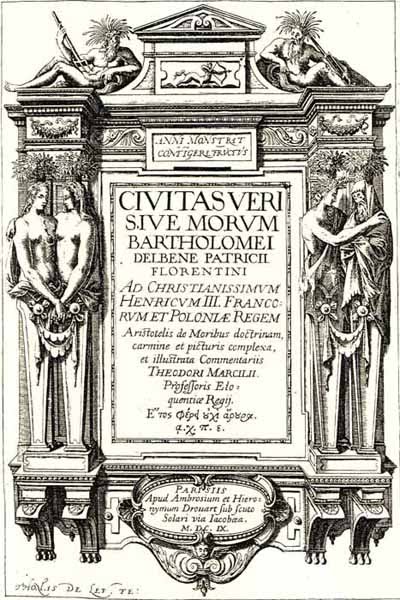
Civitas Veri

In Paris, in 1609, the printers Ambroise and Jérôme Drouart published a volume entitled Civitas Veri sive Morum (‘The City of Truth; or, Ethics’) on behalf of the recently-deceased Alphonse (or Alfonso) Del Bene (or Delbene: ca. 1538-1608), who had been bishop of Albi. The book comprised an allegorical, philosophical poem in Latin written by Alphonse’s uncle Barthélémy (or Bartolomeo) Del Bene (1515-1595), with a commentary and notes by the humanist scholar Théodore Marcile (1548-1617). Marcile’s introduction bears the date 1585, and it is likely that Del Bene’s verse was written earlier still, at some time in the 1560s, or early 1570s.


The text is illustrated by a few dozen curious engravings: it is not known whether versions of these images adorned Del Bene’s or Marcile’s manuscripts, or whether they were added later by the Drouarts. The decorated title-page was designed by a Dutch-born engraver named Thomas de Leu, so it is quite possible the remainder of the engravings were his work too; although Mario Praz, in mentioning Civitas Veri in his ‘Studies in Seventeenth-Century Literature,’ likens them to the emblems in Jan David’s Veridicus Christianus, which were apparently executed by Théodore Galle.


Del Bene’s poem is an allegorical recasting of Aristotle’s Nichomachean Ethics. It describes a month-long spiritual journey undertaken by his patroness, Marguerite, Duchess of Savoy, who travels through the City of Truth, from its five portals (one for each of the senses: see, for example, the portals of smell and taste, in the details above) through its various palaces, gardens, etc., to the five temples at its heart, culminating in visits to the Temple of Intelligence (where she meets and converses with Aristotle himself) and the Temple of Wisdom.


Del Bene’s City of Truth is presented as both a microcosm, and as an idealised locale, after the fashion of Thomas More’s Utopia and Kaspar Stiblin’s De Eudæmonensium Republica; and anticipating aspects of later works such as Johann Valentin Andreae’s Christianopolis,, Tommaso Campanella’s Civitas Sole, (‘City of the Sun’) and Bacon’s New Atlantis. The image above shows a detail of an elevated view of the City of Truth in its totality, which I spliced together from a pair of engravings on facing pages of the book.


I learned of the existence of Del Bene’s opus by way of an eye-catching engraving reproduced in John Manning’s book The Emblem: this was the depiction of ‘The Palace of Intemperance’—part of which is shown in the detail immediately above, wherein ‘Intemperance sits in a myrtle grove […] where she is regaled by Cupid and Bacchus. She spurns Right Reason under her naked foot. Before her are prepared three tables: one consecrated to Gluttony, the next to cures for her inevitable hangover, the last is furnished with incitements to Lust… An open grave lies at the foot of the plate.’ This was opposed to the altogether more seemly ‘Palace of Temperance’ as detailed in the first of two the images above.

The poem’s protagonist, Marguerite de France (or Marguerite de Valois), Duchesse de Berry, afterwards Duchesse de Savoie, 1523-74, was the youngest daughter of king François I., and sister to King Henri II. She was intellectually accomplished; conversant in Latin, Greek and Italian; and a defender at court of the Pleiade poets, in particular of Pierre de Ronsard. Praised as a new Minerva, she was seen as a successor to her aunt & namesake, Marguerite de Navarre (or Marguerite d’Angoulême), renowned author of the Heptameron.


Del Bene had entered Marguerite’s service as her secretary in 1554. Five years later, when, at the unusually late age of 36, she was married to Emmanuel-Philibert, Duc de Savoie, he moved with her to the ducal court at Turin. After Marguerite’s death, De Bene returned to the court of Henri III. of France, and was thereafter ‘charged several times with confidential missions for Emmanuel-Philibert and Catherine de Médicis’ (Henri’s mother). Besides his Civitas Veri, he wrote other Latin and Italian poetry, well-esteemed in his day.


The images above are details of scans from a reprint edition of Civitas Veri published in 2003 by Librissimo / Phénix Éditions, apparently exclusively distributed by alapage.com.


Source : Giornale Nuovo, www.spamula.net/blog

Friday, July 2, 2010

The Parallel Universe

At that time Superman was known as extremely friendly.
He would greet politely at the breakfast table,
pass the sugar when asked
and enjoy the breaktaking panorama.
He would play old music when making decisions
and afterwards phone his mother.

Until the night the windows of his birthplace were smashed
his balloon face hung like a boy's dream
throughout the town.
He asked: take pity on my situation,
but had to wave his fists
to keep people's attention.

He became The Great Absentee. He would sneak in
and sit on the back row of theatres
and roar for another encore, or grin for minutes on end
at women in the lift via mirrors
and bide his time.

He has done marvels by leaning forward
at unguarded moments
and whispering something into an ear,
by adding moustaches to unknown people's photos
in the scrapbooks he took with him to auditions.

He could actually fly. Whenever he felt bored
he simply rented a couple of comic films.

Alfred Schaffer
Translation: 2004, John Irons

Het evenwijdig universum

In die tijd stond Superman bekend als uiterst vriendelijk.
Aan de ontbijttafel groette hij beleefd,
gaf desgewenst de suiker door
en genoot van het adembenemende panorama.
Hij speelde oude muziek als hij besluiten maakte
en belde daarna zijn moeder.

Tot de nacht dat de ramen van zijn geboortehuis werden ingegooid
hing zijn ballongezicht als in een jongensdroom
door de hele stad.
Hij vroeg: heb medelijden met mijn situatie,
maar moest met zijn vuist zwaaien
om de aandacht vast te houden.

Hij werd De Grote Afwezige. In het geniep
zat hij op de achterste rij van theaters
en brulde om nog een toegift, of grijnsde minutenlang
naar vrouwen in de lift via spiegels
en wachtte zijn kansen af.

Wonderen heeft hij verricht door op onbewaakte momenten
voorover te buigen
en iets in een oor te fluisteren,
door snorren te tekenen op foto's van onbekenden
in de plakboeken die hij meenam naar audities.

Hij kon werkelijk vliegen. Wanneer hij zich verveelde
huurde hij doodgewoon een paar lachfilms.

2002, Alfred Schaffer
From: Dwaalgasten
Publisher: Thomas Rap, Amsterdam, 2002

Thursday, July 1, 2010

Usine occupée


Usine occupée
2010
201 x 32 x 85 cm
Wood, acrylic, varnish

iMarx Manifesto

The factory workers of Foxconn in China being forced to the edge of suicide will take little comfort from this, and it's certainly not what Karl Marx had in mind when he said the bourgeoisie creates its own gravediggers.


However, Apple's decision to free distribute free copies of The Communist Manifesto to millions of iPhone owners seems a curious twist as the firm now makes $5.7 billion in profits on annual turnover of $36.5 billion by exploiting cheap, ununionised workers in China.


Owners of the iPhone with the latest iOS4 can download iBooks without charge - allowing them to download the Communist Manifesto for free. The world's best selling political publication can be copied, pasted, highlighted and annotated.

The Condition of the Working-Class in England in 1844 by Friedrich Engels, Marx's sponsor, editor and closest associate - is also available for free. Marx's The Eighteenth Brumaire of Louis Bonaparte and Selected Essays are also free, along with selected extracts of Das Capital.

Lenin's State and Revolution has also gone on sale at £9.49 while the only Trotsky publication is An Appeal to the Toiling, Oppressed and Exhausted People's of Europe - a timely launch of the ebook - at £4.49. It would be interesting to know if this edition is available in China

Source: http://atthesauce.blogspot.com

Vanity Fairs

Shanghai Expo 2010 is the most recent incarnation of the Great Exhibitions that began in London in 1851


Bjarke Ingels Group, The Danish Pavilion for the Shanghai Expo, 2010
Douglas Murphy

A writer based in London, UK. He blogs at youyouidiot.blogspot.com. His first book, The Architecture of Failure (Zer0 Books) is forthcoming.

The Shanghai Expo marks the strange return to prominence of what had seemed to be a dead architectural tradition. Expos, or, as they were originally called, Great Exhibitions, Expositions Universelles or World Fairs, were huge temporary pageants dedicated to the notion of progress, but the last few generations have witnessed their slow decline into near insignificance. They have been the source of a great many of our most memorable architectural images, which is remarkable considering their highly ephemeral nature.

The very first world exhibition was the ‘Great Exhibition of the Works of Industry of All Continents’, held in London in 1851. It was organized, in the words of Prince Albert, ‘to give us a true test and a living picture of the point of development at which the whole of mankind has arrived’. The exhibition building, the Crystal Palace, was a gigantic crystalline web of mass-produced iron and glass, a vast display cabinet containing over 100,000 exhibits, ranging from industrial machinery to raw materials, from fabrics to furniture. More than six million people visited the exhibition in six months; it was one of the most significant early moments in mass culture.

On the one hand the Great Exhibition was a way of symbolically demonstrating Britain’s lead in the industrial race, but at the same time it was an event that was born from ruling-class anxieties about insurgency; conceived in the wake of the failed European revolutions of 1848 and the Chartists revolt, the Exhibition was partly designed to promote class harmony through distraction. Many opposed it on the grounds that it was a target for revolutionaries, but not only did the red hordes fail to materialize, the exhibition united the clashing aristocracy and bourgeoisie behind the banner of free trade, inaugurating a new regime of spectacular capitalism – Walter Benjamin wrote that at the Great Exhibition, ‘the masses, barred from consuming, learned empathy with exchange value’. At the same time, however, revolutionaries would see in the Crystal Palace a symbol of the future just society.

Both Paris and New York would hold their own exhibitions within the following five years, and they would soon be repeated the world over. The iron and glass architecture that accommodated these events reached its apotheosis at the 1889 Paris Exposition with the construction of the Galerie des Machines (the world’s largest room) and the Eiffel Tower, which was and would remain the world’s tallest structure for the next 40 years. But the revolutionary architecture of the exhibitions was soon subjected to a bourgeois aesthetic reaction – the 1893 World’s Columbian Exposition was entirely draped in beaux-arts frippery, prompting American Modernist architect Louis Sullivan to exclaim: ‘The damage wrought by the World’s Fair will last for half a century from its date, if not longer.’

Despite the wider rejection of the aesthetics heralded by the early Exhibitions, the Expos themselves were still opportunities to display the most modern styles. The 1900 Paris Exposition marked the brief flowering of Art Nouveau, still visible in the ironwork of Hector Guimard’s Métro stations, while early streams of Modernism were also prominently visible. Le Corbusier’s Pavilion de l’Esprit Nouveau was included in the 1925 Paris Exposition, along with the incredible Soviet Pavilion by Konstantin Melnikov, while Ludwig Mies van der Rohe’s seminal Barcelona Pavilion was the German Pavilion for the 1929 World Exhibition held in the Spanish city.

Although they were inextricably linked to ‘progress’, the Expos could also be scenes of tragic regression. There is hardly a more poignant architectural image than that of the 1937 Paris Exposition, postcards of which show the ghastly kitsch of Albert Speer’s German Pavilion and Boris Iofan’s Soviet Pavilion practically head-butting each other across the Champs de Mars, as the Eiffel Tower looks down sadly, its Utopia in peril. At the same Expo, in the Republican Spanish Pavilion, Picasso’s Guernica (1937) was hung for the first time.

After World War ii, the Great Exhibitions never attained the same level of cultural prominence that they had before; the immaterial qualities of both electronic media and atomic science did not lend themselves to large-scale spectacles of this type. Nevertheless Expos would continue, occasionally still creating seminal works of architecture; Le Corbusier and Iannis Xenakis’ Philips Pavilion from the 1958 Brussels World’s Fair, for example, was a unique, immersive audio-visual environment without equal. Generally however the tendency was that of decline, with some Expo sites even turning into futuristic ruins. The sight of Buckminster Fuller’s geodesic dome from Montreal 1967 transformed into an overgrown skeleton after a fire in 1976, or mvrdv’s now dilapidated Dutch Pavilion from Hannover 2000, is uncanny; the disappearance of something that hadn’t had a chance to properly arrive.

The cultures that the Expos gave original spatial form to are now so ubiquitous as to be almost invisible; both vast shopping malls and super-museums (supermarkets of culture) are typologies that were first accommodated in Great Exhibition buildings. With this in mind the Shanghai Expo seems anachronistic, an old fashioned spectacle of a kind that no longer has purpose – the presentation-as-new of old space. But this is strangely appropriate: the architecture of the Shanghai Expo, its individualism and flamboyance, is eclectic in a way that is almost Victorian in its stylistic incoherence.

Text by Douglas Murphy
Source : www.frieze.com

Friday, June 25, 2010

Moroseness


Jean-Jacques Feuchere
Satan, circa 1836

Thursday, June 24, 2010

Angels Of The Love Affair

"Angels of the love affair, do you know that other,
the dark one, that other me?"

1. ANGEL OF FIRE AND GENITALS

Angel of fire and genitals, do you know slime,
that green mama who first forced me to sing,
who put me first in the latrine, that pantomime
of brown where I was beggar and she was king?
I said, "The devil is down that festering hole."
Then he bit me in the buttocks and took over my soul.
Fire woman, you of the ancient flame, you
of the Bunsen burner, you of the candle,
you of the blast furnace, you of the barbecue,
you of the fierce solar energy, Mademoiselle,
take some ice, take come snow, take a month of rain
and you would gutter in the dark, cracking up your brain.

Mother of fire, let me stand at your devouring gate
as the sun dies in your arms and you loosen it's terrible weight.


2. ANGEL OF CLEAN SHEETS

Angel of clean sheets, do you know bedbugs?
Once in the madhouse they came like specks of cinnamon
as I lay in a choral cave of drugs,
as old as a dog, as quiet as a skeleton.
Little bits of dried blood. One hundred marks
upon the sheet. One hundred kisses in the dark.
White sheets smelling of soap and Clorox
have nothing to do with this night of soil,
nothing to do with barred windows and multiple locks
and all the webbing in the bed, the ultimate recoil.
I have slept in silk and in red and in black.
I have slept on sand and, on fall night, a haystack.

I have known a crib. I have known the tuck-in of a child
but inside my hair waits the night I was defiled.


3. ANGEL OF FLIGHT AND SLEIGH BELLS

Angel of flight and sleigh bells, do you know paralysis,
that ether house where your arms and legs are cement?
You are as still as a yardstick. You have a doll's kiss.
The brain whirls in a fit. The brain is not evident.
I have gone to that same place without a germ or a stroke.
A little solo act--that lady with the brain that broke.

In this fashion I have become a tree.
I have become a vase you can pick up or drop at will,
inanimate at last. What unusual luck! My body
passively resisting. Part of the leftovers. Part of the kill.
Angels of flight, you soarer, you flapper, you floater,
you gull that grows out of my back in the dreams I prefer,

stay near. But give me the totem. Give me the shut eye
where I stand in stone shoes as the world's bicycle goes by.


4. ANGEL OF HOPE AND CALENDARS

Angel of hope and calendars, do you know despair?
That hole I crawl into with a box of Kleenex,
that hole where the fire woman is tied to her chair,
that hole where leather men are wringing their necks,
where the sea has turned into a pond of urine.
There is no place to wash and no marine beings to stir in.

In this hole your mother is crying out each day.
Your father is eating cake and digging her grave.
In this hole your baby is strangling. Your mouth is clay.
Your eyes are made of glass. They break. You are not brave.
You are alone like a dog in a kennel. Your hands
break out in boils. Your arms are cut and bound by bands

of wire. Your voice is out there. Your voice is strange.
There are no prayers here. Here there is no change.


5. ANGEL OF BLIZZARDS AND BLACKOUTS

Angle of blizzards and blackouts, do you know raspberries,
those rubies that sat in the gree of my grandfather's garden?
You of the snow tires, you of the sugary wings, you freeze
me out. Leet me crawl through the patch. Let me be ten.
Let me pick those sweet kisses, thief that I was,
as the sea on my left slapped its applause.

Only my grandfather was allowed there. Or the maid
who came with a scullery pan to pick for breakfast.
She of the rolls that floated in the air, she of the inlaid
woodwork all greasy with lemon, she of the feather and dust,
not I. Nonetheless I came sneaking across the salt lawn
in bare feet and jumping-jack pajamas in the spongy dawn.

Oh Angel of the blizzard and blackout, Madam white face,
take me back to that red mouth, that July 21st place.


6. ANGEL OF BEACH HOUSES AND PICNICS

Angel of beach houses and picnics, do you know solitaire?
Fifty-two reds and blacks and only myself to blame.
My blood buzzes like a hornet's nest. I sit in a kitchen chair
at a table set for one. The silverware is the same
and the glass and the sugar bowl. I hear my lungs fill and expel
as in an operation. But I have no one left to tell.

Once I was a couple. I was my own king and queen
with cheese and bread and rosé on the rocks of Rockport.
Once I sunbathed in the buff, all brown and lean,
watching the toy sloops go by, holding court
for busloads of tourists. Once I called breakfast the sexiest
meal of the day. Once I invited arrest

at the peace march in Washington. Once I was young and bold
and left hundreds of unmatched people out in the cold.

Anne Sexton

Monday, June 21, 2010

The Museum Revisited


Ines Doujak, Sin título, 2002, color photograph. From “How Do We Want to Be Governed?”

IT IS BY PUTTING THE MUSEUM in the context of radical democratic politics that I wish to address the question of its role today, considering in particular ways in which art institutions could foment new subjectivities critical of neoliberal consensus. More generally, I want to take issue with the negative way public institutions are perceived by the mode of radical critique fashionable today: Celebrating “desertion” and “exodus,” to use the terminology of Michael Hardt and Antonio Negri—whose writing recently appeared in these pages—such critique asserts that political action should withdraw from existing institutions so that we might free ourselves from all forms of belonging. Institutional attachments are presented here as obstacles to new, nonrepresentative forms of “absolute democracy” suitable for the self-organization of the multitude. Yet such an approach forecloses any immanent critique of institutions—critique with the objective of transforming institutions into a terrain of contestation of the hegemonic order. Instead, all institutions are perceived as monolithic representatives of forces to be destroyed, every attempt to transform them dismissed as reformist illusion. The very possibility of disarticulating their constitutive elements, with the aim of establishing a different power configuration, is precisely what is rejected by the exodus approach.

In the artistic and cultural domain, this perspective suggests that critical artistic practices can have efficacy only if they take place outside cultural institutions. To imagine that museums, for instance, could provide sites for critical political intervention today is, according to such a view, to be blind to the manifold of forces—economic and political—that make their very existence possible. The strategy, here again, is to ignore them and occupy other spaces, outside the institutional field. But endorsing this course of action is, in my view, profoundly mistaken and clearly disempowering, because it impedes us from recognizing the multiplicity of avenues that would otherwise be open for political engagement. Indeed, it is to ignore the tensions that always exist within a given configuration of forces and the possibility of subverting their form of articulation. By contrast, I am convinced that fostering a strategy of “engagement with institutions” is absolutely crucial for envisioning democratic politics today. We must acknowledge that what is called “the social” is the realm of sedimented political practices—practices that conceal the originary acts of their contingent political institution—but recognize as well that such moments of political institution can always be reactivated. Every order is predicated on the exclusion of other possibilities, but as the temporary and precarious articulation of contingent practices, each order is always the expression of a particular structure of power relations. Things could have been otherwise. And so every hegemonic order is susceptible to being challenged.

The success of counterhegemonic practices depends on an adequate understanding of the relations of forces structuring the key institutions in which the political antagonist is going to intervene. With respect to artistic and cultural practices, then, counterhegemonic interventions must first and foremost recognize the role of the culture industry in capitalism’s transition to post-Fordism. To mention just a few familiar yet central features of the current dispensation: the blurring of the lines between art and advertising, the exponential development of “creative industries” dominated by the media and entertainment corporations, and the reduction of cultural institutions into entertainment centers—all these can only be understood in the context of the post-Fordist stage of capitalism. Today’s capitalism relies increasingly on semiotic techniques to create the modes of subjectification necessary for its reproduction, and cultural production plays a central role in the process of valorizing capital. The old forms of exploitation, characteristic of the times when manual labor was dominant, have been replaced by new ones that call for the incessant creation of needs and insatiable desires for the acquisition of goods. They rely on the joint forces of advertising and the “creative industries” for producing fantasy worlds through which the identity of the consumer is constructed. To buy something today is to gain entrance into a specific world, to identify with a certain culture, to become part of an imagined community. To maintain its hegemony, the neoliberal system needs to permanently mobilize people’s desires and shape their identities, and the cultural terrain, with its various institutions, occupies a strategic place in this absolutely vital process of commodification and subjectification. To challenge this system, a counterhegemonic politics must engage this terrain and target the forms of identification that are the conditions for the reproduction of post-Fordist capitalism. Thus, the museum—far from being an institution to be deserted posthaste—becomes a crucial site of political contestation.

How to visualize the future of the museum within such a framework? Could the institution contribute to undermining the imaginary environment of the consumer society? To be sure, the history of the museum has been linked since its beginning to the construction of bourgeois hegemony, but in my view this function can be altered. As Wittgenstein has taught us, signification is always dependent on context, and use determines meaning. This is also true for institutions, and we should discard the essentialist idea that some institutions are destined to fulfill one immutable function. In fact, we have already witnessed how, following the neoliberal trend, many museums have abandoned their original purpose of educating citizens into the dominant culture and have instead transformed themselves into sites of entertainment for a public of consumers. The main objective of those “postmodern” museums is to make money through blockbuster exhibitions and the sale of merchandise to tourists. The type of “participation” they promote is based on consumerism, and they actively contribute to the commercialization and depoliticization of the cultural field.

However, this neoliberal turn is not the only possible form of evolution open to the museum; another path can be envisaged, leading in a progressive direction. There may have been a time when it would have made sense to abandon the museum in order to nurture the development of novel artistic practices. But under present conditions, with the art world almost totally colonized by the market, the museum could become—indeed is uniquely positioned to become—a sanctuary from commercial interests. As several theorists have pointed out, the museum, which has been stripped of its normative role, might now be seen as a privileged place for artworks to be presented in a context that allows them to be distinguished from commodities. Visualized in such a way, the museum would offer spaces for resisting the effects of the growing commercialization of art.¹

To rethink the function of the museum along those lines would be a first step toward envisaging the institution as a possible site for countering the dictatorship of the global media market. It is interesting to note that such a move dovetails with other attempts to reclaim public institutions targeted by neoliberalism in recent years. Think, for instance, of the change of attitude of a part of the European Left with respect to the institutions of the welfare state, whose bureaucratic nature they used to criticize. This was no doubt a justified critique, but in the wake of the dismantling of these institutions by neoliberal governments, many people have begun to realize that they also constituted important forms of protection against market forces, and that their privatization has not represented a democratic advance. Similar considerations could be made with respect to the role of the state, which, after years of being demonized, has recently been reevaluated. The conclusion to draw from this new perception of the nature of public institutions is that, instead of celebrating the destruction of all institutions as a move toward liberation, the task for radical politics is to engage with them, developing their progressive potential and converting them into sites of opposition to the neoliberal market hegemony.

As far as museums are concerned, already one can point to several successful examples of this strategy of “engagement with” that I am proposing. One of the best known is the Museu d’Art Contemporani de Barcelona, which, under the direction of Manuel Borja-Villel (who now heads the Reina Sofía in Madrid), succeeded in creating a new model of museum.² Between 2000 and 2008, MACBA launched various projects informed by critical pedagogy to recover the educational role of the museum and to reestablish the institution as a constituent part of the public sphere. With the aim of proposing an alternative reading of modern art, MACBA began developing a collection and organizing exhibitions privileging artists and art scenes typically neglected by the dominant discourse on artistic modernity. Among the many notable shows the museum mounted during this period were “Philippe Thomas: Readymades Belong to Everyone” (2000); “Art and Utopia: Restricted Action” (2004); “A Theatre Without Theatre” (2007); and “Be-Bomb: The Transatlantic War of Images and All That Jazz. 1946–1956” (2007–2008). Another of MACBA’s objectives was to establish a vibrant relationship between the museum and the city and to provide a space for debate and conflict. Looking for ways in which art could make a significant contribution to the multiplication of public spheres, MACBA encouraged contact between different social movements. For example, “Of Direct Action Considered as One of the Fine Arts,” a series of workshops organized in 2000 (and coordinated by Jordi Claramonte), brought together artists’ collectives and social movements to explore possibilities for connecting local political struggles with artistic practices. Workshops were organized around topics such as precarious labor, borders and migrations, gentrification, new media, and emancipatory strategies. A further example of collaboration with the new social movements was the “How Do We Want to Be Governed?” project, which was conceived as a countermodel to the Universal Forum of Cultures launched by the city council of Barcelona in 2004. While taking culture as an alibi, the real objective of the government forum, critics argued, was to promote a major urban renewal project planned for the city’s seafront—to pave the way, in other words, for a massive real estate deal. Organized by Roger M. Buergel (then a curator at MACBA), “How Do We Want to Be Governed?” presented a series of exhibitions and public programs—talks, colloquia, screenings, performances, and debates—in venues within the industrial zones and working-class neighborhoods scheduled for demolition or radical reconfiguration. It was an exhibition in process, combining artistic work and social dynamics and providing a platform for various neighborhood movements.

The program at MACBA since the turn of the millennium represents a radical alternative to both the modern and the postmodern museum, but many other types of initiatives are worth mentioning. Of particular interest in this regard is the recently established consortium L’Internationale, a long-term collaboration among five progressive European art institutions—the Moderna Galerija in Ljubljana, Slovenia; the Július Koller Society in Bratislava, Slovakia; MACBA; the Van Abbemuseum in Eindhoven, the Netherlands; and the Museum van Hedendaagse Kunst Antwerpen (MUHKA) in Belgium—seeking to collectively use their collections and archives to challenge art-historical master narratives and to construct multiple alternative, transnational narratives. L’Internationale’s proposed network is only now in its first stages, and needs to be enriched by partners outside Europe, but it suggests a promising way for art institutions to join together in the ongoing struggle against the hegemonic discourse.

What is really at stake in this debate about ways to deal with institutions such as the museum is the political and its relation with artistic practices. The modernist view, which postulates a structural affinity between the political and the artistic avant-garde, needs to be relinquished. Its claim that the radical move consists in destruction and radical negation of tradition and that it requires exit from all institutions, political as well as artistic, is not suitable for the task facing radical politics today. As Luc Boltanski and Ève Chiapello persuasively demonstrated in The New Spirit of Capitalism (1999/2005), the managerial class successfully co-opted the various demands for autonomy of social movements that arose in the 1960s, harnessing them only to secure the conditions required by the new, postindustrial mode of capitalist regulation. Capital was able, they showed, to neutralize the subversive potential of the aesthetic strategies and ethos of the counterculture—the search for authenticity, the ideal of self-management, and the antihierarchical imperative—transforming them from instruments of liberation into new forms of control that would ultimately replace the disciplinary framework of the Fordist period. To this hegemonic move by capital, it is urgent to oppose a counterhegemonic one, which opposes the program of total social mobilization of capitalism. Instead of deserting public institutions, we must find ways to use them to foster political forms of identification and make existing conflicts productive. By staging a confrontation between conflicting positions, museums and art institutions could make a decisive contribution to the proliferation of new public spaces open to agonistic forms of participation where radical democratic alternatives to neoliberalism could, once again, be imagined and cultivated.

Text by Chantal Mouffe
Professor of Political Theory, University of Westminster

NOTES

1. See, e.g., Boris Groys, “The Logic of Equal Aesthetic Rights” in his Art Power (Cambridge, MA: MIT Press, 2008), pp. 13–22.

2. An excellent overview of the activities of MACBA during those years is found in Jorge Ribalta, “Experiments in a New Institutionality,” in Relational Objects, MACBA Collections 2002–2007 (Barcelona: MACBA Publications, 2010).

Source: Art Forum Magazine, Summer 2010

Monday, June 14, 2010

Las Vegas Studio: Images From the Archive of Robert Venturi and Denise Scott Brown


Studies of Billboards, Office of Venturi and Rauch Architects, Philadelphia,1968


Fremont Street, Las Vegas, 1968


Stardust Hotel and Casino, Las Vegas, 1968


Las Vegas strip,1966


In 1968, American architects Robert Venturi, Denise Scott Brown, and Steven Izenour, together with students from Yale University, made the city of Las Vegas the object of their study. Their findings, published in the 1972 book, Learning from Las Vegas, are legendary, extending the categories of the ordinary, the ugly, and the social into architecture. Offering great insight into the creation of this groundbreaking publication, Las Vegas Studio: Images from the Archives of Robert Venturi and Denise Scott Brown presents original research materials from the archives of Venturi Scott Brown Associates, including over 80 photographs and a selection of films shot during the authors' research that were a crucial aspect of their architectural study. Las Vegas Studio: Images from the Archives of Robert Venturi and Denise Scott Brown is curated by Martino Stierli and Hilar Stadler in collaboration with artist Peter Fischli. MOCA's presentation, organized by MOCA Curator Philipp Kaiser, follows presentations at Museum im Bellpark, Kriens, Switzerland; Deutsches Architekturmuseum, Frankfurt, Germany; and Yale School of Architecture, Connecticut.

Las Vegas Studio: Images From the Archive of Robert Venturi and Denise Scott Brown is organized by The Museum im Bellpark, Kriens.
03.21.10 - 06.20.10
MOCA Pacific Design Center
Source: Moca.org

"How one Can Think Freely in the Shadow of a Temple" Pop Up Catalog


"How one Can Think Freely in the Shadow of a Temple"
Pop Up Catalog by Kunstverein in Hamburg, Editor :Florian Waldvogel, Graphic Design: Christoph Steineggerl, Interkool. Hamburg, 2010.

Source:www.kunstverein.de

Wednesday, June 2, 2010

Marcel Broodthaers - Interview With A Cat


Ceci est une interview recueillie au Musée d'Art Moderne, Département des Aigles, 12 Burgplatz, Düsseldorf, 1970

Tuesday, June 1, 2010

Memorial to Collective Utopia


Memorial to Collective Utopia,2010
141 x 80 x 54 cm
Wood, acrylic, watercolor

For When We May Merely Speak.Hey Love

I Suppose I do believe in nothing, except we are briefly here and beauty does occur for us. I’ll try as an answer a little while, though I also hope for desire and its coming in clearly, and fulfillment, a collection of cells, geology and weather, desire actual as weather. Everything is going soon, so what if I walk like a fisherman. I’ve walked like an ocean, too, like an oar. It converts one into a belief which is shaking. Everything permeated, permanent. Nothing really ends or stays, you know. Though there will be a time when we may merely speak, as breath admits, as the admissions of breath, so what if this season euphoria comes, the mood equivalent to wet dreams, in the oddest hours of one’s living through.

Zach Savich, 2010.

Scarecrow


Nikolai Suetin, Scarecrow, 1929
Watercolor, ink, pencil on paper, 48.4x38.6 cm.
Private collection, St. Petersburg.

My Mistake

The ICA is proud to present the first solo exhibition in a British public gallery of Oscar Tuazon, a US-born, Paris-based artist, writer and curator. Tuazon's artwork is largely sculptural in nature, taking on a formal language situated between architecture, Minimalist art and an aesthetic peculiar to the utilitarian constructions of outsider communities. Comprised of a combination of natural and industrial materials, Tuazon's structures create tension both between their physical parts and with the spaces they inhabit.


Oscar Tuazon, Untitled, 2010
Installation view, Kunsthalle Bern

Adopting the problems and materials of structural engineering and hands-on construction, Tuazon's intervention in the ICA building will be comprised of a number of repeating modular units, made from large wooden beams. The structure will push the physical boundaries of the gallery space, forcing it to adapt and to reengineer itself in order to accommodate the work. Built on site and without plans, the resulting mesh of struts and columns will have an improvised, precarious quality that, in its disregard for the conventional boundaries between the ICA gallery and its other public spaces, suggests the artwork's struggle for autonomy. This will be an object potentially freed from the constraining rules of architecture and art, an object that can survive on its own, without a roof overhead or a structure to house it, or even someone to see it.

The ICA installation is an extension of Tuazon's long-standing interest in how the built environment is redefined and redesigned by the act of inhabitation. Drawing on the methodology of Henry David Thoreau, put forward in his philosophical treatise, Walden (1854), Tuazon's previous works have confronted nature and architecture to suggest that a particular lifestyle can manufacture the space around it. The development of a structure that surrounds the viewer, as opposed to existing on a human scale, constitutes a new trajectory for Tuazon that he first fully explored in an exhibition at the Kunsthalle Bern in Switzerland earlier in 2010. At the ICA, this strand of his work will continue to grow, with the structure evolving in and negotiating with the space in which it is situated.

Oscar Tuazon was born in 1975 in Seattle, Washington, USA. He moved to Paris in 2007 and co-founded the artist-run collective and gallery, castillo/corrales. His numerous solo shows include Kunsthalle Bern (2010), Künstlerhaus Stuttgart (2009), David Roberts Foundation, London (2009) and Palais de Tokyo, Paris (2007).

The exhibition, curated by the ICA's Charlotte Bonham-Carter, will coincide with the release of a comprehensive catalogue on Tuazon's work, published by Kunsthalle Bern, Do.Pe. Press, Paraguay Press, Centre international d'art et du paysage de l'île de Vassivière and Parc Saint Léger – Centre d'art contemporain.

Oscar Tuazon
My Mistake
4 June – 15 August 2010
Institute of Contemporary Arts, 
London. 

www.ica.org.uk/oscartuazon